PART 15: The Measure Of True Authority
“We have a pulse,” the physician said, and I felt the breath return to my lungs.
Colonel Brooks closed his eyes.
For several seconds, neither of us spoke.
The physician stepped farther into the corridor.
“Sergeant Moreno responded to resuscitation, but he remains critically ill.”
I nodded slowly.
“Thank you, Doctor.”
“We’re continuing intensive treatment and reassessing his condition.”
“Do whatever you believe is medically necessary.”
He gave a small nod.
“We will.”
I watched him return to the room.
Through the window, I could see the nurses continuing their work.
There were no cheers.
No dramatic celebration.
No sudden transformation from critical illness to complete recovery.
The medical team knew how fragile the improvement remained.
But Moreno’s heart was beating again.
For that moment, it was enough.
I sat down beside the corridor window and covered my face with my hands.
The morning had begun with a young officer treating me as an inconvenience.
It had continued through locked gates, delayed medical access, an investigation, and the desperate struggle to save a badly injured soldier.
Now, after everything, I found myself grateful for something as simple as a heartbeat.
Brooks sat beside me.
“That was close.”
“Very.”
He stared toward the critical-care doors.
“I keep thinking about the gate.”
I looked at him.
“So do I.”
“If we’d opened it sooner—”
I gently interrupted.
“Colonel, the medical review will determine what effects the delay may have had.”
He nodded.
“We know the access failure was wrong.”
“Yes.”
“We know it must never happen again.”
“Yes.”
“But we cannot rewrite the accident or pretend we know what every different minute would have changed.”
Brooks looked toward the floor.
“I understand.”
I rested my hands in my lap.
“What we can do is make sure the next ambulance doesn’t encounter the same obstacle.”
He nodded.
“That work has already begun.”
“Good.”
Over the next several hours, Moreno’s condition gradually became more stable.
He remained under intensive monitoring, and his doctors warned that recovery would be long and uncertain.
But his circulation improved.
The immediate emergency interventions were having an effect.
The physicians began discussing the next stages of his treatment.
By the end of the afternoon, they were cautiously hopeful that he would survive the critical period.
The other two injured service members continued recovering under medical supervision.
Their families had received updates through the appropriate casualty assistance channels.
Additional medical resources remained on standby.
The hospital’s emergency response had finally settled into a controlled rhythm.
For the first time all day, I felt that I could consider leaving.
Before I did, Colonel Brooks asked me to review the preliminary corrective-action memorandum.
We returned to the operations room.
The document was no longer filled with vague reassurances.
It identified the failures in communication, access control, visitor verification, and incident reporting.
It also established specific steps for preventing those failures from happening again.
Security personnel would receive additional training on credential verification and appropriate use of force.
Emergency access protocols would be reviewed with the medical departments.
Dispatchers and patrol personnel would practice communication procedures during simulated casualty arrivals.
Hospital staff would have a clearly defined process for reporting unsafe conduct.
And the investigation into Officer Hayes would proceed independently through the proper authorities.
I read every page.
Then I looked at Brooks.
“This is a beginning.”
He nodded.
“Yes, General.”
“Not an ending.”
“I understand.”
I signed the portion acknowledging receipt of the command’s corrective-action plan.
Then I returned the folder.
Brooks stood.
“General, I want to thank you.”
“For what?”
“For not turning this into a public humiliation of everyone involved.”
I studied him.
“Public humiliation would not repair the procedures that failed.”
“No.”
“Accurate reporting and responsible leadership might.”
He nodded.
“I won’t forget that.”
I closed my briefcase.
The damaged handle still hung awkwardly from one side.
I held it under my arm instead.
Brooks offered to have someone carry it.
I shook my head.
“I can manage.”
He smiled faintly.
“Of course.”
As we approached the main entrance, Lieutenant Ellis appeared from the adjoining corridor.
“General Caldwell?”
I stopped.
She held a small paper bag.
“I thought you might want these.”
Inside were my reading glasses, cleaned and secured in their case, along with the folded cloth she had given me earlier.
I smiled.
“Thank you.”
She glanced toward my wrist.
“How does it feel?”
“Sore.”
“And your knee?”
“Also sore.”
“Please have both checked again if the pain or swelling worsens.”
“I will.”
Her expression softened.
“I’m glad Sergeant Moreno is doing better.”
“So am I.”
She hesitated.
“May I tell you something?”
“Certainly.”
“When I saw you fall, I didn’t know who you were.”
“I know.”
“I just knew that it wasn’t right.”
I looked at her for a long moment.
“Lieutenant Ellis, that was the most important thing you could have known.”
Her eyes brightened.
I reached out and shook her hand.
“Thank you for helping someone who needed it.”
She smiled.
“You’re welcome, General.”
I watched her return to the emergency department.
Then I turned toward the glass doors.
Outside, the afternoon sunlight stretched across the sidewalk.
The cruisers were gone.
The entrance was quiet.
Visitors walked into the hospital without interruption.
For a moment, I stood where Hayes had stopped me earlier that morning.
The concrete showed no sign of what had happened.
There was no mark where my knee had struck the ground.
No evidence of the briefcase falling.
No trace of the scattered papers.
Only the memory remained.
Colonel Brooks stood beside me.
“Your vehicle is waiting.”
I nodded.
“Thank you.”
We walked outside.
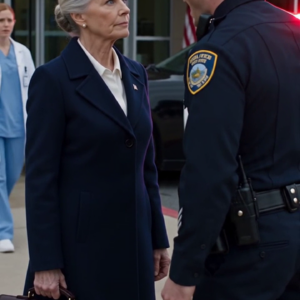
Near the curb, a security supervisor approached.
“General, Officer Hayes asked whether you would accept a written apology.”
I considered the request.
“Has the investigator approved that communication?”
“Yes, ma’am.”
“Then I will read it.”
The supervisor handed me a sealed envelope.
I opened it carefully.
The letter was handwritten.
The young officer had not tried to excuse his behavior.
He acknowledged grabbing my arm.
He acknowledged failing to follow the verification procedure.
He acknowledged submitting inaccurate statements because he feared the consequences.
And he wrote that the most shameful part of the incident was realizing he had become respectful only after seeing my rank.
I read the final paragraph twice.
He said he understood that the woman he had stopped deserved the same dignity whether she was a general, a nurse, a patient, or a stranger.
I folded the letter.
The supervisor waited.
“Would you like me to give him a response?”
I looked toward the entrance.
“Tell him I received it.”
“Yes, General.”
“And tell him that his actions going forward will matter more than the words he wrote today.”
The supervisor nodded.
“I will.”
I did not promise Hayes that he would keep his position.
That was not mine to decide through a private conversation.
I did not promise that the investigation would disappear.
It would not.
The documented facts deserved an impartial review, and the hospital needed to learn from them.
But I hoped the young officer would emerge from the experience understanding something he had failed to understand that morning.
Real authority did not begin when someone recognized your rank.
It began with the responsibility you accepted before anyone knew your name.
Several weeks later, I received a formal update from the medical center.
The investigation had substantiated the improper physical contact, the failure to follow verification procedures, and the inaccurate reporting.
Hayes had been removed from his previous patrol assignment, and the appropriate authorities had imposed disciplinary and administrative measures under the applicable process.
The hospital had implemented revised emergency access procedures.
The corrective training had begun.
Additional reporting safeguards were in place.
Colonel Brooks had personally reviewed the first round of exercises designed to test how emergency medical vehicles were admitted during security restrictions.
The report contained something else.
Sergeant Luis Moreno was alive.
He had undergone further treatment and remained on a long road to recovery.
His doctors expected significant rehabilitation, and nobody was pretending that his injuries had simply disappeared.
But he was awake.
He was communicating with his family.
And he had begun the difficult process of rebuilding his strength.
I sat in my office with the report open before me.
Outside my window, the evening sky had turned the color of faded gold.
My repaired briefcase rested beside the desk.
The marks on my wrist had disappeared.
My knee had healed.
The physical reminders of that morning were gone.
But I still remembered the look on Hayes’s face when he opened my identification holder.
Four silver stars had transformed his behavior in an instant.
For years, I had carried those stars as symbols of duty, sacrifice, and the trust placed in me by the soldiers I served.
They represented decades of decisions, difficult assignments, and responsibilities that never became lighter with experience.
Yet on that sidewalk, I had been reminded of something more important than rank.
The nurse had helped me before she knew who I was.
The physicians had fought to save Moreno because his life mattered, not because a general stood nearby.
And the strongest leaders in the hospital had been those willing to acknowledge uncomfortable truths and correct their mistakes.
I closed the report.
Then I looked at a photograph on my desk.
It showed my late husband standing beside me on the day I received my fourth star.
He had been smiling more proudly than I was.
After the ceremony, when the guests had finally gone, he had taken my hand and offered the advice I remembered most clearly.
“Margaret, never let those stars become the most important thing about you.”
I had laughed then.
Now, years later, I understood how wise he had been.
I touched the edge of the photograph.
“I haven’t forgotten,” I whispered.
Beyond the window, the last sunlight disappeared behind the buildings.
I thought of Sergeant Moreno beginning another difficult day of recovery.
I thought of Lieutenant Ellis returning to work with the same quiet courage she had shown outside the entrance.
I thought of Colonel Brooks learning that a command’s reputation depended on what it was willing to confront.
And I thought of Officer Hayes, who had discovered the painful difference between possessing authority and deserving trust.
Then I returned the medical report to its folder.
My career had taught me that a uniform could identify a person’s duty.
A badge could establish legal authority.
Four stars could reveal a lifetime of military responsibility.
But none of those things could measure the value of a human being.
That morning, Officer Hayes had seen an older woman carrying a worn leather briefcase.
He had decided she was someone he could dismiss.
Only when the stars appeared had he realized how badly he had misjudged her.
I hoped that one day he would understand the deeper lesson.
He had not been wrong because he grabbed a general.
He had been wrong because he grabbed a person who deserved to be treated with dignity.
And that was the truth I wanted every officer, every commander, and every person who entered that medical center to remember.
Respect should never have to wait for identification.