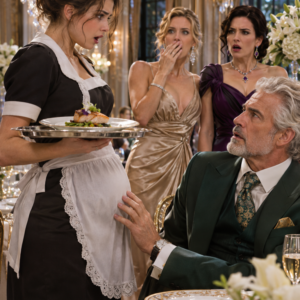
I HUMILIATED MY HUSBAND AT HIS 37TH BIRTHDAY PARTY AND TOLD EVERYONE HE HAD DESTROYED MY FUTURE. HE LEFT AN IVORY ENVELOPE ON THE TABLE, AND WHAT I DISCOVERED INSIDE CHANGED EVERYTHING I BELIEVED ABOUT OUR MARRIAGE.
“Marrying you was the worst mistake of my life, Lucas!”
Thirty people heard me say those words.
My husband stood beside his thirty-seventh birthday cake, wearing the navy suit I’d bought him for our anniversary. Thirty-seven candles flickered beneath the chandelier, illuminating a face that suddenly looked unfamiliar.
He didn’t yell.
He didn’t defend himself.
He simply asked, “Camille, is that really how you feel?”
And because I was angry, because I’d been drinking wine, and because some cruel part of me wanted him to hurt as much as I thought I had, I answered without hesitation.
“Yes. I could’ve been someone important if I hadn’t married you.”
His mother covered her mouth.
His younger sister, Natalie, whispered, “Camille, stop.”
But I wasn’t finished.
“I gave up everything for this marriage. My career. My ambitions. Every opportunity I ever had. And what did I get? A beautiful house where everyone celebrates your success while I disappear.”
Lucas lowered his eyes.
For eleven years, I’d known every expression on my husband’s face.
I’d seen him exhausted, frustrated, worried, excited, and heartbroken.
But I’d never seen him look completely empty.
He glanced at his birthday cake.
Then he smiled.
It was the saddest smile I’d ever witnessed.
“I understand,” he said.
He turned toward our guests.
“Thank you for coming tonight. I think it’s time we ended the party.”
Nobody protested.
Nobody knew what to say.
Within fifteen minutes, our beautiful home outside Cincinnati, Ohio, was silent.
I stood in the kitchen, arms crossed, waiting for Lucas to confront me.
Instead, he removed his wedding ring.
He placed it on the granite countertop.
Then he reached inside his jacket and withdrew a small ivory envelope.
My name was written across the front.
“I was going to give you this tonight,” he said.
“What is it?”
“Something I’ve spent eight months preparing.”
He pushed it toward me.
I opened it.
Inside was a letter and an official document bearing the name of Whitmore & Hayes, the architectural design firm I’d dreamed of working for since college.
My hands went cold.
It was an invitation to interview for a senior design position.
A position in the company’s new Cincinnati office.
And attached to it was a portfolio of my work.
Work I hadn’t shown anyone in years.
“Lucas,” I whispered. “How did you get this?”
He didn’t answer.
Instead, he nodded toward the letter.
“Read it.”
I unfolded the paper.
The first sentence nearly stopped my heart.
**“Camille, I never wanted to be the reason you stopped believing in yourself.”**
And the final sentence was worse.
**“I was going to ask you to start over with me. But tonight, I finally understand that I’m the person you want to escape.”**
I looked up.
That’s when I noticed the black suitcase beside the kitchen door.
It had already been packed.
Before the party.
Before I’d humiliated him.
Before he’d given me the envelope.
“Lucas, why is your suitcase there?”
He looked at me for a long moment.
“Because I knew tonight might be the night I finally had to leave.”
***
To understand why my husband had packed a suitcase before his own birthday party, you have to understand what our marriage had become.
Lucas and I met when I was twenty-three.
I was finishing my architecture degree at the University of Cincinnati, working part-time at a coffee shop, and convinced I was destined for extraordinary things.
Lucas was twenty-six, a project engineer with a modest salary and an old Honda Civic that made terrible noises whenever he turned left.
He wasn’t wealthy.
He wasn’t particularly fashionable.
But he was kind in a way that made kindness seem effortless.
On our third date, I told him about Whitmore & Hayes.
“They design buildings that change cities,” I explained excitedly. “Not just expensive offices. Libraries, cultural centers, public spaces. Places people remember.”
Lucas listened as though I were explaining the secrets of the universe.
“Then that’s where you’re going to work,” he said.
I laughed.
“You make it sound easy.”
“It won’t be easy. But you should try.”
That was one of the reasons I fell in love with him.
He never laughed at my dreams.
When we married two years later, I believed we would build two successful careers together.
For a while, we did.
I worked at a small architectural firm.
Lucas was promoted to senior engineer.
We rented a townhouse, adopted a golden retriever named Murphy, and spent Sunday mornings discussing the future over cheap pancakes.
Then my career became complicated.
My firm lost two major clients.
Projects were canceled.
Staff members were laid off.
I survived the first round of layoffs.
Not the second.
I remember coming home that afternoon with my belongings in a cardboard box.
Lucas found me sitting on the bedroom floor.
“They let me go,” I whispered.
He sat beside me.
“Then we’ll figure out what’s next.”
At the time, I believed him.
But months passed.
I applied for positions that never called back.
I attended interviews that led nowhere.
I watched classmates announce promotions and awards while I struggled to get temporary drafting work.
Eventually, I stopped applying.
Not all at once.
First, I skipped one application because the deadline seemed unreasonable.
Then another because I convinced myself I wasn’t qualified.
Then another because rejection had become unbearable.
Lucas encouraged me.
He offered to review my portfolio.
He suggested professional conferences.
He even offered to support us financially while I pursued additional certifications.
I heard those offers differently.
Every suggestion sounded like criticism.
Every encouragement reminded me that I was failing.
And every promotion he received became another reason to resent him.
It happened slowly.
So slowly that I didn’t notice when disappointment turned into bitterness.
By our tenth anniversary, Lucas had become a respected engineering director earning a comfortable salary.
We owned a four-bedroom house in a quiet neighborhood.
We traveled twice a year.
We had savings, stability, and friends who envied our marriage.
But I had stopped seeing those things as accomplishments we shared.
I saw them as evidence that Lucas had moved forward while I remained behind.
And eventually, I began blaming him for everything.
***
Six months before his thirty-seventh birthday, Lucas came home carrying flowers.
He’d received another promotion.
I was sitting at the kitchen island, scrolling through photographs of a college friend receiving an architectural award.
“Good news,” Lucas said.
I didn’t look up.
“What?”
“They approved the director position. I’ll be leading the new regional team.”
“Congratulations.”
He waited.
I kept scrolling.
“Camille?”
“What?”
“Are you upset?”
I laughed bitterly.
“Why would I be upset? You got another promotion. Wonderful. Let’s throw a parade.”
His smile faded.
“I thought you’d be happy.”
“Of course you did.”
“What’s that supposed to mean?”
I put down my phone.
“It means you get everything you want, Lucas. Everything always works out for you.”
He stood there holding the flowers.
“You know that’s not true.”
“Isn’t it?”
He set them on the counter.
“I’ve worked hard for this.”
“And I haven’t?”
“I never said that.”
“You didn’t have to.”
He went quiet.
Then he asked something that should have frightened me.
“Do you still want to be married to me?”
I stared at him.
“What kind of question is that?”
“A serious one.”
I rolled my eyes.
“Don’t be dramatic.”
He nodded slowly.
“All right.”
That night, he slept in the guest bedroom.
It was the first time he’d done that without an argument immediately preceding it.
I told myself he was being childish.
I didn’t understand that something inside him had begun to change.
***
Three months later, Lucas tried again.
It was a Sunday afternoon.
I was sitting at the dining table surrounded by old drawings and photographs of university projects.
Lucas brought me coffee.
“These are incredible,” he said, examining a rendering of a community library I’d designed during my final semester.
I shrugged.
“They’re student projects.”
“They’re still good.”
“Lucas, please don’t.”
“Don’t what?”
“Pretend you’re an expert on my career.”
He looked genuinely surprised.
“I’m not pretending.”
“You build mechanical systems. You don’t understand architectural design.”
“That’s fair,” he said. “But I know good work when I see it.”
I gathered the drawings into a folder.
“Can you just leave me alone?”
He stood there for a moment.
Then he quietly walked away.
I never knew that after that conversation, Lucas began making phone calls.
Not to arrange a job.
Not to purchase influence.
But to find out whether my portfolio still had professional value.
He contacted a former colleague who worked with architectural firms across the Midwest.
He spoke with a design recruiter.
He asked about continuing education requirements, software certifications, and career reentry programs.
Most importantly, he asked a question I had stopped asking myself.
Was it too late for Camille to become the architect she’d always wanted to be?
The answer was no.
But I didn’t know any of that.
All I knew was that my husband had become quieter.
He stopped asking about my applications.
Stopped suggesting opportunities.
Stopped trying to solve my unhappiness.
I interpreted his silence as indifference.
In reality, it was the beginning of his last attempt to save our marriage.
***
The week before his birthday, I received a call from Natalie.
“Are you doing anything special for Lucas?” she asked.
“I’m organizing a party.”
“That sounds nice.”
“Thirty people. Catering. Decorations. The whole thing.”
Natalie hesitated.
“Camille, can I ask you something?”
“Sure.”
“Are you and Lucas okay?”
I felt instantly defensive.
“Why wouldn’t we be?”
“He seems different lately.”
“Different how?”
“Sad.”
I laughed.
“Lucas has a great job, a beautiful home, and a wife who takes care of everything. What does he have to be sad about?”
Natalie didn’t laugh.
“Maybe you should ask him.”
“I don’t need marriage advice from you.”
There was a pause.
Then she said quietly, “I’m not trying to criticize you. He’s my brother. I’m worried about him.”
I ended the call.
Looking back, I realize that everyone had started noticing what I refused to see.
Lucas was disappearing from his own marriage.
And I was too busy mourning my imaginary future to notice the man standing beside me.
***
The birthday party began at seven.
Our home looked beautiful.
White roses decorated the dining table.
A catering team arranged appetizers in the kitchen.
Soft music played through the speakers.
Lucas arrived downstairs wearing his navy suit.
“You look beautiful,” he told me.
I was wearing a burgundy satin dress, the one he’d always loved.
“Thanks.”
He glanced around.
“You did a lot of work.”
“Someone had to.”
His expression tightened.
But he said nothing.
By eight thirty, the house was crowded.
Guests laughed.
Wine flowed.
Everyone congratulated Lucas on his career.
One of his coworkers, Andrew, raised a toast.
“To Lucas. A brilliant engineer, an even better leader, and probably the most dependable man I’ve ever met.”
Applause filled the room.
I smiled mechanically.
Then Andrew added, “And of course, none of this happens without Camille supporting him.”
Everyone turned toward me.
That was the moment something snapped.
Supporting him.
As though that had become my entire identity.
As though my greatest achievement was standing beside a successful husband.
I stood.
“You know what?” I said.
The room quieted.
“I think everyone should stop pretending this marriage is some beautiful success story.”
Lucas turned.
“Camille?”
I looked at him.
And I said the words that would change our lives.
“Marrying you was the worst mistake I ever made.”
The silence that followed felt enormous.
But at the time, I mistook that silence for attention.
I thought people were finally hearing my pain.
I didn’t understand that they were watching me destroy something precious.
***
Now, standing in our kitchen after the party, I held the ivory envelope and stared at the suitcase.
“Why did you pack?” I demanded.
Lucas leaned against the counter.
“Because I made a decision three weeks ago.”
“What decision?”
“That I couldn’t continue living like this.”
I felt my chest tighten.
“You were planning to abandon me?”
He shook his head.
“I was planning to talk to you.”
“Then why the suitcase?”
“Because I wasn’t sure you would listen.”
I looked down at the letter.
The invitation from Whitmore & Hayes was real.
The company’s letterhead was unmistakable.
It invited me to meet with the director of its new Cincinnati design division.
The interview had been scheduled for the following Thursday.
There was also an updated portfolio.
My drawings.
My concepts.
Even a design I’d created for a community arts center nearly ten years earlier.
“How did you get these?”
“You showed me most of them over the years. Some were stored on the old computer in the study.”
“You went through my files?”
“I looked at the work you’d previously shared with me. I should have asked before organizing it. I’m sorry.”
I stared at him.
“You contacted them?”
“I contacted someone who could evaluate your work. They referred you to the hiring team after reviewing your portfolio. The invitation came through their normal recruitment process.”
“And they offered me a job?”
“No,” he said gently. “They offered you an interview. The rest would be yours to earn.”
That distinction mattered.
Lucas hadn’t bought me a career.
He’d opened a door.
A door I had spent years insisting was locked.
I felt tears gathering.
“Why didn’t you tell me?”
“Because every time I mentioned your career, you accused me of judging you. I thought maybe if I could show you that the opportunity was real, you’d believe in yourself again.”
He paused.
“I was wrong to keep it secret. But I wanted to surprise you.”
I looked toward his suitcase.
“And if I had thanked you tonight?”
He swallowed.
“I was going to ask whether we could start again.”
“What does that mean?”
“Marriage counseling. Honest conversations. No more blaming each other for every disappointment. I wanted us to find our way back.”
His voice became unsteady.
“I wanted my wife back, Camille.”
Something inside me collapsed.
“Lucas, I’m right here.”
He looked at me.
“No,” he whispered. “You haven’t been here for a long time.”
***
I reached for his hand.
He moved it away.
That tiny movement hurt more than anything he’d said.
“Please,” I whispered.
Lucas stared at the wedding ring on the counter.
“Do you remember our wedding vows?”
“Of course.”
“You promised we’d stand beside each other through success and failure.”
“I meant it.”
“So did I.”
He looked toward the window.
“When you lost your job, I didn’t think you were a failure. When you couldn’t find another position, I didn’t think less of you. When you stopped working, I never stopped respecting you.”
Tears spilled down my cheeks.
“But somewhere along the way, you decided my success was proof of your failure.”
“I felt invisible.”
“I know.”
“You don’t understand how that feels.”
He looked back at me.
“Camille, I’ve spent years feeling invisible to the only person whose opinion mattered most.”
I couldn’t speak.
He continued.
“Do you know what I wanted for my birthday?”
I shook my head.
“Not a party. Not gifts. Not another watch.”
He gave a humorless laugh.
“I wanted you to sit beside me at dinner and ask how I was doing. That’s all.”
The kitchen seemed to tilt.
Because I couldn’t remember the last time I’d asked him that question.
Not casually.
Not while checking my phone.
Not while preparing my next complaint.
I couldn’t remember the last time I’d genuinely wanted to know whether my husband was happy.
“I’m sorry,” I whispered.
Lucas closed his eyes.
“I believe you’re sorry.”
“Then stay.”
He opened his eyes again.
“Being sorry doesn’t undo what happened.”
I started crying harder.
“Please don’t punish me for one terrible night.”
His expression changed.
“One night?”
His voice was still quiet, but something sharp entered it.
“Camille, this wasn’t one night.”
He walked toward the study.
“There’s something else you need to see.”
***
I followed him down the hallway.
The study was dark except for the desk lamp.
Lucas opened a drawer and removed a small blue notebook.
He placed it on the desk.
“What is that?”
“My journal.”
I’d never known he kept one.
He opened it to a page dated eight months earlier.
I recognized the date immediately.
It was the evening he’d brought home flowers after his promotion.
Lucas turned the notebook toward me.
I read the first entry.
**“Today Camille told me my promotion was another reminder that she had failed. I wanted to celebrate with her, but I ended up apologizing for being happy.”**
My throat tightened.
He turned another page.
**“She said she wished she’d married someone who understood ambition. I wanted to tell her that ambition was one of the reasons I fell in love with her.”**
Another page.
**“I asked whether she still wanted this marriage. She laughed and called me dramatic. I think that hurt more than if she’d said no.”**
I covered my mouth.
“Lucas…”
He turned another page.
The entry was dated three weeks before his birthday.
**“I love my wife. But I’m starting to hate the person I become while begging her to love me back.”**
I stopped breathing.
He closed the notebook.
“I didn’t write those things to use against you,” he said. “I wrote them because I needed to understand what was happening to me.”
“You should’ve told me.”
“I tried.”
“You should’ve tried harder.”
The words escaped automatically.
Lucas looked at me.
And suddenly I heard myself.
Even now.
Even while standing beside evidence of his pain.
I was still making him responsible for everything.
I pressed a hand against my forehead.
“Oh God.”
He said nothing.
“I just did it again.”
He nodded.
“Yes.”
I sank into the desk chair.
For the first time, I stopped defending myself.
And I began remembering.
Every sarcastic comment.
Every celebration I’d ruined.
Every dinner where I’d compared his achievements to my disappointments.
Every time I’d dismissed his feelings because I believed mine mattered more.
Lucas hadn’t stopped loving me overnight.
I’d been pushing him away for years.
And then I’d blamed him for standing too far away.
***
“Is there someone else?” I asked suddenly.
He frowned.
“What?”
“Another woman. Is that why you’re leaving?”
Lucas stared at me.
“No.”
“Then why give up now?”
He took a slow breath.
“Because I finally realized I don’t have to be betrayed by another person to have permission to leave an unhappy marriage.”
That sentence struck me harder than anything else.
I’d always believed separation required some dramatic crime.
An affair.
A terrible lie.
An unforgivable secret.
But Lucas was leaving because he’d reached the end of what he could endure.
And I couldn’t point to a single moment when I’d seriously considered that possibility.
He returned to the kitchen.
I followed.
“Where will you go?”
“Natalie has a guest room.”
“Does she know?”
“She knows I’ve been struggling. She doesn’t know about tonight.”
I stared at him.
“You were going to leave even if the party went well?”
“No.”
He looked at the envelope.
“I hoped it would go well. I hoped you’d see the opportunity, and we’d finally talk honestly about the future.”
“Then why pack?”
“Because hope isn’t the same as pretending everything is fine.”
He picked up the suitcase.
I stepped toward him.
“Lucas, please. I’ll take the interview. I’ll go to counseling. I’ll do anything.”
He stopped.
“Would you do those things if I stayed tonight?”
“Of course.”
“And if the interview didn’t work out?”
I hesitated.
“If they rejected you?”
I looked down.
“If you had another disappointing year?”
My silence answered him.
Lucas nodded sadly.
“That’s what I’m afraid of.”
I grabbed his sleeve.
“Please don’t leave me.”
He gently removed my hand.
Then he asked the question that would haunt me.
**“If marrying me was the biggest mistake of your life, why are you so terrified of watching me leave?”**
I had no answer.
Because the truth was uglier than anything I’d said at the party.
I had stopped appreciating Lucas.
But I had never imagined losing the life he helped us build.
***
He left at 10:47 p.m.
I remember the exact time because I watched the digital clock above the oven as the front door closed.
There was no shouting.
No dramatic farewell.
Just the quiet sound of suitcase wheels crossing the hallway.
And then silence.
I stood alone in our enormous kitchen, surrounded by leftovers from a birthday party I’d transformed into a public humiliation.
The cake remained on the dining table.
Its candles had burned out.
I walked over and stared at the frosting.
“Happy 37th Birthday, Lucas.”
I’d chosen those words.
I’d ordered that cake.
And I’d made sure he would never forget what happened beside it.
My phone vibrated.
A message from Natalie.
“Is my brother okay?”
I stared at the screen for a long time.
Then I typed:
“No. And I think I finally understand why.”
She called immediately.
I answered.
“Camille, what happened?”
I started crying.
And for once, I told the truth without editing it to make myself look better.
***
Lucas didn’t come home the following morning.
Or the next.
On Monday, he sent a short message.
“I’ll contact you about practical arrangements. Please take care of yourself.”
I read it dozens of times.
Not once did he call me sweetheart.
Not once did he say he missed me.
On Tuesday, I received an email from Whitmore & Hayes confirming the interview.
I almost declined.
Without Lucas, the opportunity felt unbearable.
But then I remembered what he’d told me.
The rest would be mine to earn.
So I opened my old portfolio.
For the first time in years, I studied my own work without immediately deciding it wasn’t good enough.
Some drawings needed improvement.
Some concepts were outdated.
But others were genuinely strong.
I spent two days preparing.
I researched the company’s projects.
I updated my technical knowledge.
I rehearsed answers to questions about my employment gap.
And on Thursday morning, I walked into the interview wearing the same charcoal blazer I’d worn to my first professional job.
The hiring director was a woman named Rebecca Sloan.
She was in her early fifties, confident, direct, and clearly unimpressed by rehearsed excuses.
“Your portfolio has promise,” she said.
“Thank you.”
“But you’ve been away from full-time architectural practice for several years.”
“I have.”
“Why?”
For a moment, I considered giving the answer I’d repeated to myself for so long.
Marriage.
Family obligations.
Sacrifice.
My husband’s career.
Instead, I took a breath.
“I lost my position during a downturn. After several unsuccessful attempts to return to the field, I lost confidence. Eventually, I stopped trying as seriously as I should have.”
Rebecca studied me.
“That must have been difficult.”
“It was.”
“What changed?”
I looked at the drawings on the table.
“Someone reminded me that disappointment isn’t the same thing as defeat.”
She nodded.
Then she asked me to explain my community library design.
And something extraordinary happened.
I began talking about architecture.
Not about resentment.
Not about the opportunities I’d missed.
About light, materials, public spaces, circulation patterns, and how buildings could change the way people experienced their neighborhoods.
For forty minutes, I remembered who I had been before bitterness became my identity.
At the end, Rebecca shook my hand.
“You have some catching up to do, Camille. But I think there’s something worth developing here.”
I left the office crying.
Not because I’d been promised a job.
Because I’d finally stopped waiting for someone else to rescue me.
***
Two weeks later, I received an offer.
It wasn’t the senior position I’d originally interviewed for.
Rebecca offered me a design associate role with a structured development plan and the possibility of advancement after demonstrating my skills.
The salary was lower than I’d hoped.
The expectations were demanding.
And I’d have to complete additional training.
Five months earlier, I would’ve considered it insulting.
Now I accepted.
I wanted to call Lucas immediately.
I even typed:
“I got the job. We did it!”
Then I deleted the message.
Because we hadn’t done it.
I had earned the position.
Lucas had helped me find the courage to try.
And those were two different things.
Instead, I wrote:
“Whitmore & Hayes offered me a position. Thank you for believing in me when I couldn’t believe in myself.”
He replied three hours later.
“I’m proud of you, Camille. You earned it.”
I stared at those words.
Then I cried harder than I had the night he left.
Because he was still kind.
Even from a distance.
***
I began counseling the following week.
At our third session, my therapist asked me a question I hated.
“What would it mean if Lucas wasn’t responsible for your unhappiness?”
I sat silently.
Then I answered.
“It would mean I wasted years being angry at the wrong person.”
She waited.
“And?”
I swallowed.
“It would mean I hurt someone who loved me because I couldn’t accept my own disappointments.”
That was the first time I said it aloud.
Lucas hadn’t forced me to abandon architecture.
He hadn’t forbidden me from working.
He hadn’t demanded that I stay home.
Those were stories I’d told myself because they were easier to bear than admitting I’d become afraid of failure.
He had supported me.
Sometimes imperfectly.
Sometimes without understanding what I needed.
But he had never stolen my future.
I’d surrendered it one frightened decision at a time.
Then I’d handed him the blame.
***
Six weeks after the birthday party, Lucas agreed to meet me.
We chose a quiet café near downtown Cincinnati.
He arrived wearing jeans and a gray sweater.
He looked different.
Not happier exactly.
But rested.
As though he had finally stopped carrying something heavy.
“Hi, Camille.”
“Hi.”
We ordered coffee.
For several minutes, neither of us spoke.
Then I placed a small envelope on the table.
He looked at it.
“What’s that?”
“A letter.”
He smiled faintly.
“We seem to have developed a habit.”
I almost laughed.
Almost.
“I wrote it because I wanted to apologize without interrupting you or asking you to make me feel better.”
He opened it.
The letter was four pages long.
I had listed the moments I remembered.
The promotion I’d ruined.
The dinner where I’d mocked his work.
The Sunday I’d dismissed his compliment.
The birthday party.
I hadn’t written excuses.
I hadn’t blamed alcohol.
I hadn’t blamed stress.
I hadn’t asked him to forget.
At the end, I’d written:
**“You didn’t destroy my future, Lucas. I was afraid to build it, and I punished you for succeeding at yours. I’m sorry for every time I made your love feel like a burden.”**
He read it slowly.
When he finished, his eyes were wet.
“Thank you,” he said.
“Do you believe me?”
“Yes.”
“Can you forgive me?”
He looked out the window.
“I think I can.”
Hope surged through me.
“Then maybe we can—”
“Camille.”
He said my name gently.
And I stopped.
“Forgiveness and reconciliation aren’t the same thing.”
My heart sank.
He folded the letter carefully.
“I’ve been seeing a counselor too.”
“You have?”
He nodded.
“I needed to understand why I kept accepting things that hurt me.”
I stared at my coffee.
“And what did you learn?”
“That loving someone doesn’t mean I have to prove my devotion by enduring endless pain.”
I couldn’t argue.
He continued.
“I spent years believing that if I found the right words, made enough money, gave you enough support, eventually you’d be happy.”
Tears gathered in my eyes.
“But your happiness was never something I could manufacture.”
“No,” I whispered. “It wasn’t.”
Lucas reached across the table.
For one beautiful second, I thought he was going to take my hand.
Instead, he placed a folded document between us.
My stomach tightened.
“What is that?”
“A separation agreement my attorney prepared for us to discuss.”
I stared at it.
He quickly added, “Nothing has to be signed today. I want us both to review everything properly, with independent advice.”
“Lucas…”
“I don’t want to fight over the house. Or our savings. I want us to handle this fairly.”
I looked at him.
“Are you asking for a divorce?”
His eyes filled.
“I’m asking us to live separately while we decide what comes next.”
I began crying.
“Do you still love me?”
He closed his eyes.
“Yes.”
The word nearly broke me.
“Then why can’t you come home?”
He looked directly at me.
**“Because I finally love myself enough to know that loving you isn’t a reason to keep hurting.”**
***
Three months passed.
I started my new job.
I made mistakes.
I stayed late learning unfamiliar software.
I presented design concepts that were criticized and revised.
I slowly rebuilt the confidence I’d lost.
And every evening, I returned to a house that felt too large.
Lucas and I communicated respectfully.
We divided expenses.
We discussed the future.
We attended several counseling sessions together, not as a promise of reconciliation, but to understand what had happened.
I wanted him back.
I never pretended otherwise.
But I stopped trying to pressure him.
For the first time in our relationship, I began learning how to love someone without demanding that he save me from myself.
Then, one Friday afternoon, Rebecca called me into her office.
“I have something to show you,” she said.
She placed a folder on her desk.
Inside was a proposal for a new community development project.
A public library and arts center planned for a neighborhood outside Cincinnati.
I studied the concept drawings.
My breath caught.
The building looked familiar.
Not identical.
But the central courtyard, angled skylights, and open public gathering space reminded me of a design I’d created in college.
“The project originated from an independent proposal submitted last year,” Rebecca explained.
“We’re reviewing how to develop it.”
“Who submitted it?”
She opened the final page.
There was a familiar name.
Lucas Bennett.
I stared at the signature.
My husband.
But Lucas wasn’t an architect.
He was an engineer.
“Rebecca, I don’t understand.”
She studied my expression.
“You didn’t know?”
“Know what?”
She hesitated.
Then she explained.
Eight months earlier, Lucas had contacted a nonprofit organization working to restore neglected public spaces.
He’d offered engineering consultation for an early concept project.
During those discussions, he’d shown the organization a community library design created years earlier by his wife.
He’d made it clear the design belonged to me.
He’d asked whether someone might review it professionally.
That introduction eventually led to the recruiter and then to Whitmore & Hayes.
But there was another detail.
One Rebecca hadn’t known I was unaware of.
Lucas had refused compensation for his preliminary engineering work.
Instead, he had asked the nonprofit to consider making the project accessible to underserved families.
Rebecca pointed toward a rendering.
“He said the original designer believed public buildings should make people feel that they belonged.”
I covered my mouth.
Those were my words.
I’d said them on our third date.
Eleven years earlier.
Lucas had remembered.
***
That evening, I went home and opened the ivory envelope again.
I’d kept it in my bedside drawer.
Inside were the interview invitation, his letter, and several pages I’d barely examined on his birthday.
One page contained correspondence about the community library proposal.
Another included notes about continuing education.
Then I found something I’d never noticed.
A handwritten page folded behind the others.
It wasn’t a professional document.
It was a list.
At the top, Lucas had written:
“Things Camille once said she wanted.”
Beneath it were small memories.
To design a library.
To visit Copenhagen.
To see one of her buildings completed.
To teach young architects.
To have a studio filled with sunlight.
To feel proud of her work again.
Every dream I’d forgotten was there.
Some were written in ink that had faded.
Others had been added recently.
At the bottom was one final line.
**“And someday, I hope she remembers that she wanted a life with me, too.”**
I sat on the bedroom floor with the paper in my hands.
And I finally understood why he’d looked so empty beside his birthday cake.
He hadn’t been surprised that I was unhappy.
He’d known.
He’d spent months trying to help me find my way back to myself.
And all the while, he had been preparing for the possibility that the woman he loved no longer wanted him.
***
There was one final thing I needed to know.
I called Natalie.
She answered cautiously.
“Camille?”
“I need to ask you something about Lucas.”
She sighed.
“What?”
“Did he really pack his suitcase before the party?”
“Yes.”
“Why?”
Natalie was silent for several seconds.
Then she said, “Because he came to my house that afternoon.”
My heart stopped.
“What?”
“He brought a small bag and asked whether he could stay if he needed to.”
I closed my eyes.
“Did he tell you he was leaving me?”
“No. He said he was going to give you a letter that night. He hoped you’d finally understand how much he loved you.”
I pressed the phone against my ear.
“And the suitcase?”
Natalie’s voice trembled.
“He said he didn’t want another year of begging someone to be happy that he was her husband.”
I began crying.
Then Natalie told me something I would never forget.
“Camille, before he left my house, he asked me whether I thought you’d still want him if your career started working out.”
I couldn’t breathe.
“What did you say?”
“I told him I didn’t know.”
A long silence followed.
Then she continued.
“He said, ‘I hope she gets everything she’s ever wanted. Even if she discovers I’m not part of it.’”
That was when I understood.
Lucas hadn’t packed his suitcase because he wanted to hurt me.
He’d packed it because he was finally prepared to stop hurting himself.
***
Nearly a year after that birthday party, the community library project received preliminary approval.
I was assigned to the architectural design team.
I wasn’t leading it.
I wasn’t famous.
My name wasn’t on the front page of any magazine.
But I was doing work I loved.
And for the first time in years, that was enough.
Lucas attended the public presentation.
I saw him standing near the back of the room.
Afterward, I approached him.
“You came.”
He smiled.
“Of course. You always wanted to design a library.”
I swallowed.
“Thank you for starting this.”
“You’re the one helping bring it to life.”
We stood together beneath the bright lights of the community center.
For a moment, it felt like we were twenty-three and twenty-six again, dreaming about the future over cheap coffee.
Then Lucas reached into his coat.
My heart skipped.
He withdrew a small blue notebook.
The same journal he’d shown me the night he left.
“I wanted you to have this,” he said.
“Why?”
“Because there’s one page I never showed you.”
He opened it near the end.
The entry was dated the morning after his birthday.
I read it slowly.
**“Last night, Camille said marrying me destroyed her future. I thought those words would destroy me. But this morning, I realized something: I can still hope she succeeds without sacrificing myself to make it happen.”**
I looked up, crying.
“Lucas…”
He continued.
“And there’s something else.”
He showed me the last page.
It was dated the previous week.
**“I don’t know whether Camille and I will ever be husband and wife again. But today she presented a design she’d worked hard to create. She looked proud of herself. I recognized the woman I fell in love with, and for the first time, I didn’t feel responsible for keeping her alive inside herself.”**
I pressed my fingers against my lips.
“Are we really over?” I whispered.
Lucas looked at me for a long time.
“I don’t know.”
It wasn’t the answer I wanted.
But it was an honest one.
He took a breath.
“I know we can’t go back to what we were.”
I nodded.
“I don’t want to.”
“And I can’t promise we’ll find our way back together.”
“I understand.”
He studied my face.
“You really do, don’t you?”
“Yes.”
For the first time, I meant it.
I wasn’t asking him to erase the past.
I wasn’t asking him to carry my regrets.
I wasn’t asking him to save me.
I was simply standing before the man I’d hurt, finally capable of seeing him clearly.
Lucas smiled softly.
“Then maybe that’s where we start.”
He didn’t kiss me.
He didn’t put his wedding ring back on.
We didn’t suddenly reconcile beneath the lights of the community center.
Instead, we walked outside together.
Two people who had once promised forever.
Two people who had nearly destroyed each other through silence, disappointment, and misplaced blame.
And two people who were finally learning that love couldn’t survive without respect.
As we reached the parking lot, Lucas stopped.
“Camille?”
“Yes?”
“Congratulations on the project.”
I smiled through my tears.
“Thank you.”
He nodded toward the building behind us.
“Your future looks pretty good.”
For eleven years, I’d believed my husband was standing between me and the life I deserved.
But the truth had been waiting inside a small ivory envelope all along.
**Lucas had never been the wall blocking my future.**
**He had been the man standing beside the door, waiting for me to believe I was capable of opening it.**
And the cruelest lesson of my life was realizing that while I was accusing him of stealing my dreams, he was quietly helping me rebuild them.
I had humiliated him in front of thirty people.
He had answered with an opportunity, a letter, and a wedding ring placed gently on the table.
No revenge.
No screaming.
No public humiliation.
Just a man finally choosing his own dignity.
And although I still didn’t know whether our marriage would survive, I knew one thing with absolute certainty.
**Losing Lucas hadn’t taught me how much I needed a husband.**
**It had taught me how deeply I’d failed to appreciate the man who had loved me when I couldn’t even love the person I’d become.**
For the first time, I was building my own future.
And if Lucas ever chose to walk beside me again, I wanted it to be because we both wanted the same life.
Not because either of us was afraid to walk alone.
THE END.