PART 15: THE PEOPLE WE BROUGHT HOME
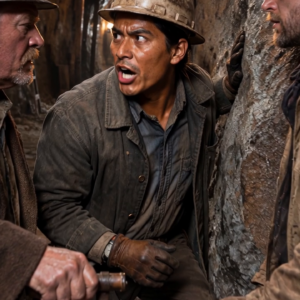
I did not wait for Caleb Voss to touch the second firing switch.
I threw myself toward the battery box and knocked it off the timber shelf.
The box struck the stone floor and skidded away from the wires.
Voss lunged after it.
Eli caught him around the waist.
They fell together against the broken timber.
I seized the loose cables and pulled them clear of the battery terminals.
No current reached the charges.
No explosion followed.
But the ceiling continued groaning.
I looked up.
A long crack had opened across the rock above the supply chamber.
The earlier explosion had damaged the supporting frame.
We had only moments before the weakened section came down.
“Eli, get out!”
He struggled to hold Voss.
The contractor twisted desperately, trying to free himself.
I grabbed Eli’s shoulder.
“Leave the wires!”
He looked toward the battery.
“It’s disconnected.”
“Then move!”
We hauled Voss upright and forced him toward the eastern passage.
He resisted at first.
Then another stone fell beside his foot.
His resistance vanished.
The three of us stumbled through the dust.
Behind us, timber snapped.
A heavy crash shook the tunnel.
I felt the air rush past my shoulders as loose stone poured into the supply chamber.
Eli pulled me around the bend.
The collapse struck the floor behind us, filling the passage with a roar that seemed to come from the center of the earth.
We kept moving.
My lungs burned.
Dust stung my eyes.
Voss stumbled repeatedly, and Eli dragged him onward.
At last, daylight appeared beyond the broken entrance.
We crossed into the open air together.
The mountain rumbled once more behind us.
Then silence settled over the worksite.
For several seconds, I could only stand there breathing.
Samuel hurried toward us.
“Everybody out?”
I looked at Eli.
He nodded.
“The magazine side is blocked.”
“Anybody left behind?”
“No.”
Samuel closed his eyes briefly.
Then he looked at me.
“That’s the last count.”
I counted anyway.
I counted Eli.
I counted the two guards.
I counted Pike, sitting beside the equipment wagon with his head bowed.
I counted Samuel and every member of our working crew.
Finally, I looked toward the infirmary tent.
Tomas lay on one cot.
Isaac lay on another.
Both men were alive.
Only then did I allow myself to sit down.
My legs shook beneath me.
Eli lowered himself beside me.
For a long moment, neither of us spoke.
Then he said, “I almost helped bury them.”
I looked at him.
“You made a terrible mistake.”
He nodded.
“I know.”
“But you cut the firing line.”
“After I should have stopped everything.”
“Then remember both things.”
He stared at the dust covering his hands.
“I will.”
I believed him.
Not because his mistake had disappeared.
It had not.
But because he had finally faced what he had done without hiding behind Pike’s orders.
Across the yard, the railroad guards took Voss into custody.
The contractor continued protesting that he had been misunderstood.
His coat was torn.
His polished boots were covered in mud.
And the authority he had carried into the tunnel had vanished.
He looked toward me once.
I met his eyes.
There was nothing left I needed to say.
The evidence would speak where his promises had failed.
That evening, the railroad inspector arrived earlier than expected after receiving word of the collapse.
His name was Edward Collins, a careful man with gray hair and a habit of writing down every answer before asking another question.
He first examined the injured workers.
Then he ordered the damaged tunnel closed until the entire structure could be inspected.
I watched his expression change as Samuel placed the ledger and contract on the table before him.
The inspector opened the accounting book.
He examined the false payroll entries.
He compared the timber invoices with the damaged supports recovered from the tunnel.
Then he unfolded the engineering warning bearing Voss’s signature.
For a long time, he said nothing.
Finally, he looked at me.
“Where did you find this?”
“Behind the fourth timber in the western chamber.”
“Who placed it there?”
“Isaac Reed.”
Collins turned toward the infirmary.
“I’ll need his testimony.”
“He’ll give it when the doctor allows him to speak.”
The inspector nodded.
Then he examined my father’s old inspection sheet.
“Daniel Begay.”
I watched his face.
“Did you know him?”
“By reputation.”
My throat tightened.
“What reputation?”
Collins studied the warning.
“He was considered difficult by contractors who disliked being questioned.”
I looked down.
“That sounds like him.”
The inspector continued.
“But the men who worked beneath him said he knew when to stop a dangerous job.”
My eyes burned.
I thought of my father standing in our kitchen, washing stone dust from his hands after another exhausting shift.
I had never understood how many times his insistence on counting workers had challenged men with more power than he possessed.
Now I did.
The inspector set the paper aside.
“Your father’s concerns deserved to be heard.”
I swallowed.
“So did Tomas’s.”
Collins looked toward the infirmary.
“Yes.”
“And Isaac’s.”
“Yes.”
I placed my notebook on the table.
“Then put their names in your report.”
He opened it.
Inside were the names I had copied that morning.
Every worker.
Every assignment.
Every mark that Pike had tried to erase.
Collins studied the pages.
“Did you write this before the blast?”
“Before sunrise.”
He looked up.
“Then it may be one of the most important documents here.”
I had spent the day believing that the sound of three knocks had changed everything.
But now I understood that the first important act had happened hours earlier.
I had counted.
My father had taught me to do that when I was still a girl.
He told me that tools could be replaced.
Timber could be purchased again.
Even damaged tunnels could be rebuilt.
But a person lost beneath a mountain could never be returned through paperwork.
The inspector closed my notebook.
“I’ll make sure the record reflects what happened.”
The investigation continued over the following weeks.
Voss’s own signed documents established that he had been warned about the defective supports long before the final blasting deadline.
The ledger showed payments collected for nonexistent workers and expensive timber that had never reached the tunnel.
The altered survey measurements confirmed that the old maintenance passage had been deliberately concealed.
Pike admitted that Voss had ordered him to block the ventilation opening and prepare the charge intended to close the western crossing.
He also admitted that he had heard knocking before ordering us to complete the final blast.
Eli gave a full account of the morning.
He acknowledged carrying the blasting cartridges and locking the safety door without personally confirming that everyone had left.
He did not excuse his actions.
His statement helped establish the order in which the doors were locked, the charge was fired, and the trapped workers first tried to signal for help.
The railroad company suspended construction and removed Voss from the contract.
The findings were referred to the territorial authorities.
Voss faced criminal proceedings arising from the deliberate trapping of the workers, the attempted destruction of evidence, and the fraudulent accounts.
Pike faced his own consequences for carrying out the orders and concealing what he knew.
The workers who had been threatened with lost wages finally received their unpaid earnings after the payroll records were examined.
The promised bonus was no longer treated as an excuse to ignore safety.
It became part of the company’s settlement with the crew.
But the money was not what I remembered most.
I remembered the morning Tomas first stood again.
His ankle required weeks of healing.
The doctor had warned him that he would need patience before returning to heavy work.
Tomas disliked that advice almost as much as he disliked the crutches.
I visited him outside his mother’s house one bright afternoon.
Three sheep grazed near the fence.
One had already escaped into the yard.
Tomas pointed toward it.
“That’s the stubborn one.”
I laughed.
“I should have known.”
His mother came outside carrying a basket.
She looked at me for a long moment before speaking.
“My son told me you kept talking to him.”
I nodded.
“He did most of the talking.”
“He said you wouldn’t let him give up.”
I looked toward Tomas.
“He had plenty of reasons to keep fighting.”
His mother set down the basket.
Then she took my hands.
I had no answer ready when she thanked me for bringing her son home.
So I simply held her hands until she let go.
Later that week, I visited Isaac.
His leg had been badly injured, but the doctor believed it could heal with time and careful treatment.
He sat beside a window with a blanket over his knees and a stack of papers on the table.
When he saw me, he smiled.
“Daniel’s girl.”
I shook my head.
“Still calling me that?”
“Until you stop reminding me of him.”
I sat beside the window.
For a while, we spoke about the investigation.
Then I asked the question that had been waiting inside me since the tunnel.
“Why did you keep my father’s records?”
Isaac looked toward the sunlight.
“Because he asked me to remember.”
I waited.
He continued slowly.
“At Coyote Ridge, your father knew the contractor could make one worker disappear from a roster with a pencil.”
I thought of Tomas’s erased attendance mark.
Isaac looked at me.
“He told me that if we didn’t keep our own count, someone else would decide who mattered.”
My throat tightened.
“He never told me about you.”
Isaac smiled sadly.
“He was trying to keep trouble away from his family.”
“He should have told me.”
“Maybe.”
Isaac reached for a folded page on the table.
“But he did leave something for you.”
I accepted it carefully.
The paper contained several lines in my father’s handwriting.
They were not a farewell letter.
They were notes from an old inspection, written beside a list of workers whose names had been omitted from a company report.
At the bottom, my father had written one sentence.
A man is not accounted for simply because someone says he is.
I stared at the words.
For years, I had repeated my father’s lesson without knowing how much it had cost him.
Now I understood that he had left me more than a trade.
He had left me a responsibility.
I folded the paper.
“I wish he could have seen what happened.”
Isaac looked at me gently.
“I think he would have recognized your work.”
I could not speak for a moment.
Then I placed the paper inside my notebook.
The railroad eventually resumed the project under a different contractor.
Before any blasting began, the company required a complete inspection of the supports, ventilation passages, and worker rosters.
Every crew member had to be accounted for before a charge could be fired.
The damaged western section was rebuilt with sound timber.
The drainage channels were cleared.
The concealed maintenance passage was included on the official survey.
No one was permitted to paint over an old measurement or replace an inspection record without leaving a written explanation.
Samuel helped supervise the new supports.
Eli returned to work after giving his statement and completing the safety review.
He was quieter than before.
But now, whenever the crew gathered for a count, he was the first man to check whether anyone was missing.
We never pretended that the morning at the western safety door had not happened.
Some mistakes cannot be erased.
They can only be faced, understood, and never repeated.
Months later, on a cold spring morning, I stood near the eastern tunnel entrance with my notebook in hand.
The rebuilt passage had been inspected.
The blasting equipment was secured.
The workers stood in a line beneath the pale New Mexico sky.
Tomas had returned on light duties, carrying tools that no longer dragged against his oversized boots.
Samuel stood beside the timber wagon.
Eli waited near the firing station.
I called the names.
One by one, the men answered.
When I reached Tomas, he lifted his hand.
“Present.”
I smiled.
“Good.”
He grinned.
Then I reached the final name.
“Eli Mercer.”
“Present.”
I closed the notebook.
Everyone was accounted for.
The foreman now responsible for the work asked whether the heading was clear.
I checked the passage one last time.
No voices came from beyond the wall.
No tapping echoed through the stone.
No worker remained uncounted.
Only then did I give permission to continue.
As I stepped away from the firing station, I touched the folded paper inside my coat.
For a moment, I could almost hear my father’s voice.
Always count the people before you count the tools.
I looked toward the mountain.
It had nearly become a grave for two men whose lives had been treated as obstacles to a deadline.
Instead, they had come home.
Their names remained on the record.
Their voices had been heard.
And I knew that whenever I entered another tunnel, I would carry the memory of those three knocks with me.
Not as a reminder of the darkness.
But as proof that sometimes the difference between life and death is one person refusing to stop listening.
THE END.