CHAPTER 2: THE FIFTY DOLLARS THAT BROUGHT MY SISTER BACK
PART 2: THE LITTLE GIRL WITH THE DRAWING
The moment I walked into the school gymnasium, I knew something had happened.
The annual school fair was almost over.
Colorful balloons hung limply from the basketball hoops. Half-empty popcorn bags littered the tables, and the smell of chocolate, pizza, and spilled lemonade filled the air.
Most of the parents had already collected their children.
But near the far wall, a small group of students stood in a circle around a table.
And sitting in the middle of them was my nine-year-old son, Morgan.
He was holding the largest chocolate cookie I had ever seen.
But he wasn’t eating it.
Beside him sat a little girl wearing a faded pink sweater. Her dark hair was tied into two uneven ponytails, and her eyes were swollen from crying.
The instant Morgan saw me, he jumped out of his chair.
“Mom!”
I hurried toward him.
Before I could say anything, his teacher, Mrs. Collins, stepped forward and gently touched my shoulder.
“Anna, before you say anything, I think you should know what happened.”
My stomach dropped.
Those were not the words any mother wanted to hear from her child’s teacher.
“Is Morgan okay?” I asked immediately.
“He’s perfectly fine.”
“Then why did you call me? Did something happen at the fair?”
Mrs. Collins looked toward the little girl.
“Yes. But not in the way you’re imagining.”
I glanced at Morgan.
He suddenly looked nervous.
His fingers tightened around the enormous cookie, and he lowered his eyes.
For one terrible second, I thought he’d gotten into a fight.
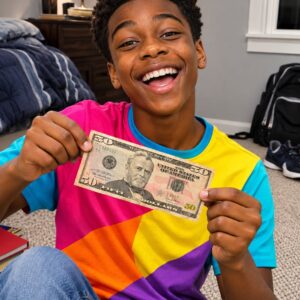
That morning, I had given him fifty dollars for the school fair.
It wasn’t an insignificant amount for us.
I worked long shifts as a nurse care coordinator at St. Catherine’s Hospital, and although I earned enough to keep us comfortable, I was raising Morgan on my own.
Every dollar in our household had a purpose.
But the annual school fair was something Morgan had been looking forward to for weeks.
He had talked endlessly about the games, the food stands, and a giant stuffed dinosaur he hoped to win.
So when he appeared in the kitchen that morning wearing his favorite blue sweatshirt, I handed him a crisp fifty-dollar bill.
His eyes widened.
“All of this is for me?”
I smiled.
“Yes, sweetheart.”
“Really? I can spend it however I want?”
“Within reason.”
He laughed.
“What does that mean?”
“It means don’t buy fifty dollars’ worth of candy and make yourself sick.”
He grinned.
Then he asked a question I barely noticed at the time.
“Mom, what’s the best thing to buy?”
I was packing my lunch for another long hospital shift.
Without giving it much thought, I replied, “Whatever makes you happy.”
He looked at the money for a moment.
Then he folded it carefully and slipped it into his backpack.
I kissed his forehead.
“Have fun today.”
“I will, Mom.”
And that was the last thing I expected to hear about the fifty dollars.
Until Mrs. Collins called me shortly after two.
“Anna, would you be able to come to the school?”
Her voice was unusually serious.
“Is Morgan hurt?”
“No. He’s safe. But something happened today, and I think you should see it for yourself.”
I had spent the entire drive imagining the worst.
Now I stood in the gymnasium, looking at my son and a little girl who appeared to have been crying for hours.
Mrs. Collins pulled me aside.
“Her name is Sophie,” she said quietly.
I glanced at the girl.
She couldn’t have been older than eight.
Her pink sweater was faded at the elbows, and one sleeve had a small hole near the wrist.
“She joined our class three weeks ago,” Mrs. Collins continued. “Her family has been having a difficult time.”
“What happened?”
“Her mother has been ill. She recently lost her job, and money has been very tight.”
I looked back at Sophie.
She was staring at the floor.
“She came to the fair without any money,” Mrs. Collins said. “The children were excited about the games and food, but Sophie couldn’t participate.”
Something tightened inside my chest.
“Did she tell anyone?”
Mrs. Collins shook her head.
“Not at first. She just sat near the wall and watched.”
I knew that look.
I had seen it countless times at the hospital.
The expression people wore when they were trying desperately not to let anyone know how badly they needed help.
“What did Morgan do?” I asked.
Mrs. Collins smiled.
“He noticed her.”
She explained that Morgan had been standing in line to buy pizza when he spotted Sophie sitting alone.
He walked over and asked why she wasn’t playing.
Sophie told him she didn’t have any money.
So Morgan bought her lunch.
Then he paid for a game.
When another child admitted that he couldn’t afford a ticket either, Morgan paid for him too.
And then another.
And another.
Before long, he had invited several children to join him.
I looked around the gym.
A dozen students were holding small prizes and colorful paper bags filled with treats.
One boy was hugging a stuffed bear.
Another little girl was proudly wearing a plastic crown.
They all looked happy.
And somehow, my son was sitting in the middle of them with a chocolate cookie he hadn’t even touched.
“He spent all fifty dollars?” I whispered.
Mrs. Collins shook her head.
“Not exactly.”
Morgan slowly approached us.
“Mom?”
I turned toward him.
His lower lip trembled.
“I hope you’re not mad.”
I crouched in front of him.
“Sweetheart, why would I be mad?”
He looked at the floor.
“Because I didn’t buy the dinosaur.”
For a moment, I couldn’t speak.
He reached into his backpack and pulled out a crumpled receipt.
“I kept this so you could see where the money went.”
I unfolded it.
Thirty dollars had been spent on food, game tickets, and small prizes.
The remaining twenty dollars had been donated to the school’s emergency lunch fund.
I stared at the receipt.
“Baby, you gave away the rest?”
Morgan nodded.
“Mrs. Collins told me there are kids who sometimes don’t have lunch money.”
I looked up at his teacher.
She was wiping her eyes.
“So I asked if I could put the twenty dollars there,” Morgan continued. “She said I could.”
I swallowed hard.
“But Morgan, you were so excited about that dinosaur.”
He shrugged.
“I know.”
“Didn’t you want it anymore?”
He looked over his shoulder at Sophie.
Then he turned back to me.
“I wanted it. But Sophie looked really sad.”
His voice became quieter.
“She said she didn’t eat breakfast because her mommy didn’t feel good this morning.”
I felt tears gathering in my eyes.
“So I bought her pizza. And when she smiled, I felt really happy.”
He paused.
“Then I remembered what you told me.”
“What did I tell you?”
“You said I should spend the money on something that makes me happy.”
I nodded slowly.
“And?”
He looked directly into my eyes.
“Seeing Sophie smile made me happier than winning anything.”
That was when I broke.
I pulled him into my arms and held him so tightly he squeaked.
“Mom, you’re squishing me.”
I laughed through my tears.
“I’m sorry, baby.”
“Are you crying?”
“Yes.”
“Did I do something wrong?”
“No, sweetheart.”
I kissed the top of his head.
“You did something wonderful.”
He relaxed against me.
For several seconds, I couldn’t let go.
I had spent years worrying about whether I was raising him properly.
Whether working long hospital shifts meant I wasn’t present enough.
Whether he needed things I couldn’t always provide.
I worried about his grades, his meals, his friendships, and whether he felt the absence of a father more deeply than he admitted.
But standing in that gymnasium, holding my nine-year-old son, I realized something.
He had understood a lesson I had spent most of my adult life trying to learn.
Happiness wasn’t always something you bought for yourself.
Sometimes, it was something you gave away.
When I finally released him, I noticed Sophie watching us.
She had an expression on her face that made my heart ache.
It wasn’t jealousy.
It was longing.
I recognized it immediately.
“Hello, sweetheart,” I said gently.
She looked up.
“Hi.”
“I’m Morgan’s mom.”
She nodded.
“He told me.”
“Did you have fun today?”
Her small face brightened.
“A lot.”
She pointed toward the table.
“Morgan bought me pizza. And he let me play the ring toss game three times.”
“Did you win anything?”
Sophie nodded enthusiastically.
Then she held up a tiny purple bracelet.
“This.”
I smiled.
“It’s beautiful.”
She looked at Morgan.
“He told me it was lucky.”
Morgan shrugged.
“It almost was. She nearly won the big teddy bear.”
Sophie giggled.
For a moment, she looked like any other happy child.
Then her smile faded.
She stared at my hospital identification badge, which was still clipped to my jacket.
I had rushed over straight from work.
“Are you really a nurse?” she asked.
I nodded.
“Yes, sweetheart.”
“At the big hospital?”
“St. Catherine’s?”
Her eyes widened.
“Yes!”
“I work there.”
She glanced at Morgan.
Something silent passed between them.
He gave her a small encouraging nod.
Then Sophie reached into the pocket of her sweater.
“Can I show you something?”
“Of course.”
She pulled out a folded piece of paper.
The edges were wrinkled, and one corner had been torn.
She held it against her chest.
“My mommy says you’re not supposed to bother grown-ups when they’re busy.”
“You’re not bothering me.”
“Promise?”
“I promise.”
She unfolded the paper.
It was a child’s drawing.
Crayon lines covered nearly every inch.
There was a hospital bed in the middle.
A woman lay beneath a blue blanket.
Beside her stood a little boy wearing a blue shirt.
At the foot of the bed was a small girl holding a purple heart.
I recognized the little boy immediately.
Morgan.
But I didn’t recognize the woman.
At least, not yet.
“Did you draw this?” I asked.
Sophie nodded.
“Yesterday.”
“It’s very pretty.”
She looked down.
“It’s supposed to be my mommy.”
I felt my smile weaken.
“Is your mommy in the hospital?”
“She was.”
Sophie traced the blue blanket with her finger.
“She was really sick. The doctors wanted to do something to make her better, but she got scared.”
My chest tightened.
I had heard versions of that sentence countless times.
People didn’t always refuse treatment because they didn’t believe doctors.
Sometimes they were afraid of the cost.
Sometimes they were afraid of what would happen to their children.
Sometimes they had already lost so much that another frightening decision felt impossible.
“What happened after that?” I asked.
Sophie shrugged.
“She came home.”
“Is she feeling better now?”
Sophie shook her head.
Her eyes filled with tears.
“Sometimes she can’t breathe good. And she gets tired when she walks up the stairs.”
I glanced toward Mrs. Collins.
She looked concerned.
“Does your mommy have someone helping her?” I asked.
Sophie shook her head again.
“Just me.”
I felt something heavy settle in my stomach.
A little girl shouldn’t have to say those words.
Not with that much seriousness.
Not at eight years old.
“Sweetheart, what do you mean, just you?”
“I get her water. And sometimes I make toast.”
Her voice became smaller.
“She says she’s okay, but sometimes I hear her crying when she thinks I’m asleep.”
I took a slow breath.
I was trained to stay calm in difficult conversations.
I had sat with frightened families during medical emergencies.
I’d explained complicated procedures to people who could barely stop trembling long enough to listen.
But hearing this little girl describe taking care of her mother made every professional boundary feel painfully fragile.
“Why did you draw Morgan?” I asked.
Sophie looked at my son.
“Because he helped me today.”
Morgan stepped closer.
“She told me her mom was sick.”
He looked a little embarrassed.
“And I told her my mom works at a hospital.”
I smiled gently.
“I see.”
“So I told her maybe you could help.”
He looked up at me.
“Was that okay?”
“Of course it was.”
Sophie held the drawing out farther.
“I thought maybe if you saw her, you could tell the doctors not to let her be sick anymore.”
My throat tightened.
“Oh, sweetheart.”
I wished healing were that simple.
I wished I could look at a drawing and promise that everything would be all right.
But working in a hospital had taught me that hope was something you had to handle carefully.
“Have you told anyone at the hospital that your mommy is still having trouble breathing?” I asked.
Sophie shook her head.
“Mommy doesn’t want to go back.”
“Why?”
She pressed her lips together.
“She says we can’t afford for her to stop working anymore.”
I looked at Mrs. Collins.
The teacher quietly stepped closer, listening.
Sophie continued.
“She was sick before she lost her job. She tried to keep going, but her boss said she missed too many days.”
My heart sank.
I knew stories like that too well.
People who needed medical care but couldn’t afford to lose income.
People who delayed treatment until their conditions became dangerous.
And people who disappeared from the healthcare system because they believed survival meant choosing between their health and their families.
I gently touched Sophie’s shoulder.
“Does your mommy know you’re talking to me?”
She hesitated.
“No.”
“That’s okay. I’m glad you told me.”
Sophie looked relieved.
Then she whispered, “She gets mad when I worry about her.”
I shook my head.
“She probably doesn’t want you to be scared.”
“That’s what she says.”
I glanced at the drawing again.
There was something strange about the hospital bed.
The blue blanket.
The small monitor drawn beside it.
The way Sophie had colored a thick red line across the woman’s chest.
It reminded me of a case that had troubled me for months.
A woman in her early thirties had come to St. Catherine’s with a serious heart condition.
She had needed a potentially lifesaving procedure.
But she had refused to remain in the hospital long enough for the necessary treatment.
There had been financial concerns.
Childcare concerns.
A complicated family situation.
Her case had been referred to my department because we helped patients find resources when medical care became financially overwhelming.
But the woman had left before I could speak to her.
I’d never met her face-to-face.
I knew her only from the referral notes and the conversations with the medical team.
The case had stayed with me because the patient had a young daughter.
I remembered wondering what would happen to that child if her mother became critically ill.
For weeks, I’d kept checking whether the patient had returned.
She hadn’t.
Eventually, the case disappeared from the active referral list.
But not from my mind.
Now I was looking at a little girl who seemed to be describing the same circumstances.
I reminded myself not to jump to conclusions.
Chicago was a large city.
Many patients struggled with heart problems.
Many families faced financial hardship.
But something in my chest had begun to tighten.
“Sophie,” I said carefully, “what hospital did your mommy go to?”
She pointed toward my badge.
“That one.”
I stopped breathing for a second.
“St. Catherine’s?”
She nodded.
“Do you remember when?”
Sophie thought for a moment.
“It was when school started getting cold outside. Before Christmas.”
The timing matched.
I looked down at the drawing.
“Did the doctors tell your mommy what was wrong?”
Sophie nodded.
“Something with her heart.”
I felt my pulse quicken.
“Her heart?”
“Yeah. She says it doesn’t work the way it’s supposed to.”
Morgan looked worried.
“Mom, can you fix her?”
I swallowed.
“I don’t know, sweetheart. But I can help her find out what care she needs.”
Sophie looked at me hopefully.
“Really?”
“Really.”
Her face brightened for a moment.
Then she lowered her eyes.
“But she doesn’t like asking people for help.”
That sentence felt strangely familiar.
I knew someone who used to say exactly the same thing.
Someone who had once refused to admit she needed anything.
Someone I hadn’t allowed myself to think about for a long time.
My younger sister.
Lily.
I pushed the memory away.
There was no reason to connect Sophie to her.
Lily had disappeared from my life twelve years earlier.
And I had spent those years convincing myself that she wanted nothing to do with me.
We had been close once.
When we were little, Lily followed me everywhere.
She borrowed my clothes.
She stole the last cookies from the kitchen.
She cried whenever I left for school without her.
I was five years older, and for much of our childhood, I felt more like her protector than her sister.
When she was afraid of thunderstorms, she climbed into my bed.
When other children teased her, she came looking for me.
And when she got sick, she always insisted that I sit beside her until she fell asleep.
“Anna makes everything better,” she used to tell our mother.
I remembered those words now with a painful clarity.
Because the last time I saw Lily, I hadn’t made anything better.
I’d made everything worse.
Our relationship had fallen apart after our father’s death.
We were both grieving.
Both angry.
And both convinced that the other person didn’t understand what we had lost.
There had been arguments about responsibilities, money, and decisions neither of us wanted to make.
I thought Lily was running away from everything.
She thought I was trying to control her life.
One night, we said things that couldn’t be easily taken back.
She left.
At first, I expected her to call.
Then weeks passed.
Then months.
I tried reaching her several times, but the numbers I had no longer worked.
Eventually, I stopped trying.
I told myself she needed space.
And after enough time passed, I began telling myself she had chosen a life that didn’t include me.
Twelve years.
That was how long it had been since I’d seen my sister.
Twelve birthdays.
Twelve Christmases.
Twelve years of wondering whether she was happy.
Whether she had married.
Whether she had children.
Whether she ever thought about me.
Now I stood in a school gymnasium, holding a child’s drawing, and felt an old ache rising in my chest.
“Mom?”
Morgan’s voice brought me back.
“Are you okay?”
I blinked.
“Yes, sweetheart.”
But I wasn’t.
Something about Sophie bothered me.
Her dark eyes.
The way she twisted the sleeve of her sweater when she was nervous.
The way she tilted her head before answering questions.
I had seen those gestures before.
Many years ago.
On a younger girl who used to follow me around our childhood home.
I looked at Sophie again.
“Sweetheart, can I ask you something?”
She nodded.
“What’s your mommy’s name?”
Sophie looked confused.
“Her name?”
“Yes. Her full name.”
She smiled slightly.
“Lily.”
The world seemed to stop.
I stared at her.
“What did you say?”
“Lily.”
My fingers tightened around the drawing.
I told myself it was a coincidence.
Lily wasn’t an unusual name.
There were thousands of women named Lily.
I took a slow breath.
“Lily what, sweetheart?”
“Dawson.”
The name meant nothing to me.
For a moment, I felt foolish.
Of course.
A coincidence.
Just a mother with the same first name as my sister.
But then Sophie added something.
“Mommy says she used to have a different last name before she got married.”
I looked up slowly.
“She did?”
Sophie nodded.
“She told me once.”
My heartbeat became painfully loud.
“What was it?”
Sophie looked toward the ceiling, trying to remember.
Then she smiled.
“Reed.”
I couldn’t move.
The noise of the gymnasium faded.
The children.
The music coming from the hallway.
The quiet conversations between the remaining parents.
Everything disappeared.
Lily Reed.
My younger sister.
The girl who used to sleep beside me during thunderstorms.
The girl who had disappeared from my life twelve years ago.
The girl I had spent more than a decade believing I would never see again.
My hands began trembling.
I looked down at the drawing.
The woman in the hospital bed.
The little girl holding the purple heart.
My son standing beside them.
Suddenly, every detail felt different.
The patient’s referral file had listed her as L. Dawson.
I had never seen her face.
I had never met her.
I had never imagined that the woman who refused lifesaving treatment might be someone from my own family.
Someone I had loved.
Someone I had lost.
Someone who was apparently raising a little girl alone while struggling with a dangerous heart condition.
I dropped into the nearest chair.
“Mom!”
Morgan hurried toward me.
I barely heard him.
Sophie looked frightened.
“Did I say something wrong?”
I shook my head.
“No, sweetheart.”
My voice cracked.
“You didn’t do anything wrong.”
She looked at the drawing.
“Do you know my mommy?”
Tears filled my eyes.
I looked at her little face again.
And suddenly, I saw it.
Lily’s eyes.
Lily’s smile.
Even the small crease between her eyebrows when she was worried.
How had I missed it?
I reached for Sophie’s hand.
“Sweetheart, does your mommy ever talk about her family?”
She hesitated.
“Sometimes.”
“Does she have a sister?”
Sophie’s expression changed.
She looked at me very carefully.
Then she nodded.
“Yes.”
My heart hammered.
“Do you know her name?”
Sophie whispered, “Anna.”
I couldn’t breathe.
Morgan looked between us.
“Mom, that’s your name.”
I nodded slowly.
Sophie studied my face.
Then she asked something that nearly shattered me.
“Are you my Aunt Anna?”
I covered my mouth.
Tears spilled down my cheeks.
“Yes,” I whispered.
“I think I am.”
For a moment, Sophie didn’t move.
Then she stepped closer.
“Mommy told me about you.”
My heart twisted.
“She did?”
Sophie nodded.
“She said you used to take care of her when she was little.”
I began crying harder.
“She said that?”
“Yes.”
Sophie looked down at her shoes.
“She said you were really good at taking care of people.”
I reached for the little girl.
She allowed me to pull her gently into my arms.
Her small body felt warm against mine.
My niece.
I was holding my niece.
A child I hadn’t even known existed.
And the woman I’d spent months worrying about at the hospital was the sister I had been missing for twelve years.
I pressed my cheek against Sophie’s hair.
“I’m so glad I met you,” I whispered.
She hugged me back.
Then she said something that made my blood run cold.
“Aunt Anna?”
“Yes, sweetheart?”
“Mommy told me something yesterday.”
I pulled back slightly.
“What did she tell you?”
Sophie’s eyes filled with tears again.
“She said if she got really sick again, I should call for help.”
My heart began pounding.
“Did she get sick again?”
Sophie nodded.
“Last night.”
I felt the floor shift beneath me.
“What happened?”
“She fell down in the kitchen.”
My grip tightened around her hand.
“Did she get back up?”
“Yes. After a while.”
“Did anyone come to help?”
Sophie shook her head.
“She made me promise not to tell anybody.”
I looked at Mrs. Collins.
Her face had gone pale.
I turned back to Sophie.
“Why didn’t she want you to tell anyone?”
Sophie wiped her cheek with her sleeve.
“Because she said she couldn’t go back to the hospital.”
I felt sick.
“And then?”
Sophie looked directly into my eyes.
“She told me if I ever met Aunt Anna, I should ask her something.”
I could barely speak.
“What?”
Sophie reached into her sweater pocket again.
This time, she took out a smaller folded piece of paper.
It was an old photograph.
The edges were worn, and a long crease ran across the middle.
I unfolded it.
Two young girls stood in front of a white house.
One was about fifteen.
The other was ten.
The older girl had her arm wrapped protectively around the younger one’s shoulders.
Both were laughing.
I recognized the photograph immediately.
It had been taken by our father during a summer vacation.
I was the older girl.
Lily was the younger one.
I hadn’t seen that photograph in more than twenty years.
My hands shook so badly that I nearly dropped it.
“Where did you get this?”
Sophie pointed at the picture.
“Mommy keeps it in her drawer.”
I stared at our younger faces.
“She still has this?”
Sophie nodded.
“Sometimes she looks at it when she thinks I’m asleep.”
A sob escaped my throat.
For twelve years, I’d believed Lily had erased me from her life.
But she had kept our photograph.
She had told her daughter about me.
And somehow, after all that time, our children had found each other in a school gymnasium.
Not because anyone had arranged it.
Not because Lily had come looking for me.
But because my nine-year-old son had noticed a little girl sitting alone.
And because he’d decided that making her smile mattered more than winning a toy.
I looked at Morgan.
He was watching me with frightened eyes.
“Mom, are you sad?”
I pulled him close.
“No, baby.”
I kissed his forehead.
“I’m just remembering someone I love very much.”
Then I turned back to Sophie.
“Sweetheart, what did your mommy want you to ask me?”
She took a shaky breath.
“She said…”
Her voice trembled.
“She said if I ever found you, I should ask whether you still hate her.”
I closed my eyes.
The words struck harder than anything I had heard in years.
Hate her?
I had spent twelve years missing her.
Twelve years wondering whether she was alive and happy.
Twelve years regretting the argument that had torn us apart.
And somewhere in this city, my little sister had been carrying the belief that I hated her.
I shook my head.
“No, sweetheart.”
My voice broke.
“Tell your mommy I never hated her.”
Sophie began crying.
“Then can you come see her?”
I held her hands.
“Of course I can.”
She looked relieved.
But then her expression changed.
She glanced at Mrs. Collins and lowered her voice.
“There’s something else.”
A terrible feeling swept over me.
“What is it, Sophie?”
She swallowed.
“Mommy doesn’t know I brought the picture.”
I nodded gently.
“That’s okay.”
“And she doesn’t know I told Morgan about her.”
I brushed a tear from her cheek.
“You’re not in trouble.”
Sophie looked toward the gymnasium doors.
Then she whispered the words that made my heart nearly stop.
“She said she was scared to see you because if you knew how sick she was, you might have to watch her die.”
I couldn’t answer.
My little sister was somewhere in Chicago, seriously ill, frightened, and convinced that the only person who might help her was also the person she had hurt too deeply to face.
I stood up slowly.
I needed to find Lily.
Not tomorrow.
Not next week.
Now.
But before I could ask Sophie where they lived, she reached for my sleeve one last time.
“Aunt Anna?”
I turned.
Her eyes were filled with tears.
“Please hurry.”
My stomach tightened.
“Why, sweetheart?”
She looked down at the photograph of two smiling sisters.
Then she whispered, “Because this morning, Mommy told me she didn’t think she had much time left.”
Don’t stop here—the ending will shock you. Continue reading Chapter 6 below.