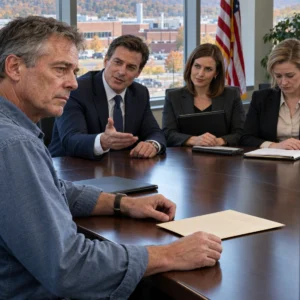
The divorce papers landed on my desk at a.m., and my wife’s attorney was smiling like he’d just won the lottery.
“Fifteen years of marriage, Mr.
Carter,” Daniel Reeves said, sliding the documents toward me. “And now it’s over.
Your wife gets the house, the investments, the retirement accounts, and full custody of both children.”
I stared at him.
He leaned closer, lowering his voice.
“There’s something else.
Your children have already told the court they don’t want to carry your name anymore.
Your daughter called you a stranger.
Your son doesn’t even want to see you.”
For a moment, the office went completely silent.
I looked down at the papers.
My wife’s signature was already there.
So were the custody demands, the financial disclosures, and a statement accusing me of emotional abandonment.
I had spent fifteen years building a family with Melissa Carter.
I had worked overtime, missed vacations, paid every mortgage installment, and sat beside her through every crisis.
And apparently, none of it mattered.
Daniel tapped the document with one finger.
“Take my advice.
Sign everything.
Fighting Melissa will only make things worse.
She’s prepared to destroy your reputation if you challenge her.”
I finally looked up.
“Is that what she told you?”
He smirked.
“She doesn’t need to tell me anything.
I have the evidence.”
I almost laughed.
Because Daniel had no idea what I knew.
I opened the bottom drawer of my desk and removed a sealed manila envelope.
It had been sitting there for eleven days, waiting for exactly this moment.
I placed it in front of him.
“Deliver this to your client.”
His smile disappeared.
“What’s inside?”
“Something your client should have told you fifteen years ago.”
He hesitated before taking it.
I stood, straightened my jacket, and returned to my computer.
“One more thing, Daniel.
Don’t let Melissa open it alone.
Her mother needs to be there.”
He stared at me as though I’d suddenly started speaking another language.
By p.m., my phone began vibrating nonstop.
First, Melissa.
Then her mother.
Then Daniel.
I ignored the first six calls.
On the seventh, I answered.
Melissa’s mother was crying so hard I could barely understand her.
“Richard, please.
Tell me this isn’t true.
Tell me you didn’t find out.”
I looked at the clock.
“What exactly are you afraid I’ve found out, Linda?”
There was a long, trembling silence.
Then she whispered five words that made my blood run cold.
“How did you know about her?”
And suddenly, I realized the envelope had opened a secret much bigger than my marriage.
I thought the hardest part of my marriage ending would be losing my wife or watching my children walk away.
I was wrong.
The real nightmare began when I discovered that the people who had called themselves my family for fifteen years had been protecting a secret so dangerous that even my wife’s own lawyer hadn’t known the truth.
The next phone call would reveal why Melissa was so desperate to take everything.
“How did you know about her?”
Linda repeated the question, her voice shaking.
I walked into my office, shut the door, and sat down.
“Because I finally had the DNA results.”
She stopped crying.
For several seconds, neither of us spoke.
Then she whispered, “You weren’t supposed to find those.”
“You’re right.
I wasn’t.”
Eleven days earlier, I had received an anonymous package at my house.
There was no return address, only my name written across the front.
Inside were three things: an old hospital photograph, a birth certificate copy, and a handwritten note.
The note contained one sentence.
Ask Melissa what happened at St.
Mary’s Hospital on October 14, 2011.
That was the day our daughter, Emily, was born.
I remembered that day perfectly.
Melissa had been rushed into an emergency delivery.
I had waited outside the operating room for nearly two hours before a nurse finally brought me a baby girl.
My daughter.
At least, that’s what I’d believed.
The anonymous package included a hospital record showing that another baby girl had been delivered within minutes of Emily.
Her name was listed as Baby B.
The mother’s name was Linda.
Melissa’s mother.
I had spent eleven days investigating quietly.
I contacted the hospital, consulted an attorney, and eventually obtained a legally authorized DNA test using samples voluntarily provided by Emily and me.
The results were devastating.
Emily was not my biological daughter.
But that wasn’t the worst part.
She wasn’t Melissa’s biological daughter either.
Linda began sobbing again.
“Richard, please listen.
We can explain everything.”
“Then explain it.”
“Not over the phone.”
I looked at the envelope Daniel had taken away.
“Your daughter has just filed for full custody of both children and accused me of abandoning them.
I think we’ve passed the point where explanations can wait.”
Linda whispered, “Melissa doesn’t know everything.”
That sentence made my stomach tighten.
“What does she know?”
Before Linda could answer, I heard another voice in the background.
Melissa.
“Mom!
Give me the phone!”
The call ended.
Less than a minute later, my front door camera sent an alert.
Melissa’s car had pulled into my driveway.
She got out, slammed the door, and marched toward the entrance.
I opened the door before she could knock.
She was holding the envelope.
Her eyes were red, but her expression was furious.
“Where did you get this?”
“Someone mailed it to me.”
“Who?”
“I was hoping you could tell me.”
She threw the envelope onto the hallway table.
“You had no right to investigate my family!”
I stared at her.
“Your family?
What about mine?”
She looked away.
Then she said something I hadn’t expected.
“Emily isn’t the only child whose birth certificate contains a lie.”
I felt the room tilt.
“What are you talking about?”
Melissa swallowed.
“Your son, Noah.”
I stepped backward.
Noah was thirteen.
He had my eyes, my stubborn personality, and the same crooked smile I’d seen in photographs of my own father.
Melissa reached into her handbag and removed another document.
“There’s something you need to understand about the night he was born.”
Before she could finish, headlights swept across the windows.
A second car had arrived.
Daniel Reeves stepped out.
And he wasn’t alone.
The man beside him was carrying a hospital file with my name printed on the front.
For the first time that evening, Melissa looked genuinely frightened.
The man beside Daniel Reeves stepped through my front door without waiting for an invitation.
He was in his late sixties, wearing a dark suit and carrying a leather briefcase.
Melissa immediately moved between him and the hallway.
“Why did you bring him here?”
Daniel looked uncomfortable.
“Because I received the contents of that envelope, and my client deserves to know exactly what she’s dealing with.”
The older man placed the hospital file on my table.
“My name is Dr.
Alan Whitmore.
I was the attending physician at St.
Mary’s Hospital in 2011.”
I stared at him.
“You’re retired.”
“Yes.
And I’ve spent the last fifteen years regretting what happened in that maternity ward.”
Melissa closed her eyes.
I looked at the file.
“Tell me about Noah.”
Dr.
Whitmore took a deep breath.
“On October 14, 2011, two newborn boys were delivered at St.
Mary’s within forty minutes of each other.
One was born to Melissa Carter.
The other was born to a woman named Rachel Bennett.”
I recognized the name.
Rachel had been Melissa’s closest friend in college.
She had disappeared from our lives shortly after Emily’s birth.
“Rachel?” I asked.
Dr.
Whitmore nodded.
“Her baby experienced serious complications immediately after delivery.
Rachel was unconscious and required emergency surgery.
During the confusion, a nurse mistakenly switched two identification bracelets.”
I felt my hands go cold.
“You’re saying Noah was Rachel’s biological son?”
“Yes.”
Melissa finally spoke.
“Richard, I didn’t know at first.”
I turned toward her.
“At first?”
She began crying.
“Rachel discovered the mistake six months later.
She came to me with the paperwork.
She wanted her son back, but she was struggling financially.
She was alone.
She was terrified she’d lose him.”
“And what did you do?”
Melissa looked down.
“I convinced her to wait.”
“Wait for what?”
“For things to settle down.”
I stared at her in disbelief.
“That was thirteen years ago.”
“I know.”
“No, Melissa.
You don’t know.
I’ve raised that boy.
I’ve taught him to ride a bicycle, helped him with homework, stayed awake when he had pneumonia, and sat in hospital waiting rooms when he broke his arm.”
“I know what you’ve done for him.”
“Then why did you keep this from me?”
She had no answer.
Dr.
Whitmore opened the file.
There was another document inside.
It was a copy of a letter dated three years earlier.
Rachel had written it to Melissa.
The letter contained a request for contact with Noah, accompanied by a promise that she would never attempt to remove him from the family.
Melissa had never shown it to me.
Instead, she had told Rachel that Noah was better off believing his biological mother was dead.
I slowly looked up.
“Was that true?”
Melissa shook her head.
“Rachel died last year.”
My anger momentarily gave way to confusion.
“How?”
“Cancer.
She sent the letter before she became seriously ill.
Her sister contacted me afterward.”
I looked at Daniel.
“Did you know about this?”
He shook his head.
“No.
I was hired to handle the divorce.
I wasn’t aware of any hospital records.”
I turned back to Melissa.
“And Emily?”
Her face crumpled.
“Emily was the other baby.”
The room became unbearably quiet.
Dr.
Whitmore explained the rest.
During the same hospital emergency, two newborn girls had also been placed in the wrong bassinets.
One belonged to Melissa and me.
The other belonged to Linda and her husband, Frank.
The hospital discovered the mistake several weeks later.
But by then, the families had already bonded with the babies.
Linda and Frank were experiencing a serious financial crisis and had recently lost their insurance.
Melissa’s father was also facing a devastating medical diagnosis.
The two families made an agreement.
They would not exchange the babies.
They would raise the children as their own and keep the mistake secret until everyone was old enough to understand.
But the agreement was never legally documented.
And over the years, fear had transformed a desperate decision into a permanent deception.
Emily was biologically Linda and Frank’s daughter.
The girl they had raised as their own was biologically mine and Melissa’s.
I sat down.
“So Emily and Noah are both biologically connected to other families.”
Dr.
Whitmore nodded.
“That’s correct.”
I looked at Melissa.
“Did you ever intend to tell me?”
She wiped her cheeks.
“I thought I could keep everyone safe.”
“By lying to everyone?”
“I was afraid you’d take the children away.”
I laughed bitterly.
“You’ve spent fifteen years watching me raise children you knew weren’t biologically mine, and you thought I’d abandon them if I learned the truth?”
She had nothing to say.
Then Daniel interrupted.
“There’s another issue.”
He opened the envelope and removed a document I’d deliberately included.
It was a copy of a financial trust agreement established fifteen years earlier.
My father had created it before his death, naming me as trustee and listing Emily and Noah as its intended beneficiaries.
The trust contained substantial assets, including shares in the company I had inherited.
But there was a condition.
If the children were ever found to have been deliberately misrepresented in legal or financial documents, the trustee was required to preserve the assets for the children while initiating an independent review.
Melissa had signed the original beneficiary declarations.
She had also submitted those declarations during our divorce proceedings, claiming the trust was marital property that belonged entirely to her.
It wasn’t.
And she knew it.
The documents in my envelope established that she had concealed the hospital discoveries while making financial claims based on information she knew to be false.
Daniel stared at the paperwork.
“Melissa, you told me the trust was jointly owned.”
She looked at him helplessly.
“I thought it was.”
“You signed the declaration.”
Her silence answered for her.
But I wasn’t finished.
I removed one final document from my desk drawer.
It was a letter from Rachel’s sister, Catherine Bennett.
She had contacted me after Rachel’s death, explaining that Rachel had kept copies of every letter, hospital record, and message exchanged with Melissa.
Catherine had also agreed to testify about Rachel’s attempts to contact Noah.
Melissa read the first page.
Her hands began shaking.
“You contacted her?”
“Yes.”
“Why?”
“Because Rachel deserved to have her story heard.
And because Noah deserved the truth.”
Melissa sank into the chair.
For the first time since the divorce papers arrived, she looked less like someone preparing to win a battle and more like someone realizing the battle had already changed.
Then came the question I had been avoiding.
“What happens to the children?”
I looked at Dr.
Whitmore.
“That’s why I wanted everyone here.”
I had already spoken with a family attorney who specialized in custody and complex parentage cases.
He had explained that biological relationships alone would not automatically determine custody.
The children’s emotional bonds, stability, wishes, and best interests would matter.
I had no intention of using DNA results to erase fifteen years of family life.
Emily was still my daughter.
Noah was still my son.
And nothing in a laboratory report could change the years I’d spent loving them.
But I also wanted them to know the truth before someone else weaponized it.
Two days later, we sat together in the family attorney’s conference room.
Emily was fifteen.
Noah was thirteen.
They had been told that something important about their births had been discovered.
Emily looked at me first.
“Are you still my dad?”
I reached across the table and took her hand.
“Every single day.
Nothing has changed about that.”
Noah looked frightened.
“Does that mean I have to go live with someone else?”
“No,” I said. “You don’t have to make any decisions today.
Nobody gets to treat you like a package being transferred between families.”
Melissa began crying.
For the first time, she didn’t interrupt.
We spent the next several months working through the legal and emotional consequences.
The hospital acknowledged its historical records had been mishandled.
An independent investigation was initiated.
The children’s birth records were reviewed through the appropriate legal process.
Melissa withdrew her demand for the entire trust after my attorney challenged the claim.
The divorce settlement was eventually negotiated without the financial victory her lawyer had originally promised her.
Custody was decided separately, with the children’s preferences and emotional needs taken seriously.
We established a shared parenting arrangement, supported by family counseling.
Emily eventually met Linda and Frank in a quiet, carefully arranged setting.
Noah met Catherine and heard more about Rachel than he had ever imagined possible.
He kept a photograph of her beside his bed.
And I kept being his father.
Melissa and I never reconciled.
Some secrets can be explained, but they cannot be undone.
Months later, after the divorce was finalized, she came to my house to drop off the children’s school bags.
She stood at the doorway for a moment.
“Richard, do you hate me?”
I considered the question.
“I hate what you did.
I hate that you let our children grow up inside a lie.
But I won’t make them pay for what happened between us.”
She nodded, tears gathering in her eyes.
Then she asked the question that had haunted her since the envelope arrived.
“Why didn’t you expose everything when you first found out?”
I looked toward the living room, where Emily and Noah were arguing over a video game.
“Because the truth was never supposed to be a weapon against them.”
She lowered her head.
I closed the door gently.
The divorce had cost me a marriage, a home, and the future I’d imagined fifteen years earlier.
But it hadn’t cost me my children.
And when Noah called from the living room, “Dad, can you help us with something?” I answered without hesitation.
Because after fifteen years of secrets, one thing had finally become clear.
A family isn’t held together by matching DNA, perfect paperwork, or carefully guarded lies.
It’s held together by the people who keep showing up.
And I intended to keep showing up for both of them.