PART 13: The Distance Between Two Weapons
My fingers closed around the rifle stock before the hidden man finished turning.
I drew it down along the coach wall, keeping the barrel pointed toward the road until the wood cleared the seat rail.
The movement made a soft scrape.
It sounded enormous to me.
The pistol came back toward the coach.
I had the rifle shouldered by then, with the pale branch centered above the front sight.
Nobody fired.
The horses breathed and shifted in their harness.
The robber remained crouched above his empty revolver, one hand spread on the dust.
The driver held himself still on the coach rung.
Inside, the boy had gone silent.
I kept my cheek against the stock.
“Put it down.”
The hidden man did not obey.
“You first.”
I could see enough of his hand now to know the pistol was level, but not enough of his face to know where his eyes were looking.
He had the advantage of concealment.
I had the advantage of a rifle braced against solid wood.
Neither advantage kept a frightened person from moving into the wrong place.
The driver lowered one foot to the road.
I let him.
He was no longer climbing toward the money.
He was getting back to the horses, where he could use the team if I needed him to.
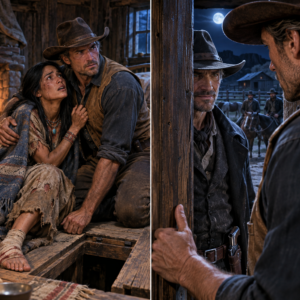
The ranch owner spoke from inside the coach.
“Shoot him.”
The woman flinched.
The older worker turned his head just far enough to confirm who had spoken.
The owner saw him looking and tried to repair the words.
“He’s threatening us.”
My rifle remained pointed away from the passengers.
The older man did not give him the comfort of answering.
The hidden man said nothing.
That silence interested me.
A moment earlier, he had threatened to shoot at almost any movement.
Now his employer had given him an order that would require him to fire against a ready rifle while witnesses watched from cover.
He had begun calculating his own chances instead of following someone else’s ending.
“You take me down, he still knows your name,” I said.
The pistol held steady.
“So does the man you put in front of you with an empty gun.”
The robber lifted his head.
The hidden man told him to stay down.
He stayed down, but his eyes had changed.
The ranch owner could offer money afterward.
He could also decide that a second hired man had caused the first man’s death.
He already had one statement explaining violence before violence happened.
Every person on that road had now seen how easily a name could be supplied to a finished account.
The older worker took the second statement from his shirt.
He held it inside the doorway where the brush could not reach it without going through him.
“His name’s on nothing,” he said.
I knew whom he meant.
The hired men had carried weapons and taken risks while their employer sat inside a coach with prepared witnesses.
Their promised payment had depended on him honoring a private arrangement after they had made themselves the easiest people to blame.
The robber rose slowly with both hands open.
He left the empty pistol on the ground.
“I was told to frighten him.”
The hidden man swore.
The robber looked toward the ranch owner.
“I wasn’t told you’d write a child into it.”
The owner called him a liar.
The woman answered.
“He wrote it before we left.”
The hidden pistol dipped a fraction.
I did not lower the rifle.
I could feel sweat moving beneath my collar despite the coolness gathering in the road.
My shoulder had begun to ache from holding still.
I welcomed the ache because it reminded me not to mistake a moment of hesitation for safety.
“Come out with the barrel down,” I said.
The brush moved.
A boot appeared, then the lower edge of a coat.
The man stepped onto the road without giving me his whole body at once, using the robber’s position as cover until the robber moved aside.
I saw his face for the first time.
It was an ordinary face made hard by the effort of keeping fear hidden.
He was neither a monster from a story nor a man I could dismiss as something too strange to understand.
He was a hired gun who had found himself inside a plan more dangerous than the money had made it sound.
His pistol remained in his hand.
“Let me take what I’m owed.”
The driver looked at the sack above the bench.
The younger worker stood close enough to hear every word.
“That’s forty men’s pay.”
The gunman’s eyes moved toward him.
I held the sight on the man’s chest.
“You can argue about a wage in town.”
The ranch owner stood behind the older worker.
For a moment, I could see only his shoulders.
Then his right hand disappeared beneath his coat again.