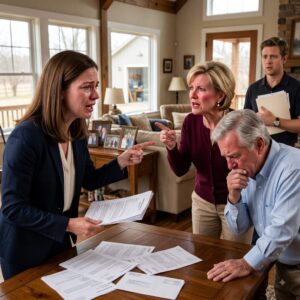
At my parents’ Christmas party, my sister’s husband raised his glass of eggnog, sneered that plowing snow was for kids, and demanded I co-sign his $160,000 loan.
I told him not to ask a kid to do a man’s job—and exactly one year later, he was facing federal prison for what he did next.
My phone buzzed with an emergency page from St.
Jude’s Memorial Hospital just as my brother-in-law, Chad, raised his glass of eggnog and sneered, “Plowing snow is for kids.
Grown men build something.”
The dispatch screen flashed red: heavy blizzard warning, main ambulance bay blocked by a four-foot drift, three critical care transport vans stranded.
I had built Apex Fleet from a single rusted Jeep Cherokee into nine commercial-grade plows running twenty-four hours a day, keeping the emergency room accessible while Chad sat in my parents’ warm living room in a tailored suit he couldn’t afford.
Mom had just cornered me near the Christmas tree, sliding a stack of commercial bank documents across the mahogany table.
She didn’t ask how my business was doing or how many consecutive all-nighters I had pulled that week.
She just demanded that I co-sign Chad’s $160,000 commercial expansion loan for his failing real-time logistics startup.
“Chad has big contracts coming in, Nathan,” Mom whispered, her eyes darting toward my sister Sarah, who looked away, too ashamed to speak for herself. “He just needs a prime guarantor with strong asset backing to unlock the line of credit.
You have nine trucks and a commercial yard.
It’s nothing to you.”
Chad laughed, a rich, patronizing sound, and took a sip of his drink.
That was when he dropped the line about plowing snow being for kids, while my sister nodded approvingly like her husband was a corporate titan instead of a fraud living on credit card float.
I didn’t yell.
I didn’t lose my temper.
I looked straight into Chad’s smug eyes, adjusted my heavy Carhartt jacket, and said, “Then don’t ask a kid to co-sign your loan.”
The room went dead silent.
Mom gasped, clutching her chest, while Chad’s smile vanished instantly, his face turning the color of a bruised plum as he slammed his glass down so hard the eggnog splashed across the festive tablecloth.
Before Chad could open his mouth to scream, my dispatcher’s radio crackled loudly from my belt: Apex One, ambulance bay zero is completely gridlocked, patient inbound in four minutes.
I turned my back on my family, shoved my hands into my pockets, and walked straight out the front door into the howling winter storm, leaving them stunned in the middle of their holiday party.
That freezing night on the hospital grounds was only the beginning.
What Chad didn’t know was that my commercial fleet wasn’t just clearing snow—we were keeping the city’s entire medical lifeline alive, and the bank holding his loan application was about to call my office for a very different reason.
I spent the next fourteen hours straight behind the wheel of Lead Truck One, pushing wet, heavy snow off the ambulance ramps and salting the emergency lanes while the city ground to a complete halt.
By morning, St.
Jude’s was fully operational, and the hospital administrator personally walked out into the sub-zero wind to shake my hand and hand me a priority municipal snow-removal contract extension worth a quarter-million dollars.
While I was securing my company’s future, Chad’s financial world was rapidly collapsing behind closed doors.
Three days after Christmas, my phone rang at AM.
It wasn’t Mom.
It was Vice President Marcus Vance from First Meridian Bank—the exact institution where Chad had applied for his $160,000 loan.
Vance wasn’t calling to ask me to co-sign.
He was calling because my commercial accounts were held at the same branch, and the loan officer processing Chad’s paperwork had noticed a glaring discrepancy.
“Nathan, we received Chad’s corporate balance sheet for the loan application,” Vance said, his voice low and serious. “He listed your commercial equipment yard and three of your plow trucks as collateral assets owned under a joint partnership with you.
He even attached a scanned signature page.”
My blood ran ice cold.
Chad hadn’t just asked me to co-sign—he had forged my signature on a preliminary asset hypothecation form weeks before the Christmas party, assuming I would simply sign the formal papers out of family obligation once the bank initiated verification.
“I never signed anything, Marcus,” I replied, gripping the steering wheel so tight my knuckles turned white. “That is corporate fraud.”
Vance paused. “If that’s true, Nathan, we have to flag this immediately.
But there’s more.
Chad’s startup has zero revenue, three pending tax liens, and maxed-out credit lines.
If this fraud investigation goes public, his company liquidates instantly.”
Later that afternoon, Mom and Sarah showed up unannounced at my maintenance yard, tears streaming down Sarah’s face.
Mom didn’t bother saying hello.
She marched right up to my office window, banging her fist against the glass until I stepped outside into the biting wind.
“Chad was arrested at his office an hour ago by federal bank investigators!” Mom shrieked, her voice cracking with hysteria. “The bank froze all his accounts because of some paperwork mix-up!
You have the power to call the bank president and tell them you approved it!
Save your brother-in-law right now, or your sister will lose her home!”
I looked at Sarah, who was sobbing into her woolen scarf, and then at Mom, whose sense of entitlement had finally hit a brick wall.
“I didn’t mix up any paperwork, Mom,” I said coldly, pulling the bank’s fraud affidavit out of my clipboard. “Chad committed felony forgery using my business assets.
And the best part?
The federal investigator is inside my office right now reviewing the security footage from the Christmas party when Chad bragged about being a real grown-up businessman.”
The look of absolute horror on Mom’s face was something I knew I would never forget.
For years, she had excused Chad’s laziness, funded his extravagant lifestyle, and treated my blue-collar grit like a backup bank account for her golden-boy son-in-law.
Now, the reality of what Chad had done—and what her blind favoritism had enabled—was crashing down around them in real-time.
“You can’t let them put him in federal prison, Nathan!” Mom cried, grabbing my jacket sleeve and shaking me. “He has a family!
He’s your sister’s husband!
Family protects family, no matter what!”
“Family doesn’t commit financial identity theft and forge signatures behind my back,” I answered firmly, gently pulling her hands away from my coat. “Chad wanted to play like a big-boy corporate executive.
Well, welcome to the real corporate world.
Actions have consequences.”
Inside my office trailer, Special Agent Miller from the federal bank fraud division closed his notebook, stood up, and looked at Sarah with a sympathetic expression. “Ma’am, your husband didn’t just submit a forged guarantee.
He used a stolen corporate tax ID number belonging to Apex Fleet to secure emergency bridge loans from private lenders, totaling over $220,000.
He is facing multiple counts of bank fraud and wire fraud.”
Sarah didn’t scream or defend him.
She simply sat down on the metal folding chair, buried her face in her hands, and whispered, “He told me our finances were fine.
He lied to all of us.”
Over the next three months, the legal proceedings moved swiftly.
Because I cooperated fully with the federal prosecutors and provided the digital audit logs proving I had never authorized a joint partnership or asset sharing, my business assets were completely cleared of any encumbrances.
Apex Fleet’s credit rating remained pristine, and the municipal hospital contract we secured after the Christmas blizzard allowed us to expand our operations into two neighboring counties.
Chad’s trial never actually made it to a courtroom.
Faced with ironclad forensic evidence—including digital signatures traced directly to his home IP address and bank surveillance footage of him dropping off the fraudulent paperwork—his defense attorney advised him to take a plea deal.
In exchange for cooperating with federal authorities regarding a broader network of shell companies he was running, Chad was sentenced to thirty-six months in federal prison, followed by five years of supervised probation and mandatory full restitution.
Because they had no liquid assets left, Sarah was forced to sell their oversized suburban home, liquidate their luxury cars, and move back into a modest two-bedroom rental near her downtown retail job.
Mom tried calling me a dozen times during the spring thaw, but I blocked her number.
The damage she had caused by enabling Chad’s delusions for years had finally shattered the illusion of family unity she had tried to maintain.
When she eventually sent a handwritten letter through the mail apologizing for her blindness and asking if we could rebuild our relationship, I read it once, placed it in my desk drawer, and went back to managing my trucks.
Last November, right as the first autumn frost settled over the city, I drove my new flagship Ford F-650 heavy plow past St.
Jude’s Memorial Hospital.
The gleaming white metal of the truck caught the morning sun, and the bold red lettering of Apex Fleet stood out sharply against the gray asphalt.
I pulled into the hospital’s primary service bay, checked my dispatch tablet, and smiled to myself.
I hadn’t inherited a dime, I hadn’t relied on a co-signer, and I hadn’t needed anyone’s permission to build my life.
Plowing snow might have sounded like child’s play to Chad, but out here in the real world, hard work built empires—and prison cells built reality.