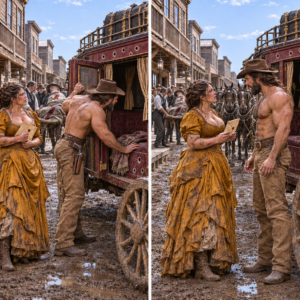
CHAPTER 1 – I Drove a Bullet-Riddled Stagecoach Into Laramie. The Mountain Man Waiting for Me Had No Idea Who He Was Marrying.
PART 1: THE BRIDE WHO ARRIVED WITH A GUNSHOT BEHIND HER
The first time I saw Gareth Lockwood, I was standing on top of a runaway stagecoach with blood running down my hands, six terrified horses beneath me, and a dying driver at my feet.
I had imagined our first meeting differently.
In the letters we had exchanged over six months, I had pictured a quiet introduction, perhaps a handshake outside the Laramie depot, followed by a journey through the Wyoming mountains toward the home he had described so carefully.
I had imagined wearing my best blue traveling dress, smoothing my hair, and trying not to look nervous.
Instead, I arrived with a torn skirt, mud on my boots, a bruised shoulder, and enough dust in my mouth to choke a horse.
And the man waiting for me looked as though he had forgotten every word he had ever learned.
“WHOA!”
I pulled the reins against my chest as the six horses thundered down the main street.
The stagecoach swayed violently, its damaged wheels throwing dirt in every direction.
A bullet had shattered the lantern beside the driver’s seat, and another had torn through the wooden panel behind me.
Samuel Higgins, the old driver, was lying across the bench, his shoulder soaked with blood.
“Hold together, Samuel,” I shouted.
He made a weak sound.
I had no idea whether he could hear me.
A few minutes earlier, we had been traveling through a narrow stretch of road near Chimney Rock when three armed men emerged from the trees.
The first shot struck the coach.
The second hit Samuel.
The third shattered the window beside my head.
I remembered Samuel shouting for me to get down.
I remembered the horses screaming.
I remembered him losing his grip on the reins.
Then I remembered the coach beginning to veer toward a rocky embankment.
I had two choices.
I could remain inside and pray that the horses somehow found their way through the pass, or I could climb onto the driver’s seat and try to stop them.
I had never considered myself a particularly brave woman.
But I had spent enough years watching life take things from me to know that sometimes there was no room left for fear.
I climbed forward, caught the loose reins, and pulled with everything I had.
The horses fought me.
One nearly went over the roadside ditch.
I shouted until my throat burned.
I kept pulling.
And somehow, through God’s mercy, the animals stayed on the road.
Now the town of Laramie was rushing toward us.
“MAKE ROOM!” I screamed.
People scattered.
A man jumped behind a wagon.
A woman grabbed her child.
Someone shouted that the stagecoach was going to overturn.
Then I saw a tall, broad-shouldered man standing near the depot.
He wore a dark hat, a weathered coat, and a thick beard that concealed much of his face.
His hands were already reaching toward the horses.
I pulled the reins one final time.
The stagecoach lurched sideways.
Its wheels screamed against the hard-packed earth.
Then it stopped.
For a moment, nobody moved.
I looked down at the stranger.
He stared up at me.
His expression was difficult to read.
I was too exhausted to care.
“GET A DOCTOR!” I roared.
The man immediately climbed onto the wheel.
“Easy, Higgins,” he said, supporting the injured driver.
“Can you hear me, old friend?”
Samuel groaned.
“He’s been shot through the shoulder,” I explained.
The stranger looked at the blood covering Samuel’s shirt.
“Get him down carefully.”
Two men hurried forward.
Together, they lifted Samuel from the driver’s seat and carried him toward the depot.
I stayed beside the horses until another teamster took control of them.
Only then did I climb down.
My knees trembled when my boots touched the ground.
I wanted to sit.
I wanted water.
I wanted someone to tell me that Samuel would live.
Instead, I noticed the stranger walking toward the coach.
He opened the passenger door.
Then he looked inside.
He checked the empty cushions.
He lifted a fallen travel shawl.
His expression changed.
“Where is she?”
I frowned.
“Who?”
He turned toward me.
“My bride.”
I stared at him.
Then I reached into my coat and pulled out the envelope I had carried across half the country.
The paper was wrinkled and stained with dirt, but the handwriting remained clear.
Gareth Lockwood.
I held it out.
“Are you Gareth Lockwood?”
His eyes moved from the envelope to my face.
“I am.”
I swallowed.
“My name is Hannah Gallagher.”
He did not move.
For several seconds, he simply stared at me.
I lifted my chin.
“I believe we have a wedding to attend, Mr. Lockwood, assuming you haven’t lost your nerve.”
The enormous mountain man opened his mouth.
Nothing came out.
And standing there in the middle of the Laramie street, with blood on my sleeves and six horses behind me, I realized that the first challenge of my marriage might not be surviving the wilderness.
It might be convincing my future husband that I was the woman he had invited.
CHAPTER 2 – PART 2 – I Drove a Bullet-Riddled Stagecoach Into Laramie. The Mountain Man Waiting for Me Had No Idea Who He Was Marrying.
PART 2: THE MAN WHO EXPECTED A DIFFERENT WOMAN
Gareth finally found his voice.
“You’re Hannah?”
“I have been for twenty-eight years.”
He glanced toward the stagecoach.
Then he looked at my muddy dress, my bruised hands, and the blood running along my wrist.
“I was expecting someone else.”
The words landed harder than I wanted them to.
I looked down at the envelope.
“Unless your letters were sent to another Hannah Gallagher, I believe you’ve found the right woman.”
He rubbed his beard.
“That’s not what I meant.”
“Then perhaps you should explain what you did mean.”
His face reddened slightly.
I had never met a man who looked quite so uncomfortable standing in front of a woman.
He was enormous, perhaps six feet four, with hands that looked capable of lifting a tree stump.
Yet he seemed unable to decide what to do with them.
“I imagined you differently,” he admitted.
“How?”
He hesitated.
“Smaller.”
I stared at him.
Then I laughed.
It was not a particularly pleasant laugh.
“Well, Mr. Lockwood, I apologize for failing to shrink during the journey.”
His expression changed immediately.
“That isn’t what I meant.”
“Men have been explaining what they mean to me since I was old enough to understand insults.”
I turned toward the depot.
“Your driver needs a doctor, and I need somewhere to wash my hands.”
He stepped aside.
“Of course.”
I walked past him.
He followed.
Inside the depot, the wounded driver lay on a narrow bench while the local physician examined his shoulder.
Samuel was conscious now, although his face had turned pale.
“Miss Gallagher,” he whispered.
I hurried to his side.
“How are you feeling?”
“Like someone tried to shoot me.”
I almost smiled.
“Then I suppose you are fortunate they missed anything important.”
He gave a weak chuckle.
The physician ordered everyone to step back while he cleaned the wound.
I waited near the wall, holding my injured hands together.
Gareth stood beside me.
For several minutes, neither of us spoke.
Finally, he said, “You saved his life.”
“Samuel saved mine first.”
“What happened on the road?”
I explained about the armed men, the gunfire, and the horses bolting.
I told him how Samuel had fallen against the bench and how the coach nearly overturned.
Gareth listened without interrupting.
When I finished, he looked at my hands.
“You’re bleeding.”
“I noticed.”
“You should have the doctor look at them.”
“I will when he’s finished with Samuel.”
He nodded.
Then he said something I did not expect.
“I thought I would be the one protecting you.”
I looked at him.
“Why?”
“Because you’re coming to live in the mountains.”
“That doesn’t answer my question.”
He looked away.
I understood then.
He had imagined a woman who would depend on him.
Perhaps he had pictured a shy little bride who would sit quietly beside his fireplace while he chopped wood and hunted game.
He had imagined himself as the strong man who would make every difficult decision.
He had never considered that his bride might already know how to survive.
“Mr. Lockwood,” I said quietly, “I did not travel all this way because I wanted another man to tell me what I could or could not do.”
His good eye returned to mine.
“I understand.”
“I’m not certain you do.”
Before he could answer, the physician approached.
Samuel would live.
The bullet had passed through his shoulder without striking anything vital, although he would need several weeks of rest.
I closed my eyes in relief.
Then Gareth offered to take me to the boardinghouse.
I accepted because my hands were beginning to ache.
At the entrance, I stopped.
“Mr. Lockwood?”
“Yes?”
“Are you disappointed?”
He looked at me for a long moment.
Then he answered honestly.
“I don’t know what I am yet.”
It was not the answer I wanted.
But I respected him more for refusing to lie.
I followed him toward the street.
The town was watching us.
I could feel the stares following my every step.
Some people recognized the woman who had brought the damaged coach into town.
Others recognized Gareth Lockwood.
I heard a woman whisper that the mountain man had certainly chosen an unusual bride.
Another laughed and said he would need a bigger chair at his dining table.
I kept walking.
Gareth heard them too.
His shoulders stiffened.
He stopped beside the boardinghouse steps and turned toward the women.
“That woman brought six horses through a mountain pass after armed men shot her driver,” he said.
His voice carried across the street.
“Any person who believes she is too much woman for this town ought to try doing half of what she did today.”
The women fell silent.
I looked at him.
For the first time since our meeting, I saw something other than disappointment in his expression.
I saw anger.
Not at me.
For me.
But I had learned long ago that one kind word did not make a safe home.
I still needed to know what kind of husband Gareth Lockwood intended to become.
And the following morning, he would have to answer that question before I agreed to marry him.
CHAPTER 3 – PART 3 – I Drove a Bullet-Riddled Stagecoach Into Laramie. The Mountain Man Waiting for Me Had No Idea Who He Was Marrying.
PART 3: THE LETTERS THAT BROUGHT US TOGETHER
I slept poorly that night.
The boardinghouse room was clean, but the mattress was narrow, and my hands throbbed whenever I moved.
I spent much of the darkness thinking about the letters Gareth and I had exchanged.
His first letter had been short.
He explained that he lived in the Wind River Range, owned a modest mountain property, and wanted a wife who valued quiet living more than fashionable society.
He did not promise riches.
He did not promise servants.
He promised honesty, a warm home, and a man who would work hard to provide for his family.
I had believed him.
My own letter had been equally honest.
I told him I was twenty-eight, that I had spent most of my adult life working, and that I wanted a home where I would not be judged before I had spoken.
I did not hide my size.
I did not pretend to be delicate.
I wrote that I was a good cook, that I could handle animals, and that I had no interest in spending my life being treated as a burden.
Gareth had replied that he valued a woman’s character more than her appearance.
I had read that sentence many times.
Now I wondered whether he had truly understood what he was promising.
At breakfast, a knock came at my door.
It was Gareth.
He held a small paper package.
“I brought you something.”
I opened it.
Inside were clean bandages, a little tin of salve, and two fresh rolls from the bakery.
“I wasn’t certain what you preferred,” he said.
“Thank you.”
He glanced toward the chair.
“May I sit?”
I nodded.
He removed his hat.
For the first time, I noticed how tired he looked.
There were faint lines around his eyes, and his beard had begun to show gray.
“I owe you an apology,” he said.
I sat across from him.
“For what?”
“For making you feel as though you weren’t the woman I wanted.”
I looked at my hands.
“Are you certain you want me?”
He was quiet.
“I want the woman who wrote those letters.”
“Then you should know that woman is standing in front of you.”
“I know.”
“Do you?”
He leaned forward.
“Hannah, I have lived alone for almost ten years.”
He told me about his years in the mountains.
He had worked for a timber company when he was younger, then purchased land with the money he had saved.
He had built his cabin himself.
He had repaired the fences, cleared the fields, and learned to live through winters that would have driven most men back to town.
But he had become accustomed to silence.
At first, he told himself that solitude was easier.
Eventually, he realized that easier was not the same as better.
“I want someone to come home to,” he said.
“Someone who asks how my day went.”
“Someone who remembers that a house is supposed to have laughter in it.”
He looked at me.
“I thought I was ready for marriage, but standing beside that coach yesterday made me realize I had been imagining marriage without truly imagining the woman.”
I considered his words.
“Did you want someone smaller because you thought she would be easier to protect?”
He nodded slowly.
“Perhaps.”
“Then let me tell you something.”
I moved closer to the table.
“I have spent most of my life being told that I take up too much space.”
“My family wanted me to disappear whenever important visitors came.”
“Men looked at me and decided what kind of wife I could become before they ever asked what I thought.”
“I did not come west to become another man’s responsibility.”
Gareth lowered his eyes.
“I understand.”
“I want a husband, not a keeper.”
He looked up.
“What if I told you I could learn the difference?”
I did not answer immediately.
Outside, a wagon rolled past the window.
A child laughed somewhere in the street.
The world continued moving while two strangers tried to decide whether they could build a life together.
Finally, I said, “Then I would tell you that learning takes time.”
“I have time.”
“And I will not pretend to be delicate.”
“I wouldn’t ask you to.”
“And I will not promise to stay silent whenever something bothers me.”
His mouth twitched.
“I would probably prefer that.”
For the first time, I smiled.
He stood.
“I have arranged for the minister to be available tomorrow afternoon, if you still wish to marry me.”
I studied his face.
“Tomorrow?”
“Only if you want to.”
I looked down at my bandaged hands.
Then I remembered the road, the gunfire, and the moment I had seen him standing beside the depot.
I had not traveled two thousand miles to be frightened away by one awkward conversation.
“Yes,” I said.
Gareth released a breath.
“Yes?”
“Yes, Mr. Lockwood.”
He smiled.
It was not a grand smile.
It was a small, almost uncertain expression that transformed his entire face.
Then he placed his hat on his head.
“Tomorrow, then.”
But before he reached the door, I remembered something.
“One question, Gareth.”
He turned.
“Your letters always mentioned the cabin, the creek, and the mountain.”
“Yes?”
“You never mentioned whether your house had a proper kitchen.”
He blinked.
Then he laughed.
For the first time, I heard a sound from him that did not seem burdened by loneliness.
“I believe it does.”
“Good.”
“Why?”
“Because after tomorrow, you’re going to learn that a mountain man who cannot keep a kitchen properly supplied is going to have a very difficult marriage.”
He shook his head, still smiling.
And I began to believe that perhaps the man I had come to marry was finally beginning to see me.
CHAPTER 4 – PART 4 – I Drove a Bullet-Riddled Stagecoach Into Laramie. The Mountain Man Waiting for Me Had No Idea Who He Was Marrying.
PART 4: A WEDDING WITHOUT PRETENDING
Samuel Higgins was awake when I visited him the following afternoon.
His shoulder was wrapped, and his face looked considerably better.
When he saw me, he raised his good hand.
“There’s my hero.”
I shook my head.
“Don’t start calling me that.”
“Why not?”
“Because I was frightened half to death.”
Samuel chuckled.
“That’s usually what courage feels like.”
I sat beside his bed.
He told me the stagecoach company would cover his medical expenses, and he expected to return to work after several weeks.
Then he looked toward Gareth, who stood near the doorway.
“You’re the mountain fellow marrying this woman?”
“I am,” Gareth answered.
Samuel grinned.
“Then I hope you know what you’ve got.”
Gareth glanced at me.
“I’m beginning to.”
Samuel became serious.
“She kept me alive, son.”
“I know.”
“No, I don’t think you do.”
The old driver adjusted his pillow.
“When that first bullet hit, I couldn’t feel my left arm.”
“The horses were running wild, and I knew the coach was going over.”
“She climbed up beside me and took the reins before I could even tell her how.”
Samuel looked directly at Gareth.
“I’ve driven stagecoaches for twenty-seven years, and I’ve never seen anyone handle six frightened horses like she did.”
Gareth listened quietly.
Then he reached for my hand.
It was the first time he had touched me without hesitation.
I allowed him to hold it.
The wedding took place in a small room behind the church.
There were no flowers beyond a little bunch of wildflowers the minister’s wife had gathered.
There was no expensive dress.
There were no musicians.
I wore my clean blue traveling dress, and Gareth wore his best dark coat.
When I entered the room, he stood waiting beside the minister.
His expression was solemn.
But his eyes were warm.
The minister asked whether we came willingly.
Gareth answered first.
“I do.”
Then it was my turn.
I looked at the man who had once imagined a different woman standing beside him.
I thought about the miles I had traveled.
I thought about the people who had laughed at me.
I thought about Samuel’s blood on my hands and the strange courage that had carried me into town.
Then I looked into Gareth’s eyes.
“I do.”
We exchanged rings.
The minister spoke the words that made us husband and wife.
Gareth kissed my forehead gently.
It was not the passionate kiss I had imagined as a girl.
It was better.
It felt like a promise made by someone who understood that love was not a performance.
Afterward, we returned to the boardinghouse for supper.
Gareth had arranged a small celebration with the minister, his wife, Samuel’s physician, and Elias Rutherford from the depot.
I was surprised by how much I enjoyed the evening.
Nobody treated me as an inconvenience.
Nobody whispered about my size.
When Gareth introduced me as his wife, he did so without hesitation.
That night, we discussed the journey to his cabin.
The mountain road would take two days.
He had brought a wagon, a strong team, and enough supplies for the trip.
I asked whether he had enough food.
He assured me that he did.
I asked whether the horses were accustomed to the road.
He said they were.
I asked whether the cabin had a proper pantry.
He looked at me with mock concern.
“Are you planning to inspect every room before you let me sleep?”
“Only the important ones.”
He laughed.
The next morning, we left Laramie.
As the town disappeared behind us, I watched the buildings become smaller.
I had no idea what waited at the end of the mountain road.
I knew only that I had married a man who was still learning how to share his life.
And I had married him because I believed he was willing to learn.
The journey was difficult.
The road narrowed as we climbed.
Pine trees crowded the slopes, and the wind carried the sharp smell of snow.
Gareth drove carefully, occasionally glancing toward me.
“Cold?”
“A little.”
“Want my coat?”
“No.”
He smiled.
“You’re determined to make this difficult.”
“I’m determined not to freeze because you think I need rescuing.”
He shook his head.
Then he reached behind the seat and handed me an extra blanket.
I accepted it.
That was how our marriage began.
Not with grand declarations.
Not with promises that nothing would ever go wrong.
But with two people slowly learning how to care for each other without taking away the other’s dignity.
CHAPTER 5 – PART 5 – I Drove a Bullet-Riddled Stagecoach Into Laramie. The Mountain Man Waiting for Me Had No Idea Who He Was Marrying.
PART 5: THE HOUSE THAT HAD WAITED FOR ME
We reached Gareth’s property shortly before sunset.
The cabin stood beneath a line of tall pines, with the mountains rising behind it like enormous gray walls.
A narrow creek ran through the lower pasture.
There was a barn, a small chicken yard, a woodpile, and a vegetable garden that had clearly been neglected.
The house itself was sturdy.
Its logs were thick, its roof had been repaired recently, and smoke stains marked the chimney.
Gareth climbed down first.
Then he walked around and offered me his hand.
I stepped from the wagon.
For a moment, I simply stood there.
It was beautiful.
Not beautiful in the way wealthy people described their homes.
There were no polished marble floors, no expensive curtains, and no servants waiting to open the door.
There was only the mountain air, the sound of running water, and a little wooden house that looked as though it had been built by someone who intended to remain.
“Welcome home,” Gareth said.
I looked at him.
“Home?”
“If you want it to be.”
I smiled.
“I think I might.”
Inside, I discovered that Gareth had prepared more carefully than I expected.
The floor had been scrubbed.
The windows were clean.
A new rocking chair stood beside the fireplace.
There were fresh blankets on the bed and a small vase holding dried mountain flowers on the table.
I touched the rocking chair.
“You made this?”
He nodded.
“Had some cedar left over.”
“It’s lovely.”
“I thought you might like something to sit in while I worked outside.”
I turned toward him.
“You thought about me sitting here?”
He looked embarrassed.
“I thought about you being comfortable.”
For a moment, I could not speak.
Then I walked through the kitchen.
It was larger than I expected, although the shelves were nearly empty.
There was a cast-iron stove, a wooden table, several pots, and a flour bin.
I opened the pantry.
Gareth stood behind me.
“Well?”
I looked at the supplies.
A small sack of flour.
Dried beans.
Salt.
Coffee.
A few potatoes.
Some smoked meat.
I turned slowly.
“Mr. Lockwood.”
“Yes?”
“Did you intend to feed your wife for the entire winter with this?”
He frowned.
“I thought it would last a while.”
I put my hands on my hips.
“Then we have work to do.”
He laughed.
It was a genuine laugh, and I found myself joining him.
The following morning, I began organizing the kitchen.
I moved the flour bin away from the damp wall, arranged the dry goods by type, and made a list of everything we needed before winter.
Gareth watched me for a while.
Then he asked whether I planned to change the entire house.
“Not the entire house.”
He looked relieved.
“Just the parts that need changing.”
He nodded.
“Fair enough.”
We developed a routine.
He worked with the cattle and repaired fences.
I prepared meals, tended the garden, and learned the layout of the property.
When I had spare time, I helped him with whatever needed doing.
At first, he protested whenever I carried something heavy.
Then I reminded him that I had driven six runaway horses through a mountain pass.
He stopped arguing quite so often.
One afternoon, I found him struggling to move a large feed barrel.
I walked over and lifted the opposite end.
He looked at me.
“I could have managed.”
“So could I.”
He grinned.
“You’re a stubborn woman.”
“And you’re a stubborn man.”
“Seems we’re well matched.”
I began to understand the man beneath his beard and weathered clothes.
Gareth was not unfriendly.
He was simply unpracticed at living with another person.
He sometimes forgot to speak when he entered a room.
He ate quickly because he had spent years eating alone.
He rarely asked for help because he had trained himself to believe that needing someone was a weakness.
I recognized those habits.
I had spent years learning to make myself smaller so other people would feel comfortable.
We were both carrying old lessons into a new home.
One evening, while we sat beside the fireplace, Gareth asked me about St. Louis.
I told him about the crowded streets, the boardinghouses, the market stalls, and the small kitchen where I had learned to cook.
I told him how my mother had taught me to make bread.
I told him how my father had once owned a little grocery shop.
And I told him how people had begun treating me differently as I grew older.
“Different how?” he asked.
I stared into the fire.
“They saw my body before they saw me.”
He remained quiet.
“Men spoke about me as though I couldn’t hear them.”
“Women offered advice I had never requested.”
“Some people thought I was funny simply because I was large.”
Gareth’s jaw tightened.
“I wish I had known you then.”
I smiled sadly.
“You would have been just another stranger.”
“Perhaps.”
I looked at him.
“But you are here now.”
He reached across the table and covered my hand.
“I am.”
And for the first time in many years, I felt that I did not need to apologize for taking up space.
Don’t stop here—the ending will shock you. Continue reading Chapter 6 below.