PART 2: THE SECRET MY PARENTS HAD KEPT
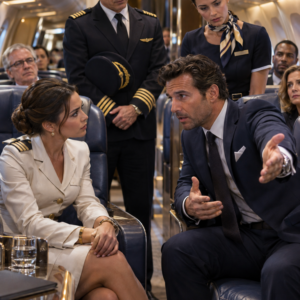
The first person to reach me when I stepped aboard the aircraft was my mother.
She wrapped her arms around me so tightly that I almost lost my balance.
“Oh, sweetheart.”
I buried my face against her shoulder.
For the first time that evening, I cried.
Not the quiet tears I had been holding back in the car.
Not the tears I had swallowed while walking through the ballroom.
These were the kind of tears that came from finally reaching a place where I didn’t have to pretend I was fine.
My mother held me while my father stood a few feet away.
Daniel Bennett had always been a quiet man.
He wasn’t someone who filled rooms with conversation or demanded attention.
He wore old sweaters, preferred repairing things himself, and believed that a perfectly good pair of shoes should never be thrown away simply because they had become unfashionable.
Tonight, however, he looked different.
He was wearing a dark suit.
His expression was controlled, but his eyes were red.
“Come here, sweetheart.”
I stepped away from my mother and went into his arms.
He kissed the top of my head.
Then he looked at me.
“Did he hurt you?”
I shook my head.
“Not physically.”
My father’s jaw tightened.
“That wasn’t what I asked.”
I understood.
He wasn’t asking whether Andrew had hit me.
He was asking whether the man I had married had broken something inside me.
I looked down.
“Yes.”
My father closed his eyes briefly.
Then he nodded.
“All right.”
That was all.
No threats.
No promises to destroy Andrew.
No dramatic declarations.
Just two simple words.
All right.
And somehow, I felt safer than I had in months.
My mother guided me toward a seat.
There was a blanket folded beside it, a small table with bottled water, and a plate of food.
I hadn’t realized how hungry I was until I saw it.
“Have something,” she said.
“Mom, I can’t eat.”
“You don’t have to finish it. Just try.”
I took a few bites.
My father sat opposite me.
For several minutes, nobody spoke.
Then I remembered Thomas’s words.
“The family business?”
My father looked at my mother.
She nodded.
He leaned forward.
“I suppose there’s no point delaying it anymore.”
“Delaying what?”
He rubbed his hands together.
“Your grandfather, my father-in-law, started Bennett Medical Systems more than forty years ago.”
I nodded.
I knew that story.
My grandfather had started a small company supplying medical equipment to rural hospitals.
He had worked long hours, driven across Pennsylvania himself, and eventually built a successful regional business.
At least, that was the version I remembered.
“When your grandfather died,” my father continued, “the company was much larger than it had been when he started. Your mother and I inherited a substantial interest.”
“Yes. I remember.”
“We sold the operating business several years later. But we retained the holding company, the investment portfolio, the foundation, and several other assets.”
I frowned.
“How much did you retain?”
My father looked at my mother.
She answered.
“Enough that neither of us has needed to worry about money for a very long time.”
I gave a small, confused laugh.
“That’s not an answer.”
My father smiled faintly.
“You’re right.”
He paused.
“Your family’s holdings are worth considerably more than you think.”
I stared at him.
“How much more?”
He gave me a number.
I thought I had misunderstood.
I asked him to repeat it.
He did.
I looked at my mother.
She nodded.
For a moment, I genuinely couldn’t speak.
The number was so far removed from anything I had ever imagined that it seemed almost meaningless.
I had grown up in a farmhouse.
My father drove an old Subaru.
My mother shopped for groceries at ordinary supermarkets.
We took family vacations in rented cabins.
My parents never bought expensive clothes or talked about investments.
When I went to college, they encouraged me to apply for scholarships even though they could have paid every expense without noticing the difference.
I remembered complaining about a broken washing machine when I was seventeen.
My father had spent the weekend repairing it.
Apparently, he could have bought the entire company that manufactured it.
I looked at him.
“Why didn’t you tell me?”
My mother reached for my hand.
“Because we wanted you to have a normal childhood.”
I laughed again, but there was no humor in it.
“Mom, I thought you were just comfortable.”
“We were comfortable.”
“You arranged a private jet in less than an hour.”
My father glanced toward the window.
“The aircraft is maintained by our family office. Thomas has been working with us for years.”
“Family office?”
He nodded.
“Your grandfather established it to manage the family’s investments and charitable commitments. Your mother and I continued it after his death.”
I looked down at my hands.
I suddenly remembered the name Bennett appearing on certain documents in my grandfather’s old study.
I remembered my mother telling me that the family had investments.
I remembered my father mentioning that the medical supply company had been sold.
But I had never understood the scale of it.
And my parents had never explained.
“Does Andrew know?”
“No,” my father answered.
“Does anyone in New York know?”
“Some people know the Bennett name. Very few know the family structure.”
I looked at him.
“Why keep it secret?”
My father leaned back.
“Your grandfather spent most of his life building something. He believed money gave people choices, but he also believed it attracted people who wanted to make decisions for you.”
My mother continued.
“When you were young, people approached our family for all kinds of reasons. Some wanted investments. Some wanted favors. Some wanted access. Your grandfather didn’t want you growing up believing that every friendship had a price.”
“So you moved to Lancaster.”
“We chose to live there,” my father corrected gently. “The farmhouse belonged to your grandmother. We loved it. We wanted you to have the freedom to grow up without everyone knowing what our family owned.”
I stared at him.
“And you never thought I deserved to know?”
My mother squeezed my hand.
“We told you what mattered. We told you that you had a family, that you had choices, and that you would never have to depend on anyone who treated you badly.”
I looked away.
I remembered my father saying something similar when I first introduced him to Andrew.
At the time, I had thought he was simply being protective.
Now I wondered whether he had seen something I hadn’t.
“Did you know Andrew was having an affair?”
My mother shook her head.
“Not until tonight.”
My father looked down.
“We knew you were unhappy.”
I frowned.
“What?”
“Your mother and I noticed.”
“When?”
“Over the last year.”
I felt my chest tighten.
“Why didn’t you say anything?”
My mother answered.
“Because every time we asked how you were doing, you told us everything was fine.”
I looked at her.
She was right.
I had told them Andrew was busy.
I had told them marriage was difficult.
I had told them pregnancy made everything emotional.
I had defended him even when I was privately falling apart.
My mother continued.
“We didn’t want to make you feel that you had to choose between your marriage and your family.”
I swallowed.
“Did you see the video?”
My father nodded.
“I saw it.”
“What did you think?”
He was quiet for a moment.
“That no daughter of mine should ever have to stand in a room full of strangers and watch her husband humiliate her.”
My eyes filled again.
He reached across the table.
“Listen to me, Nora. We aren’t bringing you here because we want to make decisions for you. We aren’t going to tell you what to do with your marriage.”
He paused.
“But we will not stand by while you believe you have no options.”
I looked at him.
“Why the private aircraft?”
“Because you were upset, pregnant, and leaving a public event in the middle of the night. I wanted you somewhere safe.”
I looked toward Thomas, who was standing discreetly near the front of the cabin.
“And he works for you?”
“He’s the director of our family office.”
I stared at my father.
“You have a director of a family office?”
My mother smiled.
“Apparently, we do.”
For the first time that evening, I laughed properly.
It was small and tired, but it was real.
My father smiled too.
Then his expression became serious again.
“There’s something else you should understand.”
I waited.
“Your grandfather established a trust in your name when you were born.”
I looked at him.
“What trust?”
“A family trust. It was designed to protect your financial independence and provide for your future.”
“How much is in it?”
“That depends on the investments and the distribution schedule. Thomas can explain the structure when you’re ready.”
I shook my head.
“I don’t want money.”
“I know.”
“I don’t want to use this against Andrew.”
My father nodded.
“Good. Because that isn’t why it exists.”
My mother brushed a strand of hair away from my face.
“The trust was created so that you would always have the freedom to leave a situation that made you unhappy.”
I looked at her.
“Even a marriage?”
“Especially a marriage.”
Something in my chest loosened.
For years, I had believed that leaving Andrew would mean losing everything.
The apartment.
The lifestyle.
The future we had planned.
The financial security of raising a child in Manhattan.
I had been so afraid of losing those things that I had ignored what I was losing every day by staying.
My mother leaned closer.
“Your father and I don’t want you to make a decision because you’re frightened. We want you to make it because you understand what you deserve.”
I nodded.
“I’ve already decided.”
My father looked at me.
“About the divorce?”
“Yes.”
“Are you certain?”
I thought about Andrew’s face when he saw me watching him kiss Lila.
I thought about the irritation in his eyes.
I thought about the messages he had sent afterward.
Not one had asked whether I was safe.
Not one had asked whether the baby was okay.
He had simply demanded that I stop being dramatic.
“Yes,” I whispered.
“I’m certain.”
My father nodded.
“Then we’ll support you.”
The aircraft began its descent.
Through the window, I could see the lights of Pennsylvania.
We were heading toward a private airfield near Lancaster.
I would be staying at the farmhouse.
The same farmhouse where I had spent summers as a child.
The same kitchen where my mother made pancakes on Sunday mornings.
The same porch where my father had taught me to ride a bicycle.
Only now I knew that the quiet life I remembered had existed beside an entire world I had never been invited to see.
As we landed, my phone vibrated again.
Andrew.
I looked at the screen.
ANDREW:
Where the hell are you?
Another message appeared.
ANDREW:
I’ve been calling you for an hour.
Then:
ANDREW:
You need to come home. We have a serious problem.
I stared at the words.
My father glanced at me.
“Is that him?”
I nodded.
“Do you want to answer?”
“No.”
My mother smiled gently.
“Then don’t.”
I turned the phone off.
When we stepped out of the aircraft, a car was waiting to take us to the farmhouse.
Thomas handed my father a folder.
My father glanced through it and then passed it to me.
“What is this?”
“Your trust documents. You don’t have to read them tonight.”
I looked at the first page.
My full name was printed near the top.
Nora Elizabeth Bennett Weston.
Beneath it was the name of the family trust.
And at the bottom was a signature I recognized.
My grandfather’s.
I looked up.
“He really planned all this?”
My father nodded.
“He wanted you to have choices he didn’t have when he was young.”
I held the folder against my chest.
For the first time since the ballroom, I felt something other than pain.
I felt curiosity.
But I also felt fear.
Because if my parents had kept this much of their lives hidden, what else had I misunderstood?
And more importantly, what would Andrew do when he discovered that the woman he believed had nowhere else to go had a family he knew almost nothing about?
I didn’t have to wait long to find out.
At a.m., my phone rang again.
This time, it was my attorney.
Mara Ellison.
I answered.
“Nora?”
“Yes?”
“Your husband has just contacted my office.”
My stomach tightened.
“What did he say?”
Mara paused.
“He says he has found the envelope you left on his desk.”
I closed my eyes.
“And?”
Her voice became firm.
“He wants to know whether the divorce papers are a joke.”
I looked toward the dark fields outside the farmhouse.
“No,” I said quietly.
“They aren’t.”
—