PART 4: THE MAN WHO THOUGHT I WOULD ALWAYS COME BACK
I saw Andrew’s car before anyone told me he had arrived.
It was a black luxury sedan, the same model he had driven for the previous two years.
It turned slowly into the driveway.
I was standing near the kitchen window, holding a glass of water.
My stomach tightened.
My father was outside repairing a fence.
My mother was preparing lunch.
Neither of them had seen the car.
I put down the glass.
“Mom?”
She looked up.
“What is it?”
“Andrew’s here.”
Her expression changed immediately.
She dried her hands on a towel.
“Do you want me to ask him to leave?”
I looked through the window.
Andrew stepped out of the car.
He was wearing a dark business suit, and he carried a bouquet of white roses.
For one strange second, I remembered our wedding.
He had brought me white roses that morning.
He had told me they represented the kind of love he wanted us to have.
I looked at the flowers in his hands.
Then I remembered Lila’s red dress.
“No,” I said.
“I’ll speak to him.”
My mother studied my face.
“Are you sure?”
“Yes. But I don’t want to be alone.”
She nodded.
“Your father will come inside.”
I watched Andrew walk toward the front door.
He knocked twice.
My mother opened it.
“Good afternoon, Andrew.”
“Ruth.”
He looked past her.
“Is Nora here?”
“Yes.”
“Can I see her?”
My mother stepped aside but didn’t smile.
“She’ll decide that.”
I walked into the hallway.
Andrew looked at me.
For a moment, his expression softened.
“Nora.”
I said nothing.
He held out the flowers.
“I brought these for you.”
I looked at them.
“Why?”
He frowned.
“Because I wanted to see you.”
“That’s not an answer.”
He lowered the bouquet slightly.
“Can we talk?”
I glanced toward my mother.
She moved into the kitchen.
My father entered from the back door a moment later.
He didn’t approach Andrew.
He simply stood near the doorway.
Andrew noticed him.
“Daniel.”
“Andrew.”
The two men exchanged brief nods.
Then Andrew looked back at me.
“Can we have a private conversation?”
I shook my head.
“No.”
His jaw tightened.
“Nora, please.”
I folded my hands over my stomach.
“Say what you came to say.”
He looked around the farmhouse.
I could see him trying to understand the situation.
The old furniture.
The family photographs.
The worn wooden floors.
The ordinary kitchen.
He probably remembered my parents as the quiet people who lived in Pennsylvania and occasionally visited New York.
He had never been particularly interested in them.
When we married, he had described my father’s business as a small family operation.
He had once joked that my parents lived like people who had never heard of online shopping.
I had laughed because I hadn’t wanted to make a disagreement out of something so unimportant.
Now, standing in front of them, he looked uncomfortable.
“First,” he said, “I want to apologize.”
I waited.
“About the other night.”
I looked at him.
“Which part?”
He blinked.
“What?”
“Which part are you apologizing for? The kiss? The affair? The public humiliation? Or the fact that you looked annoyed when you saw me watching?”
He exhaled.
“Nora, it wasn’t supposed to happen like that.”
I stared at him.
“How was it supposed to happen?”
He ran a hand through his hair.
“I was going to tell you.”
“When?”
He didn’t answer.
“Before or after the baby was born?”
“Nora—”
“Before or after you introduced Lila to everyone as the woman you were kissing?”
He looked toward my father.
Then back at me.
“She and I made a mistake.”
I almost laughed.
“You keep calling it that.”
“It was a mistake.”
“How many months does a mistake last, Andrew?”
His expression changed.
I continued.
“How many hotel rooms does a mistake book? How many late-night calls does it make? How many business trips does it take before it becomes a choice?”
He looked away.
I had never seen him so uncomfortable.
For years, he had been able to end difficult conversations by raising his voice, changing the subject, or telling me I was being unreasonable.
This time, I wasn’t asking him to explain anything.
I was simply naming what had happened.
He finally looked at me.
“I never wanted to hurt you.”
“Then why did you keep doing it?”
Silence.
“Why did you let me apologize for things I hadn’t done?”
He opened his mouth.
I continued.
“Why did you tell me I was imagining things? Why did you blame my pregnancy every time I asked where you were?”
“Nora, I was under a lot of pressure.”
I looked at him.
“That is not an answer.”
He sighed.
“Work has been difficult. The company is expanding. There are investors, negotiations, expectations. I made some bad decisions.”
I felt something cold settle in my chest.
“Did you think I wasn’t under pressure?”
He stared at me.
“I was pregnant, Andrew. I was going to appointments alone because you were always busy. I was trying to prepare a home for our child while wondering whether my husband was sleeping with someone else.”
He looked down.
“I know.”
“No, you don’t.”
I stepped closer.
“You don’t know what it feels like to lie awake beside someone and wonder whether they are pretending to sleep because they don’t want to talk to you.”
His eyes lifted.
“You don’t know what it feels like to see a photograph of your husband smiling beside another woman and then spend the next morning convincing yourself there must be an innocent explanation.”
I swallowed.
“And you don’t know what it feels like to stand in a ballroom, carrying your child, and watch the person you married kiss someone else while three hundred people stare at you.”
Andrew’s face tightened.
“I didn’t know you were going to be standing there.”
I stared at him.
That was his answer.
Not that he was sorry.
Not that he regretted hurting me.
He hadn’t expected me to see.
I nodded slowly.
“That’s what I needed to hear.”
“Nora, that’s not what I meant.”
“It doesn’t matter.”
He stepped toward me.
I moved back.
He stopped.
“Please come home.”
I shook my head.
“I am home.”
He looked around the room.
“You’re upset. I understand that. But you can’t just disappear.”
“I didn’t disappear. I told you where I was through my attorney.”
“You blocked me.”
“Yes.”
“We’re married.”
“Not for much longer.”
He stared at me.
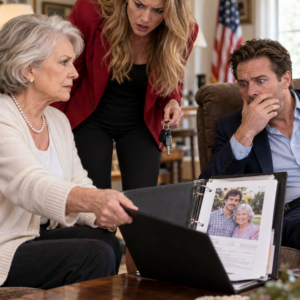
Then his eyes moved toward the folder on the side table.
“Are those the trust documents?”
I looked at the folder.
“Yes.”
He picked up the top page.
My father stepped forward.
“Put that down.”
Andrew froze.
I reached for the papers.
“They’re mine.”
Andrew released them.
He looked at my father.
“What’s going on here?”
My father remained calm.
“Your wife is making arrangements for her future.”
Andrew looked at me.
“What kind of arrangements?”
I answered.
“The kind I should have made a long time ago.”
He glanced toward Thomas’s business card on the table.
Then toward the documents.
His expression changed.
“Wait. Is this connected to the Bennett family trust?”
I didn’t answer.
He looked at my father.
“You’re involved with Bennett Holdings?”
My father nodded.
“I am.”
Andrew’s face lost some of its color.
I watched him slowly connect the pieces.
The name.
The foundation.
The aircraft.
The family office.
The wealth he had never bothered to ask about.
“How much?” he asked.
My father looked at him.
“That isn’t relevant.”
Andrew gave a short, disbelieving laugh.
“Of course it is.”
I stared at him.
“Why?”
He looked at me.
“Because you never told me.”
I shook my head.
“I told you my grandfather built a medical supply company. I told you my parents retained investments. I told you they lived in Lancaster because they liked the countryside.”
“You never told me they were worth—”
“I didn’t know the details.”
He stopped.
I continued.
“And even if I had, would it have changed anything?”
He didn’t answer.
“Would you have treated me differently?”
His silence was answer enough.
I looked at him for a long moment.
“Andrew, I never wanted you to marry my family. I wanted you to marry me.”
He rubbed his forehead.
“That’s not fair.”
“What’s not fair?”
“You made it sound as though you had nothing.”
I stared at him.
“I never said I had nothing. I said I had a family who lived quietly.”
He looked toward my father again.
“Does she control the trust?”
Thomas’s business card was still in his hand.
My father answered.
“Her trust is independent.”
Andrew looked at me.
“How much money do you have?”
I felt a strange sadness.
This was the first time in days that he had asked me a direct question.
And it wasn’t about whether I was okay.
It wasn’t about the baby.
It wasn’t about whether I had slept.
It was about money.
I shook my head.
“That is none of your concern.”
He looked frustrated.
“You’re making this unnecessarily difficult.”
I almost smiled.
There it was.
The old Andrew.
The man who could never understand why someone might refuse to make his life easier.
I stepped closer.
“You know what I find interesting?”
He waited.
“You have spent years telling me that I was lucky to have the life we built together.”
He looked away.
“You told me that I should appreciate the apartment, the holidays, the dinners, the clothes. You made it sound as though everything I had came from your generosity.”
“Nora—”
“But I was never asking for those things.”
I felt my voice become stronger.
“I wanted a husband who came home when he said he would. I wanted someone who told me the truth. I wanted someone who could look at me without making me feel foolish for trusting him.”
He was silent.
“I wanted the father of my child to be someone I could rely on.”
I looked down at my stomach.
“And you made even that feel like too much to ask.”
Andrew’s expression softened.
For the first time, he seemed to understand that I wasn’t simply angry.
I was finished.
He lowered the flowers.
“Can we try counseling?”
I shook my head.
“No.”
“Why not?”
“Because I don’t want to spend the next ten years teaching you how to respect me.”
He stared at me.
“I can change.”
“Maybe you can.”
“Then why won’t you give me a chance?”
I looked at him.
“Because you had hundreds of chances. You used every one of them to convince me that I was the problem.”
He swallowed.
Then he said something I would remember for a long time.
“I didn’t think you would actually leave.”
I nodded.
“I know.”
He frowned.
“What does that mean?”
“It means you believed I would keep forgiving you.”
I paused.
“You believed I would always be there, no matter what you did.”
He looked down.
“And you were wrong.”
For a moment, nobody spoke.
Then Andrew placed the bouquet on the table.
“I need time to think.”
I looked at him.
“You’ve had months.”
He turned toward the door.
Before leaving, he glanced back.
“What happens now?”
I answered without hesitation.
“My attorney will contact yours.”
He nodded.
Then he walked out.
I watched him cross the porch.
His car pulled away.
My mother came into the room.
She looked at me.
“Are you all right?”
I nodded.
Then I began to cry.
Not because I wanted him back.
Because I had finally said everything I had been afraid to say.
My mother wrapped her arms around me.
My father stood nearby.
Neither of them tried to make me stop crying.
After a while, my father spoke.
“There’s something else you should know.”
I wiped my cheeks.
“What?”
He hesitated.
“The Bright Horizons Foundation has been reviewing its sponsorship arrangements.”
I looked at him.
“What does that have to do with Andrew?”
“Nothing that should affect your divorce. But his company has been hoping to secure a larger partnership with the foundation.”
I frowned.
“Because of the gala?”
“Partly.”
“Are you going to cancel it?”
My father shook his head.
“No. I won’t use the foundation to punish someone because he hurt my daughter.”
I felt relieved.
“But,” he continued, “the foundation has a responsibility to maintain its own standards. The trustees will make their decisions independently.”
I nodded.
“Good.”
He smiled.
“Your grandfather would have approved.”
That evening, I received another message.
It was from Andrew.
ANDREW:
I didn’t know you were this unhappy.
I read it once.
Then again.
For some reason, that sentence hurt more than his earlier apologies.
He didn’t know.
Or perhaps he hadn’t wanted to know.
I typed a response.
I TRIED TO TELL YOU.
I sent it.
Then I put my phone down.
For the first time, I didn’t feel the need to explain myself further.
—