CHAPTER 3: THE WARNING FROM A WOMAN WHO HAD ALREADY LOST ONE SON
“Aaron, listen to me. Your father knows the baby has been born.”
My mother-in-law’s voice came through the telephone like the last words of someone standing on the edge of a cliff.
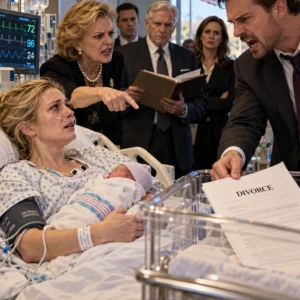
I was lying in a hospital bed, exhausted from giving birth, with a fresh incision in my abdomen and our newborn son sleeping against my chest.
Aaron stood beside me, his face drained of color.
“What does Dad have to do with this?” he demanded.
“More than you know.”
“Mom, you just told me Michael is alive.”
“I know.”
“And now you’re telling me someone wants to take my son?”
“I’m telling you not to trust anyone who arrives claiming they’re acting on behalf of the Barlow family.”
I stared at the telephone.
“Who are the Barlows?” I asked.
There was a long silence.
Then Evelyn, my mother-in-law, answered in a voice so fragile it barely sounded like hers.
“They’re the people who raised Michael.”
Aaron gripped the back of a chair.
“You know who raised him?”
“Yes.”
“How long have you known?”
His mother began crying.
“Aaron, please—”
“How long?”
“Almost fifteen years.”
The words struck him visibly.
He took a step backward.
I watched the man I’d loved for eight years struggle to understand that his mother had concealed something enormous.
For years, he had believed his twin brother died shortly after birth.
Now he was learning that the boy had survived, had been raised by another family, and had somehow become connected to our newborn son.
“Why didn’t you tell me?” Aaron whispered.
Evelyn sobbed.
“Because your father threatened to destroy everything if I did.”
I felt cold.
Aaron’s father, Richard, was a stern man who had never approved of my husband’s choices.
He was successful, respected in the community, and obsessed with maintaining the appearance of a perfect family.
But I’d never imagined he could be connected to something like this.
“What exactly did he threaten?” I asked.
Evelyn hesitated.
Then she said, “He told me that if I contacted Michael again, he’d make certain I never saw Aaron or my grandchildren.”
Aaron’s jaw tightened.
“Mom, that’s not something he gets to decide.”
“I know that now.”
I looked down at our baby.
He was sleeping peacefully, his tiny fingers curled against my hospital gown.
We had named him Noah.
After four daughters, Aaron had finally welcomed the boy he’d wanted so desperately.
Yet instead of celebrating, he was standing beside me confronting a secret that had followed his family for nearly forty years.
“Evelyn,” I said quietly, “how did you know Noah has the birthmark?”
She didn’t answer immediately.
Then she whispered, “A woman from the hospital sent me a photograph.”
My stomach tightened.
“What woman?”
“A nurse who used to work with your grandmother.”
Aaron stared at the phone.
“Mom, why would a nurse send you a picture of our newborn without asking us?”
“I didn’t ask her to. She recognized the mark because I once showed her the old photograph of the twins. She sent it because she thought I would want to know.”
I looked at Aaron.
His expression hardened.
A photograph of our son had been shared without our permission.
And somehow, within hours of his birth, people we didn’t know were already discussing him.
“Who else received that photograph?” I asked.
Evelyn’s breathing became unsteady.
“I don’t know.”
I closed my eyes.
For the first time since delivering Noah, I felt genuinely afraid.
Not because of the birthmark itself.
A crescent-shaped mark could be nothing more than a family characteristic.
But because someone had turned that small mark into a signal.
A way of identifying my child.
A reason to contact people who had apparently spent decades hiding terrible secrets.
Aaron looked toward the hospital door.
Then he asked, “What does Michael’s family want with Noah?”
Evelyn was silent.
Finally, she whispered:
“They believe your baby is the key to proving who Michael really is.”
I frowned.
“Proving what?”
“That he was stolen.”
Aaron shut his eyes.
His mother continued.
“And there’s money involved. A great deal of money.”
I felt my stomach drop.
“How much?”
Evelyn took a shaky breath.
“More than twenty million dollars.”
The room became impossibly quiet.
Then she said something that frightened me more than the amount.
“Your father has been waiting for a grandson for years, Aaron. But not for the reason you think.”
Aaron opened his eyes.
“What reason?”
Evelyn began crying.
“Because of a trust your grandfather established before you were born.”
I looked toward our sleeping son.
A trust.
A hidden twin.
A stolen child.
And my husband’s lifelong determination to have a boy.
Suddenly, details from our marriage began moving through my thoughts.
Richard’s disappointment after the birth of our first daughter.
His barely concealed frustration when our second daughter arrived.
The time he refused to attend our third daughter’s first birthday because, as he put it, “There isn’t much point celebrating another girl when the family name is dying out.”
I’d thought he was simply old-fashioned and cruel.
Now I wondered whether his obsession had something to do with money.
Aaron spoke again.
“Mom, start at the beginning.”
Evelyn exhaled.
“Your grandfather owned a manufacturing company. When he died, he left a family trust with provisions concerning the next generation.”
I frowned.
“What provisions?”
“Part of the trust was intended to support all his descendants. But a separate controlling interest was reserved for a particular branch of the family. Richard interpreted the documents as requiring a male descendant.”
Aaron stared at the phone.
“That’s why Dad kept talking about a son?”
Evelyn sobbed.
“He told me the family needed one.”
I gripped Noah more tightly.
For eight years, I’d listened to Aaron talk about wanting a boy.
I’d endured five pregnancies.
Four difficult recoveries.
The strain of raising young children.
And the constant feeling that my daughters were wonderful, but somehow not quite enough.
Now I was learning that the pressure might have begun long before my husband became a father.
Aaron looked at me.
I could see the realization forming in his eyes.
“Claire…”
I didn’t answer.
Because I had a terrible question.
“Evelyn,” I whispered, “was Richard hoping we’d have a son because of the inheritance?”
She hesitated.
“I believe so.”
My eyes filled.
Then Aaron asked, “And Michael?”
His mother’s voice became nearly inaudible.
“Michael was the child Richard gave away.”
The words seemed to drain every bit of air from the room.
Aaron stood motionless.
“What?”
Evelyn began crying harder.
“Your brother didn’t die. Your father arranged for him to be adopted by Conrad and Helena Barlow.”
Aaron stared.
“Why would he do that?”
“Because your grandfather’s company was failing, and Richard owed Conrad Barlow money.”
I felt sick.
“You’re saying he gave away his son to settle a debt?”
“That’s what I later discovered.”
Aaron slowly sat down.
I had never seen him look so devastated.
For years, he had carried the memory of a twin brother he believed was dead.
He had imagined growing up with him.
He had wondered whether they’d have looked alike.
Whether they’d have shared interests.
Whether they’d have been best friends.
Now he was learning that Michael had lived an entire life somewhere else.
And that their father had been responsible for separating them.
Aaron’s voice broke.
“Mom, where is he?”
Evelyn hesitated.
“That’s what I’m trying to tell you.”
“Where is Michael?”
There was a pause.
Then she whispered:
“He’s in the same hospital as Noah.”
I stopped breathing.
“What?”
Evelyn continued.
“He works there.”
Aaron rose so quickly that the chair struck the wall.
“What’s his name?”
“Dr. Michael Barlow.”
My heart began pounding.
Because I knew that name.
I’d seen it printed on a badge earlier that morning.
A tall physician with dark hair and kind brown eyes had come into my room shortly after delivery.
He’d examined Noah briefly as part of the newborn care team.
He’d smiled at me.
Congratulated us.
And told me our little boy looked perfectly healthy.
Then he’d looked at the birthmark beneath Noah’s ear.
And his expression had changed.
I’d noticed it.
But I’d been too exhausted to ask why.
Now I remembered every detail.
The moment his fingers paused.
The way he looked at Aaron.
The quiet question he’d asked before leaving.
“Does your family have a history of twins?”
Aaron had laughed and said yes.
The physician had nodded.
Then he’d left.
I stared at my husband.
“Aaron…”
He looked at me.
“I’ve already met him.”
His face went white.
“What?”
I swallowed.
“Dr. Michael Barlow examined Noah this morning.”
Aaron stared.
Then my telephone began ringing.
An unfamiliar number appeared on the screen.
I answered with shaking hands.
“Hello?”
A man’s voice spoke.
“Mrs. Bennett?”
“Yes.”
“My name is Dr. Michael Barlow.”
I stopped breathing.
“I believe we met earlier today.”
I looked at Aaron.
He stood completely still.
Michael continued.
“I’m sorry to contact you directly. I asked the charge nurse to confirm whether you’d be comfortable speaking with me, and she said you’d requested information about my visit.”
I glanced toward the doorway.
We had indeed asked the nurse to return with his name after Evelyn mentioned the Barlows.
Michael’s voice grew quieter.
“Mrs. Bennett, there’s something I need to discuss with you and your husband.”
I swallowed.
“What?”
He hesitated.
Then he said:
“I believe your husband is my twin brother. And there’s something your father-in-law has been doing for years that both of you need to know.”
CHAPTER 4: THE DOCTOR WHO LOOKED EXACTLY LIKE MY HUSBAND—AND THE SECRET THAT DESTROYED TWO FAMILIES
When Michael Barlow walked into our hospital room, I felt as though I were looking at my husband twenty years in the future.
The resemblance was extraordinary.
The same dark eyebrows.
The same sharp cheekbones.
The same deep-set brown eyes.
Even the way he moved reminded me of Aaron.
But there were differences.
Michael wore his hair shorter.
His expression was more reserved.
And he carried himself with the quiet confidence of someone accustomed to calming frightened families.
Aaron stood beside the window.
For several seconds, neither man spoke.
Then Michael smiled faintly.
“Hello, Aaron.”
My husband stared at him.
“You look…”
He stopped.
Michael nodded.
“I know.”
Aaron swallowed.
“Like me.”
Michael gave a sad little laugh.
“That’s what my wife said when she first saw your photograph.”
I looked at him.
“You have a wife?”
He nodded.
“Yes. Her name is Rachel.”
Aaron sat down slowly.
“And children?”
Michael’s smile faded slightly.
“One daughter. She’s twelve.”
I glanced toward Noah.
For the first time, I understood how enormous this moment was.
My husband was meeting the brother he’d spent his whole life believing was dead.
A brother who had become a doctor.
A husband.
A father.
A stranger who looked almost exactly like him.
Aaron finally spoke.
“Did you know about me?”
Michael nodded.
“For several years.”
Aaron’s expression tightened.
“Why didn’t you contact me?”
Michael looked down.
“Because I was told you knew about the adoption and didn’t want to meet me.”
My husband went completely still.
“Who told you that?”
Michael took a slow breath.
“Richard.”
I closed my eyes.
Of course.
Aaron’s father had not merely separated his sons.
He had apparently spent decades controlling the truth each one heard about the other.
Michael continued.
“I contacted him after I found my original adoption records.”
“When?”
“Seven years ago.”
Aaron stared.
“Seven years?”
Michael nodded.
“I wanted to know where I came from. My adoptive mother had always been honest about the adoption, but she didn’t know the circumstances.”
He looked toward the floor.
“When I discovered that I had a twin brother, I thought I’d finally found the missing part of my life.”
His voice broke.
“I called Richard. He agreed to meet me.”
Aaron clenched his jaw.
“What happened?”
Michael swallowed.
“He told me you had grown up knowing I existed. He said you’d chosen not to contact me because you considered me an embarrassment.”
Aaron shook his head.
“No.”
“I know that now.”
“I didn’t even know you were alive.”
Michael’s eyes filled.
For a moment, neither spoke.
Then Aaron whispered:
“I thought you died.”
Michael closed his eyes.
“I know.”
My husband stood.
He took one uncertain step toward his brother.
Then another.
And suddenly, the two men embraced.
I began crying.
They held each other as though they were afraid one of them might disappear.
I looked down at Noah.
He stirred in his blanket, completely unaware that his tiny birthmark had helped bring two brothers into the same room after nearly forty years apart.
Michael stepped back.
His eyes were red.
“I used to wonder what you were like,” he whispered.
Aaron laughed through tears.
“I’m not that interesting.”
Michael smiled.
“My daughter might disagree.”
Aaron’s face softened.
“I’d like to meet her.”
Michael nodded.
“I think she’d love that.”
For a moment, the room felt lighter.
Then Michael’s expression changed.
“There’s something else.”
Aaron looked at him.
“What?”
Michael glanced toward me.
“Claire, I need to ask you a question.”
I nodded.
“Of course.”
“Has Richard ever suggested that your daughters are less important than your son?”
My stomach tightened.
Aaron looked down.
I swallowed.
“Yes.”
Michael closed his eyes.
“I was afraid of that.”
I stared.
“Why?”
He pulled a chair beside my bed.
Then he took a folder from his briefcase.
“Because I’ve spent the last three years trying to understand a trust established by our grandfather.”
Aaron frowned.
“Mom mentioned it.”
Michael nodded.
“Richard has been telling people that the trust requires a male heir.”
I looked toward Noah.
“And does it?”
Michael shook his head.
“Not in the way he claims.”
Aaron stared.
“What does that mean?”
Michael opened the folder.
“The trust was written almost forty years ago. It established educational funds, family support provisions, and ownership interests in the manufacturing company.”
He pointed toward a paragraph.
“The language includes all legally recognized descendants.”
I frowned.
“Then why does Richard keep talking about a boy?”
Michael looked at Aaron.
“Because he controls the trust’s administration, and he has spent years misrepresenting its terms.”
Aaron’s face hardened.
“Why?”
Michael hesitated.
“Because when the trust is properly administered, it benefits both of us and our children.”
I stared.
“All our children?”
Michael nodded.
“Yes.”
“Even the girls?”
He looked almost offended by the question.
“Of course the girls.”
I felt tears burning my eyes.
For years, Aaron’s father had treated my daughters as though their births were disappointments.
He barely remembered their birthdays.
He rarely attended their school events.
When our eldest, Grace, won a reading competition, he sent a short message.
Good job. Perhaps the next one will be a boy.
I’d never forgotten it.
Now I was learning that his treatment of them might have been connected to deliberate financial deception.
Michael continued.
“Richard knew that if the trust’s full records were examined, his decisions would be questioned.”
Aaron frowned.
“What decisions?”
Michael turned another page.
“Large withdrawals. Transfers between companies. Loans secured against assets that may not have been his to pledge.”
My stomach tightened.
“How large?”
Michael looked at us.
“Millions.”
Aaron sat down.
“You’re saying Dad stole money from the trust?”
“I’m saying the records raise serious questions that need an independent audit.”
I studied his expression.
He didn’t seem interested in creating a scandal.
He seemed frightened.
Almost ashamed.
I asked, “Why would he want our baby?”
Michael looked toward Noah.
“Because Richard believes Noah’s birth gives him an opportunity to restructure the trust.”
I frowned.
“How?”
“He’s preparing documents that would appoint a male descendant as the future family representative, with Richard serving as guardian of those interests while the child is a minor.”
Aaron stared.
“That’s absurd.”
Michael nodded.
“Yes.”
I gripped the blanket.
“And he thinks he can just use Noah’s name?”
“He can try to persuade you to sign documents. He can pressure you. But he cannot simply take control of your child or his rights.”
I took a shaky breath.
Then Michael added:
“And that’s why I came. I wanted to make certain neither of you signed anything without independent legal advice.”
I looked toward Aaron.
He was staring at the folder.
For the first time, I saw something other than fear in his face.
Shame.
He looked at me.
“Claire…”
I didn’t answer.
Because another realization was forming.
My husband had spent eight years wanting a son.
His father had spent decades insisting the family needed a male heir.
And I had endured five pregnancies while trying to satisfy a dream that had never been entirely ours.
I looked at Michael.
“Did Richard ever tell Aaron about the trust?”
Michael shook his head.
“Not fully.”
Then he said something I hadn’t expected.
“I think Richard wanted Aaron to believe having a son was the most important thing he could ever accomplish.”
Aaron closed his eyes.
I stared at my husband.
For years, I’d quietly wondered whether our daughters would always feel second-best.
Now, watching him confront the source of that belief, I realized we had finally reached the moment when he would have to decide what kind of father he wanted to be.
But before either of us could speak, Michael’s telephone vibrated.
He glanced at the screen.
His expression changed.
He looked toward Aaron.
“It’s my wife.”
He answered.
“Rachel?”
A woman’s frantic voice filled the room.
“Michael, your father is here.”
Michael went still.
“What?”
“Conrad. He’s standing outside the house with two men.”
My stomach tightened.
Michael stood.
“What does he want?”
Rachel’s voice shook.
“He says he’s going to the hospital.”
Michael looked toward Noah.
Then his wife said something that made him close his eyes.
“He has a copy of the baby’s birth certificate. And he’s carrying legal documents naming himself as the child’s emergency guardian.”
CHAPTER 5: THE TWO GRANDFATHERS WHO TRIED TO CLAIM OUR BABY—AND THE DOCUMENTS I REFUSED TO SIGN
By noon, two different men were trying to make decisions about my newborn son, and neither of them had asked me what I wanted.
I looked at Michael.
“Emergency guardian?”
He nodded grimly.
“That’s what Rachel said.”
I felt anger rise through my exhaustion.
“Who exactly is Conrad Barlow?”
Michael closed his eyes.
“The man who raised me.”
“And he thinks that makes him Noah’s grandfather?”
“I’m afraid he believes it gives him certain rights.”
Aaron looked furious.
“He’s never even met our baby.”
“I know.”
“Then how does he have a birth certificate?”
Michael’s expression darkened.
“That’s what I intend to find out.”
He turned toward the door.
But I stopped him.
“Michael.”
He looked back.
“Please don’t leave without explaining something.”
He hesitated.
“What?”
“You said your father Richard gave you away to Conrad Barlow. Did Conrad know you had been taken from your family?”
Michael looked down.
“Yes.”
The answer made my stomach twist.
“He knew?”
Michael nodded.
“I found out three years ago.”
Aaron stared at him.
“Why didn’t you report it?”
“I did speak to an attorney. But by then, the original records were decades old, and the adoption itself had been finalized through the courts.”
He rubbed his forehead.
“Conrad claimed Richard had consented to the placement because he couldn’t support both babies.”
Aaron looked sick.
“Our parents weren’t poor.”
“That’s what I eventually discovered.”
Michael continued.
“Conrad told me our father received business financing in exchange for arranging my adoption. He insisted the transaction was legitimate.”
I stared at him.
“An adoption isn’t something you exchange for a loan.”
“I know.”
His voice broke.
“I spent years trying to untangle what really happened.”
For a moment, I saw the little boy beneath the accomplished physician.
A child who had grown up wondering why his biological family hadn’t wanted him.
A child who eventually discovered he had a twin brother.
And a child who was now being confronted with the possibility that both families had used him as part of a financial arrangement.
Michael glanced toward his telephone.
“I need to make sure Rachel and Ava are safe.”
I nodded.
“Of course.”
Before leaving, he looked at Aaron.
“I’d like to come back.”
My husband nodded immediately.
“So would I.”
Michael smiled sadly.
Then he looked at me.
“Claire, I know we met under terrible circumstances.”
I gave a tired smile.
“That’s an understatement.”
He laughed softly.
“But I’m glad I found you.”
I looked down at Noah.
“I’m glad you did, too.”
Michael stepped into the hallway.
Then Aaron turned toward me.
For a long moment, he simply stood there.
Finally, he whispered, “I’m sorry.”
I looked up.
“For what?”
He sat beside my bed.
“For all of it.”
I studied his face.
“Aaron…”
He swallowed.
“I’ve spent years telling you I needed a son.”
I remained silent.
He looked toward Noah.
“And I never stopped to consider what that sounded like to you.”
My eyes filled.
“Do you know what it felt like?”
He shook his head.
I took a breath.
“It felt like our daughters were wonderful, but somehow they weren’t enough.”
His face crumpled.
“I never meant that.”
“I know you love them.”
“More than anything.”
“But you kept saying the next baby would be the one who completed our family.”
He closed his eyes.
I continued.
“Grace heard you once.”
Aaron looked up sharply.
“What?”
“After Nora was born. You were speaking to your father on the phone. You said you hoped we’d have better luck next time.”
His expression changed.
I swallowed.
“Grace asked me whether having a girl was bad luck.”
Aaron covered his face.
I watched him struggle with the words.
Then I said something I’d been holding back for years.
“Our daughters didn’t arrive as failed attempts to have a son, Aaron. They arrived as people.”
He began crying.
“I know.”
I looked at Noah.
“And this baby isn’t a prize you finally won.”
Aaron reached for my hand.
“He’s our son.”
“Yes.”
I squeezed his fingers.
“Just as Grace, Lily, Nora, and Poppy are our daughters.”
He nodded.
Tears rolled down his cheeks.
“I’ve been an idiot.”
I almost laughed.
“Not always.”
He looked at me.
“Enough.”
For several seconds, we sat quietly.
Then Aaron whispered, “I think I spent my entire life trying to make Dad proud.”
I looked at him.
He continued.
“Nothing was ever good enough. My grades. My job. Our house. Every time I accomplished something, he had another expectation.”
I nodded.
“And the son?”
Aaron closed his eyes.
“That was the one thing he kept saying would make me a real man.”
I felt a deep sadness.
Aaron was a loving father in so many ways.
He made pancakes with the girls every Sunday.
He attended school plays.
He built blanket forts in the living room.
He braided hair terribly but enthusiastically.
Yet somewhere inside him was a boy who still believed his father’s approval had to be earned.
I squeezed his hand.
“Aaron, your father doesn’t get to decide what kind of man you are.”
He nodded.
I looked down at Noah.
“And our children shouldn’t have to spend their lives trying to win your approval, either.”
He began crying harder.
Then he leaned forward and kissed my forehead.
“I’m going to do better.”
I wanted to believe him.
But after eight years, I knew promises mattered less than what came afterward.
So I simply said, “I hope so.”
The hospital’s patient advocate arrived shortly after lunch.
Her name was Denise Walker.
She was a tall woman in her fifties with a calm, professional manner.
She sat beside my bed.
“Mrs. Bennett, I understand you have concerns about a photograph of your newborn being shared without your permission.”
“Yes.”
“And about someone obtaining access to his personal information?”
“Yes.”
I explained everything.
The birthmark.
Evelyn’s call.
Michael’s visit.
The photograph.
Conrad Barlow’s alleged guardianship documents.
Denise listened carefully.
Then she said, “First, I want you to know that no outside family member can simply arrive at the hospital and take custody of your child because they claim to have paperwork.”
I felt my shoulders relax slightly.
“We’d verify any legitimate legal order through the appropriate channels,” she continued. “And a private document naming someone an emergency guardian doesn’t automatically override your parental rights.”
Aaron nodded.
“Good.”
Denise turned toward me.
“We’ll also review who accessed your son’s information and whether any unauthorized disclosure occurred.”
I swallowed.
“Can you restrict visitors?”
“Of course. You can identify who is permitted to visit, and we’ll work with our security team and medical staff.”
I looked at Aaron.
He nodded.
I gave Denise the names.
Only Aaron.
Evelyn, once we’d spoken to her.
And Michael, if he returned.
No Richard.
No Conrad.
No unknown attorneys.
Nobody else.
Denise recorded my wishes.
Then she asked something I hadn’t considered.
“Mrs. Bennett, would you like to speak privately, without your husband or other relatives present?”
Aaron looked surprised.
But he immediately stood.
“Of course.”
He stepped into the hallway.
I watched the door close.
Denise waited.
Then she asked, “Do you feel safe?”
The question caught me off guard.
I stared at her.
“With Aaron?”
“With your husband, your family, and the decisions being made around you.”
I looked down at Noah.
For several seconds, I considered the answer.
I wasn’t afraid Aaron would hurt me.
But I had spent years feeling pressured to become pregnant again.
I’d ignored my exhaustion.
I’d told myself that wanting to make him happy was simply part of marriage.
Now, lying in a hospital bed after a difficult fifth delivery, I wondered whether I’d allowed his dream to become more important than my health.
“I feel safe with him,” I said slowly.
Denise nodded.
“But?”
I looked up.
“I don’t always feel heard.”
She waited.
I swallowed.
“After our fourth daughter, I wanted to stop having children. Aaron said he understood, but he kept bringing up the possibility of trying one more time.”
Denise listened without judgment.
“I eventually agreed.”
I looked down.
“I’m happy Noah is here. I love him. But sometimes I wonder whether I would have chosen another pregnancy if nobody had been hoping for a boy.”
Denise’s expression softened.
“That’s an important question.”
I nodded.
She continued.
“You have the right to make decisions about your health and future pregnancies without pressure. If you’d like, I can arrange for someone from your care team to discuss your options when you’re feeling stronger.”
I took a slow breath.
“Yes, please.”
When Aaron returned, I told him what we’d discussed.
He listened.
For once, he didn’t interrupt.
Then he said quietly, “I never want you to feel pressured to have another baby.”
I looked at him.
“I need you to mean that.”
“I do.”
He took my hand.
“We have five children, Claire. Five beautiful children.”
I smiled faintly.
“And no more promises about needing another one?”
He shook his head.
“No more.”
Then he looked down at Noah.
“Our family was complete before he arrived. I was just too busy chasing Dad’s approval to see it.”
For the first time since the birth, I felt a small piece of the tension leave my body.
At four that afternoon, Richard Bennett arrived at the hospital.
We knew because security called our room.
Aaron answered.
He listened for several seconds.
Then his expression hardened.
“No. He’s not authorized to visit.”
A pause.
“I understand he’s my father. That doesn’t change anything.”
He ended the call.
I looked at him.
“What happened?”
“Dad brought an attorney.”
My stomach tightened.
“What does he want?”
Aaron gave a bitter laugh.
“He says he has important family documents for us to sign before Noah is discharged.”
I closed my eyes.
“Of course he does.”
Then Aaron’s telephone rang.
Richard.
My husband stared at the screen.
Finally, he answered on speaker.
“Dad.”
“Aaron, I’ve been trying to reach you.”
“I know.”
“I understand you’ve spoken to Michael.”
Aaron’s face changed.
“How do you know?”
Richard ignored the question.
“Son, listen carefully. That man has spent years trying to interfere with this family.”
“That man is my brother.”
A long silence followed.
Then Richard said coldly, “He’s a Barlow.”
Aaron gripped the telephone.
“He’s your son.”
Richard didn’t answer.
My husband continued.
“You told me he died.”
“That was a complicated situation.”
“You let me mourn him.”
“Aaron, I did what was necessary.”
I felt a chill.
Necessary.
The same word people used when they didn’t want to admit something had been cruel.
Aaron’s voice became dangerously quiet.
“You gave away your son.”
Richard snapped, “I saved this family!”
I stared at the phone.
Aaron stood.
“By selling my brother?”
“Watch your language.”
“Tell me I’m wrong.”
Richard was silent.
Then he said, “Your grandfather’s company would have collapsed. Hundreds of people would have lost their jobs. Conrad provided the financing we needed.”
I closed my eyes.
There it was.
Not grief.
Not necessity in the way Richard wanted us to understand it.
A business arrangement.
A child placed into another family while money changed hands.
Aaron’s voice broke.
“You could have asked for help.”
Richard laughed bitterly.
“From whom? We were drowning.”
“You could have told the truth.”
“You were too young to understand.”
Aaron stared at the telephone.
“I’m almost forty now.”
His father said nothing.
Then Aaron continued.
“And I understand one thing perfectly.”
“What?”
“A family that survives by sacrificing one of its children hasn’t been saved.”
Richard inhaled sharply.
“Aaron, don’t be foolish. There are millions of dollars at stake.”
I leaned toward the phone.
“Richard, this is Claire.”
A pause.
“Claire. Congratulations on the boy.”
I felt my stomach twist.
Not congratulations on the baby.
Not how are you feeling after surgery?
Just the boy.
I looked at Noah.
Then I said, “We’re not signing anything.”
Richard’s voice hardened.
“You don’t understand the financial implications.”
“I understand that my newborn son is not a business instrument.”
“Claire—”
“And neither are my daughters.”
He sighed impatiently.
“I’m not discussing this with you while you’re emotional.”
Something inside me went very still.
For years, I’d been careful around Richard.
Polite.
Patient.
Always trying to keep family gatherings peaceful.
But I was exhausted.
I had just given birth.
And I was finished being spoken to as though my only contribution to the family was producing children.
“Then perhaps you should discuss it with our attorney,” I replied.
Richard went quiet.
Finally, he said, “You’ll regret making enemies of your own family.”
I looked at Aaron.
He nodded.
So I answered:
“Richard, anyone who tries to use my children as bargaining chips has already made themselves my enemy.”
I ended the call.
Aaron stared at me.
Then he smiled.
Not because anything was funny.
But because for the first time, we were standing on the same side of the problem.
He leaned over and kissed my forehead.
“That was amazing.”
I smiled tiredly.
“Good. Now could you please get me some water?”
He laughed.
“Absolutely.”
That evening, Michael returned.
He looked exhausted.
But he was no longer alone.
Beside him stood a woman with shoulder-length brown hair and kind gray eyes.
She carried a small bag and wore a worried expression.
“Claire,” Michael said, “this is my wife, Rachel.”
I smiled.
“Hello.”
Rachel came toward my bed.
“I hope we’re not intruding.”
“Not at all.”
She glanced toward Noah.
Her expression softened.
“Oh, he’s beautiful.”
I smiled.
“Thank you.”
Michael stood beside Aaron.
For a moment, the resemblance between the brothers seemed almost impossible.
Rachel noticed my expression.
She gave a tired laugh.
“I know. The first time I saw Aaron’s photograph, I thought Michael had been using an old picture of himself.”
Aaron smiled faintly.
Then Michael became serious.
“Conrad has backed off for now.”
I exhaled.
“Thank goodness.”
“But there’s something you need to see.”
He placed a folder on the table.
Inside were copies of legal correspondence.
One document concerned the family trust.
Another contained a proposed amendment.
And the third was a letter from the trust’s former administrator.
Michael looked at Aaron.
“I found this last week.”
Aaron opened the letter.
His face changed.
I leaned closer.
At the top was the name of their grandmother.
HELEN BENNETT.
Aaron frowned.
“Grandma Helen?”
Michael nodded.
“She created the trust’s original structure. Richard has been claiming for decades that the family fortune must pass through a male descendant.”
I looked at him.
“Yes?”
Michael’s voice trembled slightly.
“That’s not what Helen wrote.”
He turned the letter toward us.
I read the first paragraph.
To my sons, daughters, and the generations who follow:
I have spent my life watching women build the foundations of businesses and families while men receive the credit.
The legacy I leave must never be used to repeat that injustice.
My heart quickened.
Michael looked at Aaron.
“There’s a separate trust provision.”
Aaron swallowed.
“For whom?”
Michael took a slow breath.
Then he looked at me.
“For the eldest four daughters born into the next generation of our family.”
I stopped breathing.
“What?”
Michael nodded.
“Claire, your girls are named beneficiaries under a provision your father-in-law never told you about.”
Aaron stared at the document.
“Grace?”
“Yes.”
“Lily?”
“Yes.”
“Nora and Poppy?”
Michael nodded.
“All four.”
I covered my mouth.
For years, Richard had treated my daughters as disappointments.
Now I was being told they might be connected to the very inheritance he claimed required a son.
Michael continued.
“And Claire, there’s something else.”
My stomach tightened.
“What?”
He looked directly at me.
“Richard didn’t need Noah to unlock the money.”
I stared.
“Then why was he so desperate for a grandson?”
Michael’s expression darkened.
“Because he needed someone to replace the daughters whose inheritance he’s already been spending.”
CHAPTER 6: THE FOUR DAUGHTERS HE CALLED DISAPPOINTMENTS WERE THE ONES WHO ACTUALLY OWNED THE FORTUNE
“My daughters have an inheritance?”
I looked from Michael to Aaron.
Neither answered immediately.
Then Michael nodded.
“Yes.”
I shook my head.
“But they’re children.”
“That doesn’t prevent them from being beneficiaries of a trust.”
I looked down at the document.
The language was dense.
Full of legal expressions and references I didn’t understand.
But four names were unmistakable.
Grace Bennett.
Lily Bennett.
Nora Bennett.
Penelope Bennett.
Poppy’s full legal name.
All four appeared in a schedule attached to the trust records.
I stared at them.
For years, Richard had barely acknowledged my daughters.
He referred to them collectively as “the girls,” sometimes struggling to remember which one was which.
Yet their names appeared in a document connected to the family fortune.
“How much?” I whispered.
Michael hesitated.
“We need a full accounting.”
I looked at him.
“How much was supposed to belong to them?”
He took a breath.
“The trust’s assets were valued at approximately thirty-two million dollars during the last complete accounting we located.”
My mouth went dry.
“Thirty-two million?”
“That’s the value of the trust’s holdings at that time, not necessarily the amount available to your daughters.”
Aaron leaned forward.
“What did Grandma Helen actually leave?”
Michael turned to another page.
“She established a general family trust, with income available for several purposes. But she also created a separate legacy fund for descendants who qualified under particular provisions.”
I frowned.
“Why the daughters?”
Michael smiled sadly.
“Because Helen spent forty years running the family’s manufacturing business while the men took credit.”
Aaron stared.
“What?”
His brother nodded.
“The original patents, supplier relationships, and much of the early company financing came from Helen.”
Aaron looked stunned.
“Dad always said Grandpa founded everything.”
“Grandpa registered the company,” Michael replied. “But Helen built much of the operation.”
I looked at the letter again.
The handwriting was elegant.
But the words were firm.
No girl born into this family should ever grow up believing that she must become a boy to deserve a place at the table.
My throat tightened.
I read the sentence aloud.
Aaron covered his face.
For a long moment, he didn’t speak.
Then he whispered, “She knew.”
Michael nodded.
“She understood exactly what the men in this family were like.”
I thought of Grace asking whether being a girl was bad luck.
Of Lily announcing one day that she wanted to be a firefighter, only to have Richard tell her that was a man’s job.
Of Nora drawing a picture of herself flying an airplane and being told to choose something more ladylike.
Of little Poppy, barely old enough to talk, receiving a disappointed sigh instead of excitement when we announced her birth.
I felt tears sliding down my cheeks.
“Your grandmother understood them better than I did.”
Michael looked at me gently.
“Claire, none of that was your daughters’ fault.”
“I know.”
But I couldn’t stop crying.
Because somewhere inside, I’d allowed Richard’s disappointment and Aaron’s longing to make me question whether I was giving my family what it needed.
Now I was reading words from a woman who had died before I joined the family.
A woman who seemed to have understood the importance of protecting girls long before anyone told her my daughters would exist.
I touched the paper.
“She made sure they would have something that couldn’t be taken away just because they weren’t boys.”
Michael nodded.
“That was her intention.”
But the financial records were much uglier.
Michael opened another section of the folder.
“These withdrawals were authorized under Richard’s control of trust administration.”
Aaron frowned.
“What withdrawals?”
Michael pointed toward several entries.
A company loan.
A consulting payment.
An investment transfer.
A property acquisition.
The amounts were enormous.
Hundreds of thousands of dollars.
Sometimes more.
“What is this?” Aaron asked.
“Money moved into companies Richard controls or has interests in.”
I stared at the pages.
“Was he allowed to do that?”
“That depends on the governing documents and whether those transactions were genuinely for the trust’s benefit,” Michael said. “The independent lawyer reviewing the matter has concerns.”
Aaron rubbed his forehead.
“So Dad kept saying we needed a son while he was spending money meant for our daughters?”
Michael nodded slowly.
“That’s one of the possibilities the accounting needs to resolve.”
I looked toward Noah.
He was awake now, staring vaguely at the light above his bed.
His tiny mouth opened in a yawn.
For the first time, the absurdity of the situation struck me.
My newborn had been alive for less than two days.
He hadn’t spoken.
He hadn’t taken a step.
He hadn’t learned to recognize his own hands.
Yet two powerful men were already treating him as the center of a financial strategy.
I turned toward Michael.
“Where does Conrad fit into this?”
He sighed.
“Conrad has been trying to obtain a share of the Bennett family trust for years.”
Aaron stared.
“Through you?”
Michael nodded.
“He financed Richard’s company decades ago. The adoption arrangement was connected to that financing, though the full circumstances are disputed.”
I swallowed.
“Then why would he want Noah?”
Michael looked uncomfortable.
“Conrad believes having a young Bennett descendant placed under his guardianship would strengthen his claim that the Barlow family has an ongoing interest in the trust.”
I stared.
“But he’s not related to Noah.”
“No.”
“And we haven’t asked him to be a guardian.”
“No.”
“So the papers are meaningless.”
“They don’t establish any guardianship by themselves,” Michael replied. “But the fact he prepared them without your knowledge is deeply concerning.”
I looked at Aaron.
“We need a lawyer.”
He nodded immediately.
“Today.”
Rachel spoke for the first time in several minutes.
“I can recommend someone independent of both families.”
I turned toward her.
“Please.”
She smiled gently.
“My sister is an attorney. She doesn’t handle trusts, but she can help us find someone who does.”
I thanked her.
For a moment, the room grew quiet.
Then Rachel looked toward Noah.
“May I hold him?”
I hesitated.
Not because I disliked her.
But because after everything that had happened, I suddenly felt protective of every inch of my child’s tiny body.
Rachel noticed.
She smiled.
“Only if you’re comfortable.”
I looked at her.
Then I nodded.
“Of course.”
I carefully placed Noah in her arms.
She held him gently.
His little hand curled around her finger.
Rachel smiled.
“Oh, sweetheart.”
Michael stood beside her.
His expression softened.
For a moment, I saw something in his eyes I couldn’t explain.
Not simple affection.
Something deeper.
A sadness that made me wonder whether there was another story I hadn’t heard.
Rachel looked up at him.
“Michael?”
He nodded.
“I’m all right.”
But he wasn’t.
I could see it.
Then she said quietly, “You should tell them.”
Michael went still.
Aaron looked at him.
“Tell us what?”
Michael stared at Noah.
For several seconds, he seemed unable to speak.
Then he whispered:
“I had a son once.”
The room became silent.
I looked at Rachel.
Her eyes filled.
Michael continued.
“He died when he was three.”
I felt my chest tighten.
“Oh, Michael.”
He nodded.
“His name was Benjamin.”
Aaron looked devastated.
“I didn’t know.”
“How could you?” Michael whispered. “We didn’t know each other.”
For a moment, neither man spoke.
Then Michael continued.
“Benjamin was born with a serious heart condition. He underwent several surgeries. We did everything we could.”
Rachel wiped a tear from her cheek.
“But he didn’t survive.”
I looked at Noah.
The little crescent birthmark beneath his ear seemed suddenly much less important than the fact that he was alive.
Michael watched him.
“When I saw Noah this morning, I wasn’t only thinking about the mark.”
He swallowed.
“I was remembering the first time I held my son.”
My eyes filled.
“I didn’t know.”
He shook his head.
“You couldn’t have.”
Aaron moved closer.
Then he put a hand on Michael’s shoulder.
Michael began crying.
For years, I’d watched my husband dream about having a son.
And now I was standing beside his twin brother, a man who had had a son and lost him.
The contrast was almost unbearable.
One brother had spent years believing his family was incomplete without a boy.
The other had learned that no amount of longing could protect a child from tragedy.
I looked down at Noah.
And I whispered:
“I’m so sorry about Benjamin.”
Michael nodded.
“Thank you.”
Then he looked at Aaron.
“Brother, I need you to understand something.”
Aaron wiped his eyes.
“What?”
Michael’s voice broke.
“The greatest thing about being a father isn’t having a son. It’s having the chance to love the child you’ve been given while they’re here.”
Aaron began crying.
He looked toward Noah.
Then toward me.
And I knew that the words had reached a place inside him that no argument ever could.
That evening, Aaron called home.
Our daughters were staying with my sister, Natalie, while I recovered.
When Grace answered, her face appeared on the video screen.
She wore purple pajamas.
Her hair was tied into a messy ponytail.
“Daddy!”
Aaron smiled.
“Hey, princess.”
“Is Noah coming home soon?”
“Hopefully in a couple of days.”
She grinned.
“Can I hold him?”
“Of course.”
Then she hesitated.
“Daddy?”
“Yes?”
“Are you happy now?”
Aaron’s smile faded.
“What do you mean?”
Grace looked down.
“Because you finally got a boy.”
I felt my heart ache.
Aaron closed his eyes.
For a moment, he couldn’t speak.
Then he looked directly at the screen.
“Grace, sweetheart, can I tell you something?”
She nodded.
“Of course.”
He took a slow breath.
“I was happy when you were born.”
She smiled uncertainly.
“And when Lily was born?”
“Yes.”
“And Nora?”
“Yes.”
“And Poppy?”
Aaron’s eyes filled.
“Every single time.”
Grace looked confused.
“Then why did Grandpa say you were finally lucky?”
Aaron swallowed.
“Because Grandpa was wrong.”
I covered my mouth.
Grace stared.
“Wrong?”
“Yes.”
Aaron leaned closer.
“I need you to know something very important.”
She listened.
“You were never a practice baby while Daddy waited for a boy. You were the first person who made me a father, and nothing could ever make you less special.”
Grace’s eyes filled.
“Really?”
“Really.”
He smiled through tears.
“And Lily, Nora, and Poppy made our family even more wonderful.”
She smiled.
“And Noah?”
Aaron laughed softly.
“Noah, too.”
Grace considered that.
Then she asked, “So boys aren’t better?”
Aaron shook his head.
“No, sweetheart.”
“Girls aren’t worse?”
“Never.”
She smiled.
“Good.”
Then she shouted toward the hallway:
“LILY! DADDY SAYS WE’RE NOT DISAPPOINTMENTS!”
My heart broke.
Aaron covered his face.
I reached for his hand.
From the screen, Lily came running.
Then Nora.
Then little Poppy, carrying a stuffed rabbit.
All four crowded around the phone.
For the next fifteen minutes, Aaron spoke to each daughter.
He told them he loved them.
He told them he was proud of them.
He apologized for anything he’d said that made them feel less important.
And he promised that when he came home, he would listen to their stories before showing everyone the new baby.
When the call ended, Aaron was crying openly.
I held his hand.
For a long moment, neither of us spoke.
Then he whispered:
“Claire, I can’t believe Grace was carrying that.”
I nodded.
“She was.”
He wiped his face.
“I thought I was hiding my disappointment.”
I looked at him.
“Children notice more than we think.”
He nodded.
Then he said something that made me love him in a way I hadn’t felt for months.
“I’m going to spend the rest of my life making sure our girls never have to wonder whether they’re enough.”
I squeezed his hand.
“Then start tomorrow.”
He nodded.
“I will.”
The following morning, our attorney arrived.
Her name was Amelia Grant.
She was in her late forties, with short dark hair and a calm, no-nonsense manner.
She listened as we explained the family history.
The adoption.
The trust.
The disputed withdrawals.
The attempted guardianship documents.
And the concerns about Noah’s photograph.
When we finished, Amelia folded her hands.
“First, your children are not property. No trust arrangement gives either grandfather the right to take them.”
I felt my shoulders relax.
“Second, we will demand complete trust records through the appropriate legal process.”
Aaron nodded.
“And third, you’ll need to decide whether you’re willing to challenge Richard’s control of the family assets.”
My husband didn’t hesitate.
“Yes.”
Amelia looked at him.
“Even if it damages your relationship?”
Aaron took my hand.
“It’s already damaged.”
He looked toward Noah.
Then he continued.
“And I’m not going to let him do to my children what he did to Michael.”
Amelia nodded.
“Then we’ll proceed.”
Before leaving, she handed me a copy of Helen Bennett’s original letter.
“I thought you might like to keep this.”
I looked at the page.
At the sentence about girls deserving a place at the table.
I smiled through tears.
“Thank you.”
Then Amelia paused at the door.
“One more thing.”
I looked up.
“What?”
“While reviewing the early trust records, we found a reference to an additional beneficiary.”
Aaron frowned.
“Who?”
Amelia hesitated.
“Someone named Benjamin Barlow.”
Michael went completely still.
Rachel’s face turned white.
I looked at them.
“Benjamin?”
Michael whispered:
“That’s my son.”
CHAPTER 7: THE DEAD CHILD WHOSE NAME WAS STILL BEING USED—AND THE GRANDMOTHER WHO LEFT US A WAY OUT
The moment Michael heard his dead son’s name, he looked as though someone had opened an old wound with a knife.
“Benjamin?” he whispered.
Amelia nodded.
“Yes.”
Rachel gripped the edge of her chair.
“That can’t be right.”
I looked between them.
“What does the document say?”
Amelia opened the file.
“Benjamin was listed as a descendant beneficiary several years ago. That’s consistent with the trust’s provisions.”
Michael swallowed.
“He was alive then.”
Amelia nodded.
“But there are later records concerning distributions supposedly made for his benefit.”
Rachel stared at her.
“What later records?”
Amelia looked uncomfortable.
“Some are dated after his death.”
The room became silent.
Michael lowered himself into a chair.
Rachel covered her mouth.
I watched her begin to tremble.
For several seconds, nobody spoke.
Then Michael asked, “How much?”
Amelia turned a page.
“Approximately six hundred and twenty thousand dollars appears to have been transferred through accounts designated for Benjamin’s benefit.”
I felt sick.
Rachel began crying.
Michael stared at the table.
“Benjamin never received that money.”
Amelia nodded.
“We haven’t established where it ultimately went.”
He pressed a hand against his forehead.
“During his last year, we applied for assistance from the family trust to cover certain expenses related to his care.”
I looked at him.
“What happened?”
“Richard refused.”
Aaron turned sharply.
“He refused?”
Michael nodded.
“He said I wasn’t truly part of the family.”
My husband stood.
I had never seen his face look so furious.
“He said that to you?”
Michael nodded.
“His exact words were that the family’s money belonged to legitimate descendants.”
Aaron stared at him.
“But you were his son.”
Michael smiled bitterly.
“I reminded him.”
Rachel wiped her eyes.
“We weren’t asking him to pay for everything. Benjamin had insurance. We had savings. But there were travel expenses, specialized equipment, and time away from work.”
Her voice broke.
“Richard told us there was no money available.”
I looked at the documents.
“And now you’re saying there were transfers under Benjamin’s name?”
Amelia nodded.
“Yes. The records require investigation.”
Michael sat motionless.
Then he began crying.
Not loudly.
Not dramatically.
Just a quiet, terrible grief.
I moved closer.
“Michael…”
He shook his head.
“It’s not the money.”
I nodded.
“I know.”
He looked toward Noah.
“Nothing could bring Benjamin back.”
His voice trembled.
“But someone used his name.”
Rachel began sobbing.
Michael whispered:
“My son died, and they still couldn’t leave him in peace.”
Aaron crossed the room.
He knelt beside his brother.
Then he wrapped his arms around him.
For a moment, I watched two grown men holding each other.
Brothers separated at birth.
Fathers shaped by entirely different lives.
One mourning a child.
The other finally understanding that parenthood was not about fulfilling a family expectation.
And standing between their histories was a man who had apparently been willing to manipulate both of them for money.
The legal investigation began within days.
Amelia filed the necessary requests for trust records.
An independent fiduciary accounting was initiated.
Richard’s control over disputed transactions was challenged.
Conrad Barlow’s claimed guardianship documents were reviewed.
They had no legal effect on Noah’s custody.
The hospital also investigated the unauthorized sharing of Noah’s photograph and took steps to strengthen patient privacy procedures.
We learned that the nurse had recognized the crescent-shaped birthmark from an old photograph Evelyn had once shown her.
She had sent Evelyn a picture without obtaining our permission.
Evelyn had shared the news with an acquaintance who still had ties to Conrad.
From there, information about the birth had spread.
What had seemed like an elaborate surveillance operation turned out to be a chain of careless disclosures.
But the financial conduct was another matter.
Records revealed that Richard and Conrad had maintained business connections for decades.
The adoption arrangement had been connected to financial assistance given to Richard’s company.
Over the years, both men had benefited from transactions involving the Bennett family trust.
Some were legitimate.
Others raised serious concerns.
The greatest surprise concerned Helen Bennett’s legacy fund.
Richard had spent decades presenting the trust as though it existed primarily to benefit a male heir.
But Helen’s original instructions had established protections for all descendants.
A portion was specifically intended to support girls in the family who might otherwise be excluded from opportunities.
The named beneficiaries included our four daughters.
They also included Michael’s daughter, Ava.
And Benjamin’s records showed that money should have been preserved and administered for his benefit while he was alive.
Instead, several questionable transfers had been made.
There were irregular signatures.
Unexplained withdrawals.
Payments to related companies.
And documents that appeared to have been prepared without the knowledge of the people whose names appeared on them.
When Amelia explained the findings, Aaron was silent for several minutes.
Then he asked, “How much has Dad taken?”
She hesitated.
“Based on the preliminary accounting, potentially several million dollars may have been diverted or improperly administered.”
I covered my mouth.
Several million.
Money intended to help children.
Money that could have supported education, medical needs, and family security.
Money Richard had treated as something he controlled.
Aaron slowly stood.
“Then we need to stop him.”
Amelia nodded.
“That’s what the legal process is for.”
Richard came to our house two weeks after Noah was born.
This time, he didn’t bring an attorney.
He arrived alone.
His expensive car stopped in the driveway shortly after sunset.
I was sitting in the living room feeding Noah.
Aaron had just finished reading bedtime stories to the girls.
When the doorbell rang, he checked the security camera.
His expression changed.
“It’s Dad.”
I looked up.
“Do you want to speak to him?”
Aaron hesitated.
Then he nodded.
“Yes.”
I adjusted Noah’s blanket.
“Then I’ll stay.”
Aaron looked at me.
“Are you sure?”
I nodded.
“I’m not hiding from him in my own home.”
He opened the door.
Richard stood on the porch.
For the first time since I’d known him, he looked uncertain.
“Aaron.”
“Dad.”
Richard glanced toward me.
“Claire.”
I nodded.
“Richard.”
He looked toward Noah.
“May I see my grandson?”
I felt my stomach tighten.
Aaron stepped aside, but remained near the doorway.
“You can come inside and talk. You’re not holding Noah today.”
Richard’s face hardened briefly.
Then he nodded.
“All right.”
We sat in the living room.
For several seconds, nobody spoke.
Finally, Richard looked at Aaron.
“I understand you’ve been working with Michael.”
“Yes.”
“And you’ve contacted lawyers.”
“Yes.”
Richard sighed.
“Son, you’re making a terrible mistake.”
Aaron leaned forward.
“Then explain the trust.”
His father looked away.
“It’s complicated.”
“Explain Michael.”
Richard’s jaw tightened.
“Aaron…”
“Explain why you told me he died.”
Richard remained silent.
Then Aaron continued.
“Explain why you spent years telling me I needed a son, while hiding the fact that my daughters were entitled to benefit from Grandma Helen’s trust.”
Richard looked toward me.
I met his eyes.
He couldn’t seem to hold my gaze.
Finally, he whispered, “I was trying to keep the company together.”
Aaron stared.
“By giving away your child?”
Richard closed his eyes.
“The company was about to collapse.”
“Then let it collapse!”
Richard flinched.
Aaron stood.
“I would rather have grown up poor with a brother than rich with a lie.”
The room went quiet.
Richard stared at him.
Then he said something that surprised us both.
“So would I.”
Aaron stopped.
“What?”
Richard began crying.
It was the first time I’d ever seen him cry.
He covered his face.
“I’ve spent almost forty years trying to convince myself that what I did was necessary.”
He shook his head.
“I told myself Michael would have a better life with the Barlows. I told myself you’d never know the difference.”
Aaron stared.
Richard continued.
“But every birthday, I remembered him.”
His voice broke.
“Every Christmas. Every time you asked why you were an only child.”
I held Noah closer.
Richard wiped his face.
“And when you started having children…”
He looked toward me.
“I became obsessed with the idea of a grandson because I thought it would give me another chance to build the family legacy.”
I stared at him.
“But you already had grandchildren.”
He nodded miserably.
“Five granddaughters, before Noah arrived.”
I felt tears rising.
“You barely knew them.”
“I know.”
“You missed their birthdays.”
“I know.”
“You made Grace believe she’d disappointed her own father simply by being born a girl.”
Richard closed his eyes.
I leaned forward.
“You were so desperate to preserve a family name that you forgot the family members already carrying it.”
He began crying harder.
For a moment, I almost felt sorry for him.
But then I thought about Benjamin.
The dead child whose name appeared in questionable financial records.
And I remembered that regret was not the same as accountability.
Aaron seemed to understand the same thing.
“Dad,” he said quietly, “if you’re sorry, cooperate with the investigation.”
Richard looked up.
“And accept whatever consequences come.”
His father stared at him.
Then slowly nodded.
“I will.”
I didn’t know whether he meant it.
I hoped he did.
But I wasn’t going to build my family’s future around another promise from Richard Bennett.
The following month, something unexpected happened.
A letter arrived from Conrad Barlow.
It was addressed to Aaron and Michael.
The brothers opened it together at our dining table.
I sat nearby with Rachel.
Conrad had written several pages.
He admitted that the adoption arrangement had been connected to the financial rescue of Richard’s company.
He claimed he’d genuinely wanted a child and had believed Richard was willing to place one twin for adoption.
He acknowledged that he knew the mother had not been fully informed.
The letter was not a complete confession of every disputed transaction.
But it was more than he’d ever admitted before.
Then came a paragraph that changed Michael’s expression.
Michael, I know you may never forgive me. But I want you to understand that your mother Helena loved you from the moment she held you.
Michael began crying.
Helena Barlow had died five years earlier.
He’d spoken of her often.
She was the person who’d encouraged him to become a doctor.
The person who stayed awake with him when he was sick.
The person who taught him that family was defined by care, not simply blood.
Conrad continued.
Helena never stopped asking me to tell you the truth about your birth family.
I refused.
I was afraid that if you knew, you would leave us.
Michael covered his face.
Rachel held his hand.
Then Aaron read the final paragraph aloud.
I wanted to keep my son so badly that I helped take another mother’s child.
And now I see that my greatest failure wasn’t loving Michael.
It was believing that loving him gave me the right to decide who else was allowed to love him.
Michael began sobbing.
Aaron placed a hand on his shoulder.
For a long time, neither spoke.
Then Michael whispered:
“All these years, I thought somebody had to lose me for somebody else to have me.”
I looked at Rachel.
She was crying.
Michael continued.
“But maybe there was room for more than one family.”
Aaron nodded.
“There was.”
The brothers embraced.
And I realized that the tragedy of their separation had never been a lack of love.
It had been the belief that love had to be controlled.
That a child could belong to one family only if another family disappeared.
That security could be purchased with silence.
Now, for the first time, both brothers were choosing something different.
CHAPTER 8: THE FIVE CHILDREN WHO INHERITED WHAT THEIR GRANDFATHER TRIED TO HIDE—AND THE MIRACLE THAT BROUGHT TWO BROTHERS HOME
One year after Noah was born, I stood in a beautiful garden watching my husband dance with all four of our daughters.
Grace wore a pale blue dress.
Lily had chosen bright yellow.
Nora wore pink shoes that flashed when she walked.
And little Poppy insisted on wearing a crown made of paper flowers.
Aaron held Grace’s hand.
Lily danced beside him.
Nora spun in circles.
And Poppy laughed so hard she nearly fell over.
I watched from a nearby table, holding Noah on my lap.
He was almost walking.
His dark hair had begun curling around his ears.
And the little crescent-shaped birthmark that had once frightened us was barely visible beneath his growing hair.
The garden belonged to Michael and Rachel.
We were celebrating the first anniversary of the brothers’ reunion.
For years, Aaron had believed Michael was dead.
Michael had believed Aaron didn’t want him.
Now they spoke almost every day.
Sometimes they argued.
Sometimes they laughed.
Sometimes they simply sat together, discovering how many things they had in common.
Both hated mushrooms.
Both loved old motorcycles.
Both had terrible singing voices.
And both had a habit of tapping their fingers against the table when they were nervous.
Watching them together was like witnessing two halves of a story finally finding the missing pages.
Rachel sat beside me.
She smiled toward the children.
“Look at him.”
I followed her gaze.
Aaron had lifted Poppy into his arms.
She was laughing.
“Daddy! Again!”
He spun her gently.
Rachel smiled.
“He looks happy.”
I nodded.
“He is.”
She looked toward Michael.
He stood nearby, talking with his daughter, Ava.
Ava was a thoughtful girl with dark hair and a bright smile.
She’d become close to our daughters almost immediately.
Grace adored her.
Lily followed her everywhere.
And Poppy called her “Big Cousin Ava.”
Rachel’s eyes softened.
“I never imagined we’d have this.”
I looked at her.
“A family reunion?”
She nodded.
“After Benjamin died, Michael stopped talking about his childhood. He said he didn’t want to bring more uncertainty into our lives.”
I swallowed.
“And now?”
Rachel smiled.
“Now he has a brother.”
She looked toward the children.
“And our daughter has four little cousins and a baby cousin who all think she’s wonderful.”
I laughed.
“Because she is.”
Rachel reached for my hand.
“Thank you for welcoming us.”
My eyes filled.
“Rachel, you didn’t need to earn a place.”
She smiled.
“Neither did you.”
For a moment, we sat quietly.
Then I looked toward Aaron.
He was kneeling beside Grace, listening intently as she explained something about a science project.
I smiled.
A year ago, he’d dreamed of having a son.
Now he seemed to understand that the greatest gift of fatherhood had been waiting right in front of him.
The Trust Settlement
The legal proceedings involving the Bennett family trust continued for several months.
Independent accountants examined the records.
The trustees reviewed questionable transfers.
The court addressed disputes concerning administration and beneficiary rights.
Eventually, a settlement and restructuring were completed, alongside separate proceedings concerning the suspected misconduct.
Richard lost his position controlling the trust.
Conrad’s unsupported claims of authority over Noah were rejected.
The children’s beneficial interests were protected under an independent trust arrangement.
The final accounting established that the family trust still held significant assets, including shares in the manufacturing company, investment funds, and property interests.
But the greatest surprise came when Amelia explained how Helen Bennett had structured the legacy provisions.
“Claire,” she said, smiling, “your daughters were never supposed to be excluded.”
I nodded.
“I know.”
She placed the final documents before us.
“Under the corrected administration, Grace, Lily, Nora, Poppy, and Ava all have protected interests in the family legacy fund.”
I stared at the names.
“Even Ava?”
“Of course.”
Michael smiled through tears.
“And Noah?”
Amelia nodded.
“He has rights under the applicable general descendant provisions, just as the others do.”
I looked toward Aaron.
He squeezed my hand.
For years, his father had insisted the family needed a boy to preserve its future.
Now the trust had been properly administered without requiring any child to be considered more important than another.
The financial arrangement didn’t magically erase everything.
There were ongoing responsibilities.
Tax considerations.
Independent trustees.
Rules about distributions.
But something essential had changed.
Our children’s futures were no longer dependent on Richard’s approval.
Amelia turned another page.
“There’s one additional matter.”
I laughed softly.
“Of course there is.”
She smiled.
“Michael and Rachel have decided to establish a memorial fund in Benjamin’s name.”
My heart tightened.
Michael nodded.
“Yes.”
Rachel reached for his hand.
“We want to help families whose children require complex medical care.”
I swallowed.
“That’s beautiful.”
Michael smiled sadly.
“Benjamin’s life was short. But it mattered.”
Aaron put a hand on his brother’s shoulder.
“Of course it did.”
Michael looked around the table.
“I don’t want his name to exist only on financial records.”
His eyes filled.
“I want it attached to something good.”
Rachel nodded.
“We’re creating the Benjamin Barlow Family Support Fund. It will provide assistance to families facing difficult medical journeys.”
I began crying.
For a moment, I thought about the cruel irony of the old trust.
A fund meant to protect descendants had become something people fought over.
Now part of its restored legacy would help families facing the kind of hardship Michael and Rachel had known.
I looked at Michael.
“Benjamin would be proud.”
He smiled through tears.
“I hope so.”
The Woman Who Had Been Waiting Forty Years
Evelyn came to visit us one Sunday afternoon.
She arrived carrying an old photo album.
Aaron opened the door.
For a moment, mother and son simply looked at each other.
Then he stepped forward.
“Mom.”
She smiled through tears.
“Hello, sweetheart.”
He embraced her.
Evelyn began crying.
“I thought I’d lost you both.”
Aaron held her tightly.
“You haven’t.”
Inside, Michael stood beside Rachel.
When Evelyn saw him, she stopped.
Her hands began trembling.
“Michael?”
He smiled gently.
“Hello, Mom.”
She covered her mouth.
For years, she had imagined this moment.
She had looked at photographs.
Written letters she never mailed.
Searched for answers.
And lived beneath the weight of a secret she hadn’t known how to escape.
Now her two sons stood in the same room.
Alive.
Healthy.
Together.
Evelyn took one uncertain step toward Michael.
Then another.
“May I?”
Michael nodded.
She embraced him.
He closed his eyes.
And for a long moment, they simply held each other.
I looked toward Aaron.
He was crying openly.
Evelyn pulled back.
She touched Michael’s cheek.
“You look so much like your brother.”
Michael laughed through tears.
“He looks like me.”
Aaron grinned.
“I’m the better-looking twin.”
Michael raised an eyebrow.
“That’s debatable.”
Evelyn burst out laughing.
Then she began crying again.
She held both their hands.
“I missed so much.”
Michael nodded.
“Yes.”
Her expression crumpled.
“I’m sorry.”
He squeezed her fingers.
“I know.”
Aaron looked at his mother.
“We can’t change the past.”
She nodded.
“But we can stop hiding it.”
Evelyn smiled through tears.
“Yes.”
Then she opened the photo album.
Inside were photographs of the twin boys as newborns.
Two tiny faces.
Two identical birthmarks.
Two children who should have grown up together.
Evelyn turned the pages slowly.
She showed them the hospital bracelets.
The first photographs.
The blanket she’d knitted.
And a small piece of paper she had kept tucked between the pages.
It contained their original names.
Aaron James Bennett.
Michael Thomas Bennett.
Michael touched the paper.
For several seconds, he couldn’t speak.
Then he smiled.
“Thomas.”
Evelyn nodded.
“That was your grandfather’s middle name.”
He looked at Aaron.
“Did you know?”
Aaron shook his head.
“No.”
Michael laughed softly.
“I spent almost forty years without knowing my original middle name.”
Evelyn squeezed his hand.
“You can keep the name you have.”
Michael nodded.
“I know.”
Then he smiled.
“But I think I’d like to keep this one in my heart, too.”
I watched them.
A mother.
Two sons.
And an old photograph that had finally stopped being a reminder of loss.
It had become the beginning of something new.
The Night Aaron Finally Understood
That evening, after everyone left, Aaron and I sat together on the back porch.
The children were asleep.
The house was quiet.
Noah’s baby monitor rested on the table between us.
A warm breeze moved through the garden.
Aaron took my hand.
“Claire?”
I looked at him.
“Yes?”
“Can I ask you something?”
I smiled.
“Of course.”
He hesitated.
“Do you ever regret having Noah?”
I stared at him.
“No.”
He nodded slowly.
“But do you regret how hard I pushed for another baby?”
I looked toward the garden.
For a moment, I considered pretending the answer was simple.
But we’d spent enough years avoiding uncomfortable truths.
“Yes,” I said quietly.
Aaron closed his eyes.
I continued.
“I love Noah with everything I have. I wouldn’t trade him for anything.”
He nodded.
“But I regret that I sometimes felt I had to prove something by getting pregnant again.”
A tear rolled down his cheek.
“I know.”
I looked at him.
“I was tired, Aaron.”
He squeezed my hand.
“I know.”
“And I needed you to see that.”
He began crying.
“I should have.”
For several minutes, we sat silently.
Then he whispered:
“I’m sorry I made you feel that our daughters weren’t enough.”
My eyes filled.
“Thank you.”
He looked toward the house.
“Today Grace asked me whether she could become an engineer.”
I smiled.
“Of course she did.”
He nodded.
“She wants to build bridges.”
I laughed softly.
“She spent three hours building one from wooden blocks yesterday.”
Aaron smiled.
“I told her she could become anything she wanted.”
My eyes filled.
“Good.”
He looked at me.
“Then she asked whether Grandpa Richard would be proud.”
I swallowed.
“What did you say?”
Aaron took a deep breath.
“I told her she didn’t need Grandpa Richard’s approval to become an engineer.”
I smiled.
He continued.
“And I told her I’d be proud of her whether she built bridges, painted pictures, taught school, or decided to do something else entirely.”
I reached for his cheek.
“That was exactly what she needed to hear.”
Aaron nodded.
Then he smiled sadly.
“It’s funny.”
“What?”
“I spent years thinking the birth of a son would finally make me feel like a complete father.”
He looked toward the house.
“But today, when Grace told me she wanted to build bridges, I realized something.”
I waited.
He smiled through tears.
“I already had four daughters who needed me to believe in them. And I’d been too focused on the child I hoped to have to notice the extraordinary people growing up right in front of me.”
I began crying.
Aaron leaned forward and kissed me.
Then he whispered:
“Thank you for giving me our family.”
I smiled.
“Thank you for finally seeing all of it.”
EPILOGUE: FIVE YEARS LATER
The first thing visitors noticed when they entered our house was the enormous photograph hanging above the fireplace.
It showed seven people.
Aaron.
Me.
Grace.
Lily.
Nora.
Poppy.
And Noah.
All of us smiling beneath a tree in our backyard.
Beside it hung another photograph.
Two nearly identical men standing shoulder to shoulder.
Aaron and Michael.
Evelyn stood between them, holding their hands.
Rachel and Ava smiled beside Michael.
And in front stood our five children, laughing as Noah tried to escape the photographer’s attention.
The caption read:
FAMILY IS NOT A NAME TO PRESERVE. IT IS PEOPLE TO LOVE.
A lot had changed in five years.
Grace was twelve now.
She built elaborate models of bridges and insisted she would become an engineer.
Lily loved painting and had covered nearly every available surface in our house with colorful drawings.
Nora had decided she wanted to become a veterinarian.
Poppy was fascinated by music and had recently begun piano lessons.
And Noah, now five, was obsessed with dinosaurs.
He wore dinosaur pajamas.
Collected dinosaur toys.
And announced at least once a week that he intended to become a paleontologist.
Aaron adored every one of them.
Not equally in the sense that he treated them as interchangeable.
But individually.
He knew Grace’s favorite books.
Lily’s favorite colors.
Nora’s favorite animals.
Poppy’s favorite songs.
And Noah’s favorite dinosaurs.
He attended school performances.
Helped with homework.
Cooked terrible pancakes.
And never again referred to any of our children as the missing piece of the family.
One afternoon, I found him sitting on the living room floor with Noah.
They were building a wooden train track.
Noah looked up.
“Daddy?”
“Yes, buddy?”
“Why do I have four sisters?”
Aaron smiled.
“Because that’s how our family grew.”
Noah considered that.
“Was I the last baby?”
Aaron laughed.
“Yes.”
“Why?”
Aaron glanced toward me.
Then he smiled.
“Because our family was already full of people to love.”
Noah looked thoughtful.
Then he asked:
“Do you like me best because I’m a boy?”
I stopped in the doorway.
Aaron went still.
For a moment, I saw the old fear pass across his face.
Then he shook his head.
“No, buddy.”
Noah frowned.
“Why not?”
Aaron lifted him onto his lap.
“Because being a boy isn’t what makes you special.”
Noah thought about that.
“What does?”
Aaron smiled.
“Being you.”
Noah grinned.
Then he asked:
“Is Grace special?”
“Very.”
“Lily?”
“Absolutely.”
“Nora?”
“Of course.”
“Poppy?”
“The most wonderful Poppy in the world.”
Noah laughed.
Then he hugged his father.
“Good.”
I stood in the doorway with tears in my eyes.
Five years earlier, I had wondered whether Aaron would ever stop measuring fatherhood by the birth of a son.
Now he was teaching our son that he didn’t have to be special because he was male.
He was special because he was loved.
The Last Gift
On Noah’s fifth birthday, Evelyn brought a small wooden box.
Inside was a silver necklace.
Attached to it was a tiny crescent-shaped pendant.
I smiled.
“That’s beautiful.”
Evelyn nodded.
“It belonged to Helen.”
Aaron looked surprised.
“Grandma Helen?”
“Yes.”
She opened a folded letter.
“Your grandmother left this with her personal things. I think it’s time you heard it.”
The room grew quiet.
Evelyn began reading.
To the children who come after me,
I hope the world has become kinder by the time you are old enough to understand these words.
I hope daughters are no longer told they must wait for sons to carry a family forward.
I hope boys are no longer taught that their worth depends on power, money, or control.
And I hope every child born into this family knows that being loved is not something they have to earn.
I felt tears rising.
Evelyn continued.
I spent many years building a business while others received the praise.
I know what it means to be overlooked.
That is why I have tried to leave something behind that recognizes every child.
Not because they are male.
Not because they are female.
Not because they can continue a name.
But because they are part of a family, and every family member deserves dignity.
Aaron wiped his eyes.
Evelyn read the final lines.
“A family’s legacy is not the surname engraved above its door.”
“It is the kindness its children carry into the world after we are gone.”
With love,
Helen Bennett.
For several moments, nobody spoke.
Then Grace looked at Aaron.
“Daddy?”
He smiled.
“Yes, sweetheart?”
“Was Grandma Helen an engineer?”
Aaron laughed softly.
“Something very close to one.”
Grace’s eyes widened.
“Really?”
Evelyn nodded.
“She designed machines, improved factory systems, and helped build the company.”
Grace beamed.
“Then I want to be like her.”
I smiled through tears.
Aaron put his arm around her.
“Then you’ll be wonderful.”
That evening, after the birthday party ended, I sat in the garden watching the sunset.
Aaron came outside carrying two cups of tea.
He handed one to me.
Then he sat beside me.
For a while, we watched the children playing through the living room window.
Grace was showing Noah how to build a stronger bridge from blocks.
Lily and Nora were making paper decorations.
Poppy was dancing to music.
The house was filled with laughter.
Aaron took my hand.
“Do you remember the day Noah was born?”
I smiled.
“How could I forget?”
He laughed softly.
“I thought it was going to be the happiest day of my life.”
I looked at him.
“Then everything happened.”
He nodded.
“Michael. The birthmark. The phone call. Dad. The trust.”
I smiled sadly.
“Quite a day.”
Aaron became quiet.
Then he said:
“I thought holding my son would finally make me feel complete.”
I watched the sunlight move across the garden.
“And did it?”
He shook his head gently.
“No.”
I turned toward him.
He smiled.
“Not the way I expected.”
I waited.
Aaron looked toward the house.
“Watching our children grow up has taught me that no single child completes a family.”
His eyes filled.
“Every child changes it. Every child adds something. But none of them arrives to make up for someone who came before.”
I smiled.
He squeezed my hand.
“And I learned that the family I was trying so hard to create was already standing right in front of me.”
I leaned against his shoulder.
For a long moment, we sat quietly.
Then I whispered:
“I’m glad you learned that.”
He kissed my forehead.
“So am I.”
THE FINAL SURPRISE
A week after Noah’s birthday, Michael invited us to the opening of the Benjamin Barlow Family Support Center.
It was a beautiful building beside the children’s hospital.
Inside were comfortable waiting rooms, a communal kitchen, counseling offices, and a small garden.
The center offered practical assistance to families whose children needed extensive medical care.
Michael and Rachel stood near the entrance.
Ava was beside them.
When we arrived, Michael smiled.
“Brother.”
Aaron embraced him.
“Brother.”
I looked at the two men.
Five years earlier, they had been strangers.
Now they finished each other’s sentences.
They argued about sports.
They teased each other about their identical faces.
And they made sure their children grew up knowing they belonged to one another.
Rachel hugged me.
“Thank you for coming.”
I smiled.
“We wouldn’t miss it.”
Then Michael took the microphone.
The crowd grew quiet.
He looked toward a large photograph hanging beside the entrance.
It showed a smiling little boy.
Benjamin.
Michael’s voice trembled.
“My son lived for three years.”
Rachel wiped her eyes.
“He taught me more about love in those three years than I had learned in all the years before.”
Michael paused.
“When Benjamin died, I thought the best part of my life had ended.”
His eyes filled.
“Then something extraordinary happened.”
He looked toward Aaron.
“I found my brother.”
Aaron began crying.
Michael smiled.
“And through him, I found a family I’d never known.”
He looked toward Noah.
“Five years ago, I held a newborn with a small crescent-shaped birthmark beneath his ear.”
I felt tears rising.
“I recognized that mark because it was the same one my brother and I had been born with.”
Michael smiled through tears.
“That tiny mark brought us together.”
He paused.
“But it wasn’t the mark that kept us together.”
He looked toward the children.
“It was the decision to stop treating family like something we owned and start treating it like something we were responsible for loving.”
The crowd applauded.
Then Michael turned toward Rachel.
She carried a small wooden plaque.
Together, they unveiled it.
The plaque read:
THE BENJAMIN BARLOW FAMILY SUPPORT CENTER
Every Child Matters. Every Family Deserves Hope.
I began crying.
Aaron put his arm around me.
And for the first time, I understood the full meaning of everything we’d experienced.
The birthmark hadn’t been a warning that Noah belonged to someone else.
It had been a reminder of where our family came from.
The family secret hadn’t been uncovered because Noah was more important than his sisters.
It had been uncovered because adults had spent decades hiding the truth, and finally someone had decided to stop.
Richard’s obsession with a male heir had nearly destroyed the family he claimed to protect.
But Helen’s words, Michael’s courage, and Aaron’s willingness to change had given us a different future.
A future where Grace could become an engineer.
Lily could become an artist.
Nora could become a veterinarian.
Poppy could become a musician.
And Noah could become whatever he wanted.
Without any of them having to earn the right to be loved.
That night, after the children were asleep, I entered Noah’s bedroom.
He was lying beneath a dinosaur blanket.
His dark curls fell across his forehead.
I leaned down and kissed his cheek.
Then I gently moved his hair away from his left ear.
The tiny crescent-shaped birthmark was still there.
I smiled.
Five years earlier, the sight of that mark had turned our happiness into fear.
Now it reminded me of a family restored.
Two brothers reunited.
A lost grandmother’s legacy finally honored.
And five children growing up in a home where nobody had to apologize for being born a girl or a boy.
Aaron appeared in the doorway.
He smiled.
“Everything okay?”
I nodded.
“Yes.”
He came beside me.
Together, we looked at our sleeping son.
Then Aaron whispered:
“Remember what I said when I first held him?”
I looked at him.
“Yes.”
He swallowed.
“I asked what you’d done.”
I nodded.
His eyes filled.
“I wish I could take those words back.”
I smiled gently.
“You can’t.”
He nodded.
“I know.”
Then he took my hand.
“But I can tell you what I should have said.”
I looked at him.
He smiled through tears.
“Thank you for every one of our children, Claire. Not because they fulfilled a dream I had, but because they made our lives richer simply by being here.”
I leaned against him.
He kissed my forehead.
And as we stood beside Noah’s bed, I finally felt that the fear and disappointment that had followed us through five pregnancies had given way to something better.
Not a perfect family.
Not a family without mistakes.
But a family that had learned how to love one another without conditions.
After four daughters, my husband finally held the son he’d always wanted.
But that baby didn’t complete our family.
He helped my husband discover that our family had been complete all along—and that the greatest inheritance we could give our children was a love that never asked them to be someone else.
I turned off the bedroom light.
Aaron slipped his hand into mine.
And together, we walked down the hallway toward the rooms where our four daughters slept.
Five children.
Two parents.
One family.
And not a single disappointment among them.
THE END