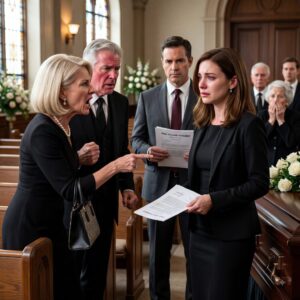
My mother’s palm struck the Thanksgiving table so hard that thirty-two relatives fell silent.
“Your sister is taking your portion of Grandma’s estate, Emily.
You already have enough!”
I stared at her across the enormous dining room in my parents’ Pennsylvania home.
My younger sister, Jessica, sat beside her, smiling as though she’d just won a lottery.
I was thirty-four, a successful commercial architect, and apparently that meant my family could steal from me.
“That’s not your decision, Mom,” I replied.
My father, Robert, set down his wineglass.
“Don’t embarrass us in front of everyone.
Jessica needs that money more than you do.”
I looked toward the corner of the room.
A silver-haired woman in a navy suit sat quietly beside the fireplace, her leather briefcase resting against her chair.
I nodded once.
She opened her briefcase and stood.
And suddenly, the Thanksgiving dinner my parents had spent weeks planning became something entirely different.
But to understand why, you need to know what happened three weeks earlier.
My grandmother, Margaret Whitmore, died at eighty-six.
She had raised me during summers when my parents were too busy celebrating Jessica’s achievements to notice mine.
Grandma taught me to cook, manage money, and recognize when someone was trying to manipulate me.
Six months before her death, she called me to her house.
“Emily, promise me something.”
“Anything, Grandma.”
“Don’t let your mother convince you that loving your family means surrendering what belongs to you.”
At the time, I thought she was talking about my parents’ constant requests for money.
I was wrong.
Grandma owned a historic farmhouse, investment accounts, and several acres of valuable land outside Lancaster.
Her estate was worth approximately $2.4 million.
Her will divided the estate between Jessica and me, with smaller gifts for charity.
But two weeks after the funeral, Mom called.
“Jessica’s struggling financially.
We’re adjusting the inheritance.”
“Adjusting how?”
“She’ll receive your portion.
You’re doing perfectly well.”
I laughed, thinking she was joking.
She wasn’t.
When I refused, Dad threatened to tell the entire family how selfish I’d become.
Then came the Thanksgiving invitation.
Thirty-two relatives.
One enormous dinner.
And a carefully planned public announcement intended to shame me into surrendering my inheritance.
What my parents didn’t know was that I’d already spoken to Grandma’s estate attorney.
Her name was Catherine Brooks.
And Grandma had left something with Catherine that nobody else knew existed.
Back at Thanksgiving, Catherine stepped into the center of the dining room.
“Good evening.
I’m Catherine Brooks, attorney for the estate of Margaret Whitmore.”
My mother’s face drained of color.
“Who invited you?”
“I did,” I answered.
Catherine placed a thick folder on the table.
“Before anyone makes further claims regarding this inheritance, there are several facts that must be established.”
Jessica crossed her arms.
“Emily’s trying to ruin Thanksgiving.”
Catherine ignored her.
“Mrs.
Whitmore anticipated precisely this situation.”
My father stood.
“This is a private family gathering.
Leave immediately.”
Catherine calmly removed a sealed envelope.
“Your mother instructed me to deliver this if anyone attempted to pressure Emily into surrendering her inheritance.”
The room went completely still.
Then Catherine looked directly at my parents.
“However, the letter isn’t the most serious matter.”
She pulled out a second document.
“Three days before Margaret Whitmore died, someone submitted paperwork attempting to transfer her farmhouse.”
My mother’s wineglass slipped from her fingers.
And Catherine said the words that changed everything.
“The signature on that paperwork wasn’t Margaret’s.”
For several seconds, nobody moved.
Then my father pointed toward Catherine.
“That’s a disgusting accusation.”
Catherine remained composed.
“I’m describing documents submitted to the county recorder’s office.
Whether a crime occurred is a matter for investigators.”
Jessica pushed back her chair.
“This is ridiculous.
Grandma wanted me to have the farmhouse!”
“Then why wasn’t that reflected in her will?” I asked.
My sister’s expression hardened.
“Because you manipulated her!”
Aunt Linda, my mother’s older sister, finally spoke.
“Jessica, Margaret told me herself that she wanted both granddaughters treated equally.”
My mother spun toward her.
“Stay out of this, Linda!”
Catherine placed copies of the disputed deed on the table.
The paperwork purported to transfer Grandma’s farmhouse to Jessica for ten dollars.
It had been signed three days before Grandma’s death, when she was receiving hospice care.
But there was a problem.
According to her medical records, Grandma had been heavily medicated that afternoon.
More importantly, the notary listed on the document had reported that the notarization was not hers.
Catherine explained that the estate had already filed a legal challenge to the deed.
My father gripped his chair.
“You’re destroying this family over money.”
“No,” I answered. “Someone tried to take property that didn’t belong to them.”
Jessica suddenly began crying.
“Grandma promised me that house!
She knew I needed somewhere to live!”
I felt an unexpected pang of sympathy.
Jessica had recently lost her job, and her husband had moved out.
But hardship didn’t justify fraud.
“Then you should have asked for help,” I said.
“I did!
Mom said she’d handle everything!”
The words escaped before Jessica realized what she’d admitted.
My mother froze.
Catherine slowly turned toward her.
“Mrs.
Whitmore, did you prepare the disputed transfer?”
Mom’s face reddened.
“I was protecting my daughter.”
Dad grabbed her wrist.
“Don’t say another word.”
Catherine closed the folder.
“You’re entitled to legal counsel.
I won’t question you further.”
But Aunt Linda wasn’t finished.
“Margaret called me four days before she died,” she announced. “She was terrified.”
The room grew quiet again.
“She said someone had been searching through her desk, looking for property documents.”
My father stared at the floor.
I remembered Grandma’s final telephone call.
Her voice had been weak.
“Emily, the blue box.
Make sure Catherine gets the blue box.”
I’d delivered it to Catherine the following morning without opening it.
Inside were Grandma’s handwritten notes, copies of financial records, and a small digital recorder.
Catherine had warned me that the recordings might not be admissible without further legal review.
But the notes had led her to the suspicious deed.
My mother suddenly whispered:
“Margaret was supposed to sign it.”
Every head turned.
Dad shut his eyes.
Mom covered her mouth.
Then Jessica stood.
“Wait.
What do you mean, supposed to?”
My mother said nothing.
Jessica’s voice rose.
“Mom, you told me Grandma signed the paperwork herself!”
Catherine looked at me.
There was something else in her expression.
Something she’d deliberately withheld until now.
She opened a smaller envelope and placed a bank statement before my father.
“Mr.
Whitmore, there’s another issue involving an account belonging to your late mother.”
Dad’s face turned gray.
Catherine continued.
“Four hundred and eighty thousand dollars disappeared from that account during the final month of her life.”
My mother looked at him in horror.
“Robert,” she whispered, “what did you do?”
My father stared at the bank statement as though it might disappear.
“That money was a loan,” he finally said.
“A loan?” Jessica repeated.
“Your grandmother agreed to help us.”
Catherine folded her hands.
“Then there should be documentation supporting that agreement.”
Dad said nothing.
The account had been held jointly by Grandma and Dad for convenience while she was ill.
He had access to help pay medical bills.
Instead, bank records showed a $480,000 transfer into his personal account.
Three days later, $300,000 had been transferred to a company owned by Jessica’s estranged husband.
Jessica looked stunned.
“That was Daniel’s business account.”
Dad nodded miserably.
“His company was failing.
He promised to repay everything.”
My mother turned toward him.
“You told me the money came from refinancing our house!”
“I thought I could replace it before anyone noticed.”
Jessica sank into her chair.
“So Daniel took Grandma’s money, and then left me?”
Dad couldn’t meet her eyes.
Catherine explained that the estate’s representatives were reviewing the transfers and would pursue recovery through the appropriate legal channels.
My father would have to account for every dollar.
The disputed farmhouse deed was already being challenged.
And the will remained unchanged.
But Catherine wasn’t finished.
“Margaret also left Emily a personal letter.”
She handed me a cream-colored envelope.
My hands trembled as I opened it.
My dearest Emily,
You have spent your life trying to earn love from people who measure your worth by what you can give them.
I watched you pay your father’s medical bills, help your sister through college, and quietly rescue this family more times than they deserved.
I never wanted my estate to become another burden you were expected to carry.
You owe nobody your inheritance.
Use it to build the life you deserve.
Love, Grandma.
I couldn’t stop the tears.
For years, I’d believed that being the responsible daughter meant never saying no.
Grandma had understood what I hadn’t.
My mother approached me cautiously.
“Emily, sweetheart, surely we can settle this privately.”
I folded the letter.
“Mom, you announced my inheritance was being taken away in front of thirty-two people.
You made it public.”
She began crying.
“Families make mistakes.”
“Yes,” I said. “But they also take responsibility.”
I looked at Jessica.
“You didn’t know about the forged signature?”
She shook her head.
“Mom told me Grandma had agreed.
I believed her.”
For the first time that evening, Jessica looked genuinely ashamed.
“I’m sorry, Emily.”
I believed she regretted what had happened.
But forgiveness would take time.
Over the following months, the estate’s attorneys obtained court orders protecting the disputed property while the deed challenge proceeded.
The bank records became part of a formal investigation.
Dad eventually entered a repayment agreement with the estate, secured against his remaining assets.
Investigators continued examining how the disputed documents had been prepared.
Jessica cooperated with the investigation and gave up her claim under the challenged deed.
She retained the inheritance Grandma had actually left her.
I received my lawful share after the estate’s debts and expenses were resolved.
I used part of it to establish an architecture scholarship in Grandma’s name.
On the first anniversary of her death, I visited her grave.
“Thank you for teaching me to stand up for myself,” I whispered.
My phone buzzed.
A message from Mom.
We’re having Thanksgiving again this year.
Can we start over?
I looked at the message for a long time.
Then I typed:
Starting over requires telling the truth, not pretending nothing happened.
I put my phone away.
And for the first time in my life, I walked away from my family’s expectations without feeling guilty.
Grandma had left me more than money.
She had left me the courage to say no.