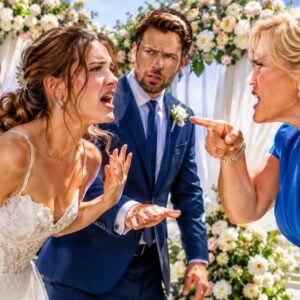
At on the afternoon of my wedding, while I stood behind the closed doors of a renovated barn outside Asheville, North Carolina, my wedding coordinator leaned toward me and quietly asked the question I had been avoiding for nearly an hour.
“Claire, do you want us to keep holding the ceremony?”
I looked past her through the small window in the door.
Nearly a hundred guests were seated outside.
My fiancé, Daniel Foster, was already waiting beneath the wooden arbor.
His parents sat in the front row.
My grandmother was there.
My cousins were there.
The two seats marked Mother of the Bride and Father of the Bride were empty.
My parents had missed my wedding.
Not because of an accident.
Not because their flight was canceled.
Not because someone was in the hospital.
They were forty-five minutes away at my nephew Mason’s ninth birthday party.
I swallowed and looked at my phone again.
Three unread messages from Mom.
The latest one said:
We’re leaving soon.
Please don’t start without us.
It was already seventeen minutes past the scheduled ceremony time.
Daniel’s sister, Brooke, stood beside me as one of my bridesmaids.
She saw the screen and muttered,
“You cannot keep ninety people waiting because your parents decided a kid’s birthday party was more important.”
I hated hearing it said that plainly.
Mostly because it was true.
My older sister, Vanessa, had scheduled Mason’s birthday party on the exact same Saturday as my wedding.
She knew my wedding date eleven months in advance.
When she announced the birthday plans three weeks before the wedding, I thought she was joking.
“Mason’s actual birthday is Tuesday,” I reminded her over the phone.
Vanessa sighed dramatically.
“Claire, he has school Tuesday.
His friends have activities Sunday.
Saturday is the only day that works.”
“My wedding is Saturday.”
“I know.”
There was a silence.
Then Vanessa said,
“The party is from noon to three.
Your ceremony isn’t until four.
Mom and Dad can do both.”
The locations were almost an hour apart.
I told my parents it was ridiculous.
Dad responded with his usual peacekeeping answer.
“We’ll make it work.”
Mom added,
“Mason is only nine once.”
I stared at her.
“I’m only getting married once.”
Mom smiled awkwardly.
“Of course, sweetheart.
Nobody is comparing the two.”
Except apparently everyone was.
Vanessa had always been the center of our family’s gravity.
She was four years older, louder, more emotional, and incredibly good at turning every disagreement into an emergency.
When Vanessa was upset, Mom rushed to fix it.
When Vanessa needed money, Dad quietly transferred it.
When Vanessa divorced Mason’s father, my parents practically moved into her house for six months.
I was the easy daughter.
The independent daughter.
The daughter who “never needed anything.”
Somehow that became an excuse to give me less.
At , I called Dad.
He answered over loud music and children screaming.
“Hey, kiddo.”
My stomach dropped.
“You’re still there?”
“We’re getting ready to go.”
“The ceremony was supposed to start twenty minutes ago.”
“I know.
I know.”
“Then leave.”
Dad lowered his voice.
“Vanessa hasn’t brought out the cake yet.”
For several seconds, I genuinely thought I had misheard him.
“The cake?”
“Mason keeps asking Grandma and Grandpa to stay while he blows out his candles.”
I closed my eyes.
“Dad, I’m standing in my wedding dress waiting for you.”
“I understand.”
“No.
I don’t think you do.”
Mom suddenly came onto the phone.
“Honey, please don’t make this ugly.”
I nearly laughed.
“I’m making it ugly?”
“Vanessa has had a difficult year.”
There it was.
The sentence that had explained half my childhood.
Vanessa had a difficult year.
Vanessa was stressed.
Vanessa needed support.
Vanessa didn’t mean it.
Vanessa was sensitive.
I looked at Brooke.
Then I looked through the door at Daniel.
He was speaking quietly with his father, trying not to glance toward the empty seats.
Something inside me finally went still.
I told Mom,
“We’re starting.”
“Claire, wait fifteen minutes.”
“No.”
“Your father is supposed to walk you down the aisle.”
“Not anymore.”
Mom gasped.
“Claire.”
“You chose where you wanted to be.”
“That’s not fair.”
“It doesn’t need to be fair.
It already happened.”
I ended the call.
My hands were shaking, but for the first time all afternoon, I could breathe.
I asked my grandfather’s younger brother, Uncle Walter, to walk me down the aisle.
He looked stunned.
Then his eyes filled with tears.
“It would be an honor.”
The ceremony started at .
My parents arrived at .
By then, Daniel and I were married.
They entered during cocktail hour still wearing paper birthday hats Mason had apparently insisted everyone wear.
Mom pulled hers off the second she saw me.
Dad looked devastated.
Vanessa wasn’t with them.
Mom approached me first.
“Why didn’t you wait?”
I stared at her.
“You seriously just asked me that?”
“We told you we were coming.”
“You told me that an hour ago.”
Dad stepped forward.
“Claire, we messed up.”
Mom immediately interrupted him.
“We were put in an impossible position.”
“No,” I said. “You were put in a position where you had to choose.”
Mom frowned.
“And we were trying to support both of our daughters.”
“You supported Vanessa.”
“That doesn’t mean we don’t support you.”
I looked toward the empty chairs where they should have watched me marry Daniel.
“It meant exactly that today.”
Mom’s expression hardened.
Then she said something I would remember for the rest of my life.
“When you have children, maybe you’ll understand why Mason’s feelings mattered.”
Daniel had walked up behind me.
He heard everything.
He put his hand gently against my back.
I looked at my mother and said,
“Please enjoy the reception.
I’m not discussing this tonight.”
She tried to hug me.
I stepped away.
That apparently hurt her more than missing my ceremony had hurt me.
Over the next week, both my parents called repeatedly.
I didn’t answer.
Then Vanessa sent me a message.
You’re being unbelievably dramatic.
Mom has been crying for days.
Mason’s birthday had nothing to do with your wedding.
Stop punishing everyone because you needed all the attention for one day.
I read the message three times.
Then I blocked her.
Two weeks later, Mom appeared at our house without warning.
Daniel opened the door.
She insisted on speaking to me.
I eventually came downstairs.
Mom looked exhausted.
She said,
“We need to fix this.”
I replied,
“I agree.”
She visibly relaxed.
Then I continued.
“But the first thing I’m fixing is how I think about our relationship.”
Her smile disappeared.
I had spent two weeks replaying my wedding, my childhood, every canceled dinner, every emergency involving Vanessa, every time my parents had told me I was “strong enough to understand.”
I finally understood.
I had never been their priority because they trusted me to survive not being one.
So I looked directly at my mother.
“I’m not calling you Mom anymore.”
She stared at me.
“What?”
“And I’m not calling Dad ‘Dad.’ You’re Linda and Robert now.”
Her face went completely white.
“You can’t be serious.”
“I am.”
“I’m your mother.”
“You’re biologically my mother.
But I’m done giving you a title that means something your behavior doesn’t.”
Linda started crying.
Then she whispered,
“You’re trying to hurt me.”
I shook my head.
“No.
I’m changing the relationship to match the one you actually gave me.”
That evening Robert called Daniel.
And what he said made it clear my parents were far more angry about losing the words Mom and Dad than they had ever been about missing their daughter’s wedding.
Robert asked Daniel to put the phone on speaker.
I was sitting at the kitchen island.
“Claire,” he began, “your mother came home devastated.”
I responded,
“Linda came to my house expecting forgiveness without apologizing.”
There was a pause.
“Please don’t call her Linda.”
“That’s her name.”
“She’s your mother.”
“She missed my wedding for a birthday cake.”
Robert exhaled heavily.
“We’ve apologized for being late.”
“No.
You’ve apologized for the timing.
Neither of you has apologized for choosing Vanessa.”
“That isn’t what happened.”
“Then explain what happened.”
Silence.
Finally, Robert said,
“Mason started crying when we said we had to leave.”
“And?”
“He thought we didn’t care about his birthday.”
I almost laughed.
“So you protected him from feeling disappointed by making me get married without my parents.”
Robert had no answer.
Over the next month, the conflict spread through the family.
Linda told relatives I had “cut them off.”
I hadn’t.
I still answered necessary messages.
I simply called them Linda and Robert.
Apparently that was worse.
My aunt Karen called me.
“Your mother says you’re humiliating her.”
“How?”
“She says you introduced her to Daniel’s coworker as Linda.”
“That’s her name.”
Karen sighed.
“Claire.”
“What should I have said? ‘This is the woman who was supposed to be sitting in the front row at my wedding’?”
Karen went quiet.
Thanksgiving became the next battleground.
Linda texted:
Dinner at 2.
Please come.
Your father and I want the family together.
I replied:
Daniel and I will be there at 2, Linda.
She called immediately.
I ignored it.
At Thanksgiving, Vanessa arrived forty minutes late with Mason.
She barely looked at me.
During dinner, Linda kept trying to force normality.
“Claire, pass your mother the potatoes.”
I passed them to her.
“Here you go, Linda.”
Vanessa slammed her fork down.
“This is pathetic.”
Daniel straightened beside me.
I remained calm.
Vanessa continued.
“You got your big wedding.
Everybody spent thousands of dollars celebrating you.
Mom and Dad missed twenty minutes, and now you’re treating them like strangers.”
“They missed the ceremony.”
“They were there for the reception.”
“That isn’t the same.”
“It was Mason’s birthday!”
“His birthday was three days later.”
Mason looked confused.
Vanessa snapped,
“Do not drag my son into this.”
“You scheduled the party.”
“For his friends.”
“You scheduled it after knowing my wedding date for almost a year.”
Vanessa stood.
“You think everything is about you.”
Robert suddenly spoke.
“Sit down, Vanessa.”
Everyone froze.
Robert almost never challenged her.
Vanessa stared at him.
“What?”
“I said sit down.”
She did.
Robert rubbed his face.
Then he looked at me.
“There’s something you don’t know.”
Linda immediately said,
“Robert, no.”
He ignored her.
“The party wasn’t originally scheduled for Saturday.”
I stared at him.
Vanessa’s face changed.
Robert continued.
“It was supposed to be Sunday.”
Linda pushed back from the table.
“Robert.”
But he kept talking.
“Vanessa moved it.”
I looked at my sister.
“You moved it to my wedding day?”
Vanessa crossed her arms.
“It worked better.”
“For who?”
Nobody answered.
Then nine-year-old Mason, who clearly didn’t understand why the adults had suddenly gone silent, looked at me and casually said,
“Mom said Saturday was better because Grandma and Grandpa promised they wouldn’t leave my party for your wedding.”
The entire table stopped breathing.
Vanessa whipped toward him.
“Mason.”
He looked frightened.
“What?”
I turned slowly toward Linda and Robert.
“You promised her?”
Linda’s eyes filled with tears.
“It wasn’t exactly like that.”
Robert stared down at his plate.
And suddenly I realized they hadn’t accidentally stayed too long at the party.
They had known before my wedding day that they probably wouldn’t make my ceremony at all.
I looked at Robert.
“Tell me exactly what happened.”
Linda shook her head.
“Not here.”
“Here is perfect.”
Vanessa pushed her chair back.
“I’m leaving.”
I stood.
“No.
You wanted everyone involved when you made the plan.
Everyone can hear what the plan was.”
Vanessa glared at me.
“You’re acting insane.”
Daniel finally spoke.
“No.
She’s asking a straightforward question.”
Robert looked older than he had at my wedding.
He said,
“About six weeks before the wedding, Vanessa called us.”
Vanessa muttered,
“Dad.”
“She was upset because Mason had been asking whether we cared more about Claire’s wedding than his birthday.”
I looked at her.
“A nine-year-old independently asked that six weeks before his birthday?”
Vanessa said nothing.
Robert continued.
“Vanessa said Mason was already struggling because of the divorce.
She said he felt abandoned by his father.”
That part was true.
Vanessa’s ex-husband, Eric, lived in Tennessee and had become increasingly unreliable after the divorce.
Robert continued.
“She asked whether we could promise Mason that his birthday would come first that weekend.”
My stomach tightened.
“And you promised.”
Linda finally spoke.
“We promised a child we wouldn’t abandon him.”
I stared at her.
“You weren’t abandoning him.
You were leaving a birthday party after three hours to attend your daughter’s wedding.”
“He didn’t see it that way.”
“Because Vanessa made sure he didn’t.”
Vanessa stood again.
“Don’t blame me because your wedding wasn’t the center of the universe.”
I looked at her.
“No.
I blame you because you deliberately turned your son’s birthday into a loyalty test.”
She opened her mouth.
Mason suddenly started crying.
That ended the argument.
Whatever anger I had toward Vanessa, I wasn’t going to make a nine-year-old sit through adults tearing one another apart.
Daniel and I left.
In the car, neither of us spoke for several minutes.
Then Daniel said,
“You okay?”
“No.”
“Want me to drive somewhere before we go home?”
I shook my head.
“I just want to understand why they agreed.”
Daniel glanced at me.
“I think you already do.”
I did.
Vanessa had threatened them with emotional consequences.
I had never done that.
And my parents had spent decades responding to whoever made the greatest amount of noise.
Three days later, Robert came to our house alone.
He didn’t come inside immediately.
He stood on the porch and said,
“I owe you the apology I should have given you the day of the wedding.”
I waited.
He continued.
“I knew there was a good chance we’d miss the ceremony.
Your mother knew too.
Vanessa told us if we left before Mason finished cake and presents, she would tell him we chose your wedding over him.”
I felt sick.
Robert looked down.
“We should have told her that was unacceptable.”
“Yes.”
“We didn’t.”
“No.”
“I told myself you’d understand.”
That sentence hurt more than I expected.
“Why?”
Robert’s eyes were wet.
“Because you always did.”
There it was.
The truth.
I asked,
“Do you understand what that actually means?”
He nodded slowly.
“It means we punished you for being reasonable.”
I didn’t answer.
Robert continued.
“We knew Vanessa would explode if we disappointed her.
We knew you’d be hurt, but we assumed eventually you’d forgive us.”
“So you chose the person who would make your lives harder.”
“Yes.”
It was the first completely honest answer either parent had given me.
Robert apologized without excuses.
I didn’t immediately forgive him.
But I appreciated that he finally understood what he was apologizing for.
Linda was different.
She refused to accept that Vanessa had manipulated the situation.
For several months, she continued sending messages.
A daughter shouldn’t call her mother by her first name.
Family relationships require forgiveness.
I hope someday you understand what this is doing to me.
I answered only once.
You are still focused on what I call you instead of why I stopped calling you Mom.
She never responded.
Vanessa and I had no contact for almost five months.
Then one afternoon, she showed up at my office building.
She looked exhausted.
“I need to talk to you.”
“I’m working.”
“Five minutes.”
I nearly walked away.
Then she said,
“It’s about Mason.”
We went to a coffee shop downstairs.
Vanessa stared at her hands.
“Mom and Dad aren’t speaking to me.”
That surprised me.
“Why?”
“Dad told me I need to apologize to you.”
“And?”
“I told him I didn’t do anything.”
I almost stood up.
Vanessa quickly added,
“I know.
I know how that sounds.”
She took a breath.
Then, for perhaps the first time in my life, my sister said something without defending herself.
“I moved the party because I was jealous.”
I stared at her.
She swallowed.
“You were getting married.
Everyone was happy for you.
Daniel’s family loves you.
Your life looked…stable.”
“Vanessa—”
“My marriage failed.
Eric barely sees Mason.
I was angry that you got to have this perfect day while I was dealing with everything.”
“My day wasn’t perfect.”
“I know.”
She looked at me.
“I made sure it wasn’t.”
The admission landed quietly.
No screaming.
No excuses.
Just the ugliest truth in the room.
She told me she had convinced Mason that the birthday weekend was “special” and repeatedly asked him whether he would feel sad if his grandparents left early.
She created the fear she later demanded our parents solve.
I asked,
“Why tell me now?”
Vanessa wiped her eyes.
“Because Mason asked me why Aunt Claire doesn’t visit anymore.”
That hurt.
I had intentionally kept my anger away from him, but children still noticed absences.
Vanessa continued.
“And I realized I’d turned him into a weapon because I was angry at you.”
I didn’t forgive her that afternoon.
But I told her I wanted a relationship with Mason that didn’t depend on my relationship with her.
She agreed.
Things changed slowly after that.
Robert became Robert for another four months.
Then one evening, after he helped Daniel repair a section of our backyard fence, I handed him a beer.
“Thanks, Dad.”
He froze.
He didn’t make a big deal out of it.
He simply nodded and said,
“Anytime, kiddo.”
Linda took longer.
Almost a year after the wedding, she asked to meet me alone.
She finally said,
“I kept thinking being your mother meant you owed me the title.”
I waited.
“But maybe the title was something I was supposed to keep earning.”
That was the first time I called her Mom again.
Vanessa and I are still complicated.
We probably always will be.
I don’t trust her the way I once did.
But Mason knows none of the worst details, and I intend to keep it that way.
As for my wedding, I used to hate looking at the ceremony photographs because of those two empty chairs.
Now my favorite picture is the one of Uncle Walter walking me down the aisle.
He is smiling.
I am crying.
Daniel is waiting for me.
And in the background are two empty seats.
For a long time, I thought those chairs represented what I lost.
Now I think they represent the moment I finally stopped pretending I had to accept whatever my family gave me just because I was the daughter who could handle it.