## Part 3 – The Blue Room
**Part 3**
“No.”
Dominic’s voice was quiet.
That made it more serious.
Eleanor looked at him.
“Dominic.”
“I said no.”
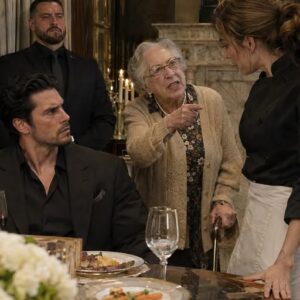
I stood in the dining room with an old brass key pressed into my palm and the uncomfortable feeling that I had wandered into the middle of a family argument that had begun decades before I arrived.
I held out the key.
“Take it.”
Dominic frowned.
“What?”
“I don’t want to break into some private room because of something my father supposedly said twenty-seven years ago.”
Eleanor made an indignant sound.
“You wouldn’t be breaking in. You have the key.”
“That’s not the reassuring distinction you think it is.”
Dominic almost smiled.
Almost.
Then his gaze returned to the key.
“The blue room was my father’s study.”
That explained something.
Not everything.
But something.
“After he died,” Dominic continued, “I closed it.”
“How long ago?”
“Eleven years.”
“And nobody has been inside?”
“Housekeeping goes in twice a year.”
Eleanor cleared her throat.
Dominic turned.
“What?”
“Housekeeping goes in once a month.”
His eyes narrowed.
“Why?”
“Because dust is not a memorial.”
I looked away to hide my smile.
Dominic noticed anyway.
“You find that amusing?”
“A little.”
“This evening began with me trying to fire you.”
“And it’s gone downhill beautifully.”
That time, he did smile.
Barely.
It changed his whole face.
Then it disappeared so quickly I wondered if I had imagined it.
Eleanor touched his arm.
“Samuel asked me to keep the key.”
Dominic looked at her.
“Why didn’t you tell me?”
“Because he asked me not to unless Grace returned.”
“She was five when he left Chicago.”
“I know.”
“And you agreed to this?”
“I trusted him.”
Dominic looked toward the photograph still lying on the table.
“What was in the room?”
“I don’t know.”
“You had twenty-seven years and never looked?”
Eleanor gave him an offended stare.
“I have flaws, Dominic. Betraying dead friends is not one of them.”
For some reason, that settled the matter.
Twenty minutes later, the four of us stood on the third floor.
The mansion seemed different at night.
Less grand.
More lonely.
The upstairs corridor stretched beneath dim wall sconces, lined with paintings and closed doors. Nothing looked abandoned, exactly, but everything looked preserved.
Like a museum built around someone who refused to admit the exhibit was over.
Dominic stopped at the last door.
It was painted deep blue.
Not navy.
Not gray.
Blue.
An oddly cheerful color in such a serious house.
“My mother chose it,” he said.
I looked at him.
“The color?”
He nodded.
“She said every house needed one door that looked like it led somewhere interesting.”
Eleanor smiled.
“She was right.”
Dominic ignored her.
I inserted the key.
It turned easily.
The lock clicked.
Nobody moved.
I looked at Dominic.
“You should open it.”
His expression hardened.
“My father left whatever is inside to you.”
“According to Eleanor.”
“Which is unfortunately as binding as most legal documents.”
“Nicky.”
He opened the door.
The smell hit me first.
Cedar.
Old paper.
A faint trace of tobacco that had survived eleven years.
Dominic stopped at the threshold.
The room was large but surprisingly warm.
Bookshelves covered two walls.
A broad wooden desk faced the windows.
There were two leather chairs near a fireplace.
A chessboard rested on a small table, pieces frozen in the middle of a game.
Dominic stared at it.
“My father always played white.”
I glanced at the board.
“Was he winning?”
“No.”
“How can you tell?”
“Because I was black.”
I looked at him.
“That was your game?”
He nodded.
“We started it the week before he died.”
I didn’t know what to say.
Neither did Eleanor.
For once.
Dominic stepped farther inside.
His fingers touched the back of one leather chair.
“He hated unfinished games.”
Something in his voice made me look away.
Adrian quietly remained near the door.
I walked toward the desk.
Nothing immediately suggested my father.
There were fountain pens.
A brass letter opener.
Several photographs.
One showed Dominic as a boy beside a woman with laughing eyes.
His mother, I assumed.
He caught me looking.
“Cecilia.”
“She was beautiful.”
“Yes.”
No qualification.
No guardedness.
Just yes.
Then I saw another photograph.
My parents.
They were standing in a restaurant kitchen.
My father wore an apron.
My mother held a wooden spoon.
Between them stood Eleanor and Cecilia Moretti.
All four were laughing.
I lifted the frame.
“What was this?”
Eleanor came closer.
“The old staff kitchen.”
“My father cooked?”
“Badly.”
“Extremely badly,” Dominic said.
I looked at him.
“You remember that?”
“He once made lasagna with cottage cheese.”
I gasped.
“That proves nothing.”
“It proves enough.”
For the first time that evening, laughter entered the room.
Quiet.
Brief.
But real.
Then Eleanor touched the photograph.
“Your mother was the talented one.”
“She barely cooked when I was growing up.”
“She stopped after you moved.”
“Why?”
Eleanor looked toward the desk.
“I think the answer may be here.”
We searched carefully.
Not tearing through drawers.
Not treating the room like evidence.
More like archaeology.
In the bottom drawer of the desk, beneath bundles of old correspondence, I found a narrow wooden box.
There was a brass plate on the lid.
S.B.
My father’s initials.
My hands began to tremble.
Eleanor sat beside me.
“You don’t have to open it tonight.”
“Yes, I do.”
Inside were recipes.
Dozens of them.
Handwritten cards.
Some were in my mother’s handwriting.
Some belonged to my father.
Some were signed C.M.
Cecilia Moretti.
I picked up the first.
Lemon cookies.
I stared at Eleanor.
She smiled.
“Those cookies.”
“The ones you were waving at Dominic?”
“Yes.”
“You got the recipe from his mother?”
“She stole it from your mother.”
“What?”
“Margaret insisted Cecilia stole it.”
“She did steal it,” Dominic said.
Eleanor pointed at him.
“You weren’t even born when they started making those.”
“I heard the argument approximately six thousand times.”
Beneath the recipe cards was a notebook.
On the first page, my father had written:
**The Long Table.**
I turned the page.
It wasn’t a diary.
It was a plan.
A restaurant.
Not an ordinary restaurant.
A neighborhood dining room where some tables would be full price, some subsidized, and one long communal table would be open each evening to anyone referred by a shelter, church, school, or hospital.
People who could pay would.
People who couldn’t would still eat.
My mother had written notes in the margins.
Cecilia had added menu ideas.
Eleanor had apparently contributed an entire page arguing about tablecloths.
“This was yours?” I asked.
“Ours,” Eleanor said.
“Why didn’t it happen?”
Silence.
Dominic took the notebook.
He studied several pages.
“My mother never told me.”
“She intended to.”
“When?”
“When it was ready.”
“Which it never was.”
Eleanor looked down.
I turned more pages.
There were financial plans.
Supplier lists.
Possible locations.
Then, near the back, a legal memorandum.
I read slowly.
A small trust had been established to fund the restaurant.
Four contributors.
Lorenzo Moretti.
Cecilia Moretti.
Samuel Bennett.
Margaret Bennett.
My mouth went dry.
“My parents didn’t have this kind of money.”
“Your father earned an interest in one of the company’s early import partnerships,” Eleanor said.
“I never knew that.”
“He didn’t want you raised around wealth.”
“He succeeded.”
Dominic leaned over the document.
“The trust still exists?”
“No,” Eleanor said.
“I think it does.”
We looked at him.
He pointed to a clause.
“This wasn’t a direct development fund. The principal was transferred into a property vehicle.”
Adrian stepped closer.
“Which one?”
Dominic read the name.
“Lakefront Community Holdings.”
Adrian’s expression changed.
“I know that name.”
“From where?”
“It appears in the Marrowgate acquisition.”
My heart started pounding.
“What does that mean?”
Adrian left the room.
He returned several minutes later carrying his tablet.
“The Milwaukee building.”
“My restaurant?”
“Yes.”
He turned the screen.
“The building was owned by Lakefront Community Holdings for twenty-six years.”
I stared at the words.
“Until Marrowgate bought it?”
“Yes.”
Dominic looked at Eleanor.
“You’re telling me Grace operated her restaurant in a building partly created by her parents’ trust?”
“I didn’t know where the trust ultimately invested.”
Adrian scrolled.
“There’s more.”
Of course there was.
There was always more.
“The lease Bennett Table held wasn’t standard.”
I looked at him.
“What do you mean?”
“It included a legacy tenant provision.”
Dominic closed his eyes.
“Which means?”
“You couldn’t be removed without first receiving an option to renew or purchase your unit.”
I sat very still.
“No one offered me either.”
Dominic’s expression became grim.
“They forged the waiver because the sale couldn’t proceed without clearing the legacy clause.”
It felt strange.
For months I had believed I lost my restaurant because I was unlucky.
Because cities changed.
Buildings sold.
Small businesses disappeared.
That was life.
Now I was discovering that somewhere in a file, somebody had apparently rewritten my choices for me.
“I want to see the original,” I said.
Dominic nodded.
“You will.”
My fingers returned to the notebook.
Near the back was an envelope.
It had never been sealed.
On the front, my father had written:
**For Grace, if she ever finds her way back.**
My vision blurred.
I didn’t open it immediately.
I couldn’t.
Thirty-one years separated me from the five-year-old girl who had left Chicago.
Nine years separated me from the daughter who had stood beside a hospital bed and listened to her father tell her not to waste her life being afraid of starting over.
He had known things he never told me.
He had left them here.
Why?
I opened the envelope.
The letter was only two pages.
Grace,
If you are reading this, then chance has a sense of humor.
There are things parents keep from their children because they are ashamed.
Other things they keep because they believe silence can protect them.
I do not know which kind of father history will decide I was.
I smiled through tears.
That sounded exactly like him.
I continued.
Years ago, I discovered irregularities in the accounts at Moretti & Sons. Not crimes. Not what newspapers would imagine from the Moretti name. Something smaller and sadder.
Someone had been quietly moving money away from the community trust Cecilia created.
I reported it.
The records disappeared.
Then the blame settled on me.
Lorenzo believed the evidence.
Cecilia did not.
Margaret wanted us gone before bitterness became our daughter’s inheritance.
So we left.
My hands shook.
Dominic stood across from me.
He looked pale.
I kept reading.
I could have fought.
I chose you.
Perhaps that was cowardice.
Perhaps it was wisdom.
I still do not know.
But there is one thing I know with certainty:
The trust belonged to an idea bigger than any of us.
Someday, if you choose, finish what we could not.
Not because anyone owes you a restaurant.
Not because the Morettis owe the Bennetts an apology.
Do it only if feeding people still makes you feel the way it did when you were seven and you served me burnt toast as though it were a feast.
Love,
Dad.
I lowered the letter.
Nobody spoke.
Then Dominic quietly asked, “Was there a name?”
I shook my head.
“No.”
Adrian studied the notebook.
“We may be able to trace the transfers.”
Eleanor wiped her eyes.
“Samuel always thought records told the truth eventually.”
Dominic moved to the window.
For a long moment, he stared out over the dark grounds.
“My father believed Grace’s father stole from my mother.”
Eleanor’s voice was gentle.
“Yes.”
“And he never corrected that?”
“He didn’t know he was wrong.”
Dominic turned.
“You did.”
“I suspected.”
“For thirty-five years?”
“I had no proof.”
“You had Samuel’s letter.”
“His letter explained his side. It did not identify who moved the money.”
Dominic looked away.
I could see something in him unraveling.
His father was no longer simply dead.
He had become fallible.
Capable of believing the wrong person.
Capable of allowing an innocent family to leave.
I understood that kind of grief.
Sometimes losing someone once was not the end of losing them.
Sometimes you lost the version of them you had carried afterward.
I walked toward Dominic.
“This isn’t your fault.”
He looked at me.
“I own the company that bought your building.”
“You were seventeen when my father left Chicago.”
“I signed the authorization framework that allowed Marrowgate to operate.”
“You didn’t forge my signature.”
“No.”
“Then stop trying to collect guilt simply because it’s available.”
A strange look crossed his face.
“That sounded like Nell.”
“I resent that.”
“You should,” Eleanor said.
I laughed despite everything.
Dominic looked at me.
Then he smiled again.
This time, he didn’t hide it quickly enough.
Something warm and inconvenient moved through my chest.
I ignored it.
Adrian cleared his throat.
“There is another document in the box.”
He handed me a folded page.
It was not old.
The paper was recent.
I looked at Eleanor.
“When was this put here?”
“I don’t know.”
I unfolded it.
At the top was the letterhead of Moretti Property Group.
Dated six months ago.
Two months before my restaurant closed.
It was an internal memorandum regarding the Milwaukee acquisition.
One sentence had been highlighted.
**Legacy tenant obstacle can be resolved under existing authority. Owner need not be informed unless exception exceeds threshold.**
Below it was an approval signature.
Victor Hale.
But beneath that was something else.
A handwritten note.
Three words.
**Dominic mustn’t know.**
Dominic read it over my shoulder.
His face went completely still.
Adrian looked from the note to his employer.
“Boss…”
Dominic took the paper.
Then he noticed something I hadn’t.
The handwriting.
He held the note toward Eleanor.
“Do you recognize this?”
She took one look.
The color drained from her face.
“Yes.”
“Whose is it?”
Eleanor slowly lifted her eyes to Dominic.
“Your father’s secretary.”
Dominic frowned.
“She retired twelve years ago.”
“I know.”
“Then why is her handwriting on a document dated six months ago?”
Eleanor’s answer was barely a whisper.
“Because she didn’t retire.”
She looked at me.
“She disappeared.”
**–END OF PART 3–CLICK “NEXT” AT THE BOTTOM OF THE PAGE TO CONTINUE READING**