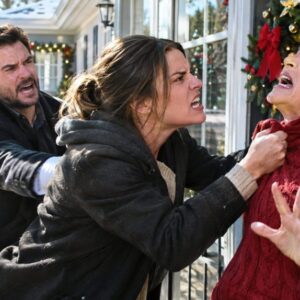
# FULL STORY — THE VALENTINE’S DAY BETRAYAL
## The Folder My Wife Never Wanted Me to See
Rachel stopped in the doorway.
For a moment, nobody spoke.
I was lying on the carpet with one hand pressed against my injured ribs. Claire was kneeling beside me, her fingers trembling against my shoulder. Mike stood near the desk, looking as though he wanted to disappear.
Rachel’s eyes moved from my bloodstained shirt to the scattered roses and chocolates.
Then she saw the open drawer.
“What happened here?” she demanded.
Claire immediately stood up.
“Mason had an accident. He stumbled and hit the desk. I was just about to call an ambulance.”
Rachel stared at her.
“Then why haven’t you?”
Claire opened her mouth, but no words came out.
Rachel pulled out her phone and called 911.
While she spoke to the dispatcher, Mike quietly moved toward the desk.
I noticed because I had been watching him ever since Claire whispered about the folder.
His hand reached for the open drawer.
“Don’t,” I managed to say.
He froze.
Rachel turned toward him.
“Step away from that desk.”
Mike raised both hands.
“I was just trying to clear some space.”
“Then leave it alone.”
Something in Rachel’s voice made him obey.
She had worked for my company for nearly twelve years. She knew every major employee, every executive, and nearly every important contract that had passed through our offices.
Rachel wasn’t easily intimidated.
And unlike Claire, she seemed genuinely frightened for me.
“The ambulance is coming, Mason,” she said, kneeling beside me. “Just keep breathing. Don’t try to move.”
I tried to tell her about the folder.
All I managed was one word.
“Drawer.”
Rachel followed my gaze.
She saw the dark blue folder sitting inside.
My name was printed on the front.
Beneath it were the words:
**TRANSFER AUTHORIZATION.**
Rachel’s expression tightened.
She looked at Mike.
“Why is that here?”
Mike swallowed.
“It’s company paperwork.”
“Then why is it in Claire’s office?”
“She’s been helping us organize some administrative documents.”
Rachel gave him a long, hard look.
“Claire doesn’t work in finance.”
Claire stepped forward.
“Rachel, this really isn’t the time.”
Rachel stood.
“You’re right. Your husband is bleeding on the floor. That’s what matters right now.”
Then she did something neither Claire nor Mike expected.
She photographed the folder without touching it.
Mike’s face turned pale.
And for the first time that night, I saw real fear in my wife’s eyes.
Not embarrassment.
Not regret.
Fear.
I didn’t know what was inside that folder.
But I knew one thing.
Whatever it contained was important enough that Claire had tried to hide it while her husband lay injured at her feet.
The ambulance arrived eight minutes later.
By then, the pain in my chest had become almost unbearable.
The paramedics carefully moved me onto a stretcher.
Claire tried to climb into the ambulance.
I stopped her.
“Rachel.”
My wife stared at me.
“Mason, I’m your wife.”
I looked at the woman who had promised to love me through sickness and health.
Then I looked at Rachel, who had been the first person to actually call for help.
“I want Rachel.”
Claire began crying.
“Please don’t do this.”
I didn’t answer.
For the first time in our marriage, I had nothing comforting left to say.
—
The hospital confirmed that I had three fractured ribs, a deep cut along my side, and significant bruising from striking the desk.
Fortunately, there was no major internal bleeding.
The doctors told me I would recover, but the next several weeks would be painful.
I barely heard them.
My mind kept returning to the office.
Claire kissing Mike.
Mike insisting he hadn’t touched me.
Claire telling him to shut up.
And that blue folder.
Rachel stayed at the hospital until nearly midnight.
She sat beside my bed while I stared at the ceiling.
Finally, I asked the question that had been eating at me.
“Did you get the folder?”
She hesitated.
“I didn’t remove it. But I took pictures of the cover and the papers I could see from the open drawer.”
“Did you read them?”
“Only enough to recognize something was wrong.”
I turned toward her.
“What did you see?”
Rachel lowered her voice.
“A transfer agreement. Your name was on it.”
“What kind of transfer?”
“I’m not certain yet.”
“Rachel.”
She looked at me.
“There was a reference to thirty percent of the company’s ownership.”
For several seconds, I couldn’t speak.
Thirty percent.
That wasn’t a minor accounting issue.
That was a significant portion of the business I had spent seventeen years building.
“Who was receiving it?”
Rachel shook her head.
“The recipient’s name was covered by another page.”
I closed my eyes.
Three weeks earlier, I had questioned a payment of $84,600 that appeared in our internal records.
Mike had explained it as an advance connected to a consulting contract.
I’d asked for the supporting paperwork.
He promised to send it.
Then Claire had brought the subject up over dinner.
“Mike seems stressed lately,” she’d said.
I’d looked up from my plate.
“Why?”
“He thinks you don’t trust him anymore.”
“I asked him about one payment.”
“Well, maybe you should remember how much he’s done for the company.”
I had laughed.
“Since when are you his attorney?”
She hadn’t laughed back.
At the time, I thought she was simply defending someone we both considered a friend.
Now I wondered how long she had been protecting him.
“Rachel,” I whispered, “I need you to do something.”
“Anything.”
“Call our outside attorney tomorrow morning. Tell her there may be unauthorized documents involving my ownership.”
Rachel nodded.
“And don’t let Mike know what we’re checking.”
Her expression was grim.
“I think he already knows.”
—
Claire came to the hospital the next morning.
She carried a small overnight bag containing clothes, a toothbrush, and the medication I normally took for headaches.
She looked exhausted.
Her eyes were swollen.
For a brief moment, seeing her standing there brought back the woman I had married.
The woman who used to make pancakes on Sunday mornings.
The woman who held my hand during my father’s funeral.
The woman who had once slept in a hospital chair for two nights when I had pneumonia.
I hated that those memories still mattered.
“Mason,” she said softly.
I didn’t respond.
She placed the bag on a chair.
“I brought your things.”
“Thank you.”
She looked relieved that I’d spoken.
Then she approached the bed.
“Can we talk?”
I turned my head toward her.
“How long?”
She frowned.
“What?”
“You and Mike. How long?”
Claire pressed her lips together.
“It wasn’t supposed to happen.”
“That wasn’t my question.”
She lowered her eyes.
“Four months.”
I stared at her.
Four months.
Christmas.
Our anniversary dinner.
The weekend trip we’d taken to Chicago.
All of it had happened while she was secretly involved with Mike.
“How many times?”
“Mason, please.”
“How many times did you meet him?”
She began crying.
“I don’t know.”
I nodded slowly.
That answer told me enough.
“Did he come to our house?”
She didn’t answer.
My stomach tightened.
“Claire.”
“Only once.”
I looked away.
She reached for my hand.
I pulled it back.
“Don’t.”
Her face crumpled.
“I made a terrible mistake.”
“A mistake is forgetting an anniversary. You made hundreds of decisions.”
She wiped her cheeks.
“I know.”
“Did you sleep with him in our house?”
“No.”
“Then why did you hesitate?”
“Because I knew you wouldn’t believe me.”
I looked at her.
“Can you blame me?”
She sat down.
For a moment, neither of us spoke.
Then I asked about the folder.
Her entire body changed.
“What folder?”
“The one in your desk.”
She looked toward the door.
“That was Mike’s paperwork.”
“Why was my name on it?”
“I don’t know.”
“Why did you tell him not to let Rachel see it?”
Claire stopped breathing for a second.
Then she whispered, “You heard that?”
“Every word.”
She covered her face.
“Mason, there’s something you don’t understand.”
“Then explain it.”
She shook her head.
“I can’t. Not yet.”
I felt something inside me go cold.
She had just admitted to an affair.
She had watched me nearly lose consciousness on her office floor.
And somehow, there was still another secret she was unwilling to tell me.
I pressed the button beside my hospital bed.
A nurse entered a few moments later.
“Is everything okay?”
I looked at Claire.
“I need some rest. Please ask my visitor to leave.”
Claire stood so quickly that her chair scraped against the floor.
“Mason, please don’t shut me out.”
I didn’t raise my voice.
“You’ve been shutting me out for four months.”
She waited for me to change my mind.
I didn’t.
Eventually, she walked away.
And when the door closed, I felt a kind of loneliness I had never experienced before.
Not because I was alone.
Because the person I had always expected to be there was no longer someone I could trust.
—
Our attorney, Rebecca Hayes, arrived that afternoon.
Rebecca had represented my company for nine years.
She wasn’t dramatic.
She wasn’t easily impressed.
And she had the habit of asking questions that made people uncomfortable.
Rachel joined us.
Together, they explained what they had discovered.
The $84,600 payment hadn’t been a normal consulting advance.
It had been transferred to a company called Westbridge Advisory Group.
At first glance, that sounded ordinary.
Businesses paid consultants all the time.
But Westbridge had no meaningful operating history.
Its listed mailing address belonged to a commercial mail service.
And one of its managing members was Michael Turner.
Mike.
I stared at Rebecca.
“You’re telling me Mike paid himself eighty-four thousand dollars?”
“Not exactly,” she said. “The records suggest he approved a payment to an entity he controlled. We still need to establish who authorized it and whether any legitimate services were provided.”
“Why would he be stupid enough to use his own name?”
“He didn’t use it on the invoices. Rachel located it in the company’s registration records.”
Rachel folded her arms.
“Someone expected this to stay buried.”
Rebecca opened another document.
“There’s more.”
She placed a copy of a draft agreement in front of me.
At the top were the same words I had seen on the blue folder.
TRANSFER AUTHORIZATION.
Below them was a proposal involving a thirty percent ownership interest in my company.
The intended recipient was Westbridge Advisory Group.
I stared at the page.
“That’s impossible.”
Rebecca nodded.
“Under the company’s operating agreement, you control the voting rights necessary to approve a transfer of this size.”
“So they couldn’t do it without me.”
“Not legitimately.”
I looked at the signature block.
My name appeared beneath a signature that looked remarkably similar to mine.
For a moment, I couldn’t move.
“That’s not my signature.”
Rebecca studied my face.
“You’re certain?”
“Absolutely.”
I had signed thousands of documents.
I knew the difference between my signature and someone else’s imitation.
The fake was close.
But the final stroke was wrong.
I always finished my last name with a short upward line.
This one curved downward.
“Someone forged it,” I said.
Rebecca closed the folder.
“We have reason to investigate that possibility. But a draft carrying a questionable signature isn’t the same as a completed ownership transfer. We need to establish whether anything was filed, delivered, or relied upon.”
I nodded.
“Who prepared it?”
“That’s what we’re investigating.”
Rachel looked at me.
“Mason, there’s another problem.”
I turned toward her.
“Mike had access to your executive files.”
“I know.”
“He also had permission to review older contracts when we upgraded the document system.”
I remembered approving that request.
Mike had told me he needed historical agreements to build a more efficient reporting process.
I’d signed the access request without hesitation.
“How much did he copy?”
Rachel shook her head.
“We don’t know yet.”
Rebecca leaned forward.
“Until we understand the situation, don’t confront him about the documents. We’ve arranged for an independent forensic review and preservation of the relevant records.”
I looked at the forged signature again.
Then I asked the question I was afraid to hear answered.
“Does Claire’s name appear anywhere?”
Rebecca hesitated.
And that hesitation hurt worse than my fractured ribs.
“Yes.”
—
For the next two days, I remained in the hospital.
Claire sent me messages constantly.
She apologized.
She begged to visit.
She promised that Mike meant nothing to her.
I didn’t respond.
On the third morning, Rebecca returned.
She carried a thick envelope.
Inside were copies of emails, financial records, document access logs, and several messages recovered from company-managed accounts.
Rebecca reminded me that the forensic review was still preliminary.
But the pattern was becoming difficult to ignore.
Mike had communicated with Westbridge about acquiring an ownership interest in my company.
He had prepared draft agreements.
He had accessed confidential financial documents.
And several of those documents had been forwarded to Claire’s personal email address.
I stared at Rebecca.
“Why?”
“Some of the messages suggest she was helping him obtain access to documents that required your approval.”
I shook my head.
“Claire doesn’t work for my company.”
“She doesn’t need to. She had access to your home office, your personal schedule, and occasionally your laptop.”
I remembered how often Claire had asked whether I was coming home late.
How frequently she’d volunteered to organize papers on my desk.
How she’d insisted that Mike should handle more responsibility.
Suddenly, ordinary memories seemed different.
Rebecca slid another page toward me.
It contained an email from Mike to Claire.
The subject line read:
**February Transition.**
My hands began to shake.
The message was dated January 29.
Mike had written:
*”If Mason agrees to the restructuring before the end of the quarter, Westbridge can move forward without complications.”*
Claire’s response came twenty minutes later.
*”He trusts you. Don’t push him too hard. I’ll handle the conversation at home.”*
I read those words three times.
At home.
She had been using our marriage to influence business decisions.
Not simply hiding an affair.
Actively helping Mike.
“There’s another message,” Rebecca said quietly.
I wasn’t sure I wanted to see it.
She handed it to me anyway.
It was dated February 6.
Claire had written:
*”If he starts asking questions about the payment again, we need another plan.”*
Mike replied:
*”Then make sure he doesn’t get involved until the documents are ready.”*
I lowered the paper.
My chest tightened.
“Are you saying they planned to hurt me?”
Rebecca shook her head.
“No. These messages don’t establish that. They may refer to delaying your review of the transaction. We should not assume something more serious without evidence.”
I appreciated her caution.
But I couldn’t forget the office floor.
The blood.
The silence.
And the way Mike had looked toward the door.
I asked Rachel to join us.
When she arrived, I told her I needed to know one thing.
“Was there a security camera near Claire’s office?”
She nodded.
“In the hallway.”
“Could it see inside?”
“Not directly.”
“What about the doorway?”
“Part of it.”
I looked at Rebecca.
“Can we review it?”
She nodded.
“We’ve already asked the security provider to preserve the recording.”
—
The footage changed everything.
Not because it proved someone had pushed me.
It didn’t.
The camera was positioned above the hallway, facing the corridor outside Claire’s office.
It couldn’t see the desk.
It couldn’t see the chair.
But it captured the open doorway.
At p.m., I appeared carrying roses and chocolates.
At , I entered the office.
Less than a minute later, the camera recorded movement near the doorway.
Then came the sound of something striking the floor.
The hallway microphone captured only faint, muffled audio.
The investigators could not reliably identify individual words.
But what happened afterward was painfully clear.
Neither Claire nor Mike came out to call for help.
Thirty-eight seconds passed.
Then Mike appeared briefly in the doorway.
He looked down the corridor.
He stepped back inside.
Another forty seconds passed.
Rachel entered the hallway.
And only after Rachel reached the office did anyone call 911.
I sat in silence.
Eighty seconds.
They had left me bleeding for more than a minute while apparently deciding what to do.
Rebecca stopped the video.
“There’s one more part.”
She replayed the recording.
This time, I watched Mike’s hands.
When he briefly appeared in the doorway, he was holding something dark blue.
A folder.
He looked down the hallway.
Then he returned to the office with it.
Rachel leaned forward.
“That’s the folder.”
Rebecca nodded.
“Most likely.”
I stared at the screen.
“He was trying to move it.”
“We can’t establish exactly what he intended from this footage alone,” Rebecca said. “But it does show him handling an object consistent with the folder before Rachel arrived.”
I barely heard the qualification.
What broke me wasn’t the suspected financial scheme.
It was the delay.
I’d been lying on the floor, struggling to breathe.
My wife had seen the blood.
And instead of calling for an ambulance immediately, she had allowed Mike to move around the office with a folder.
When the video ended, I asked Rebecca to play it again.
She refused.
“Not right now, Mason.”
“Why?”
“Because you’ve watched it five times. And every time, you stop breathing normally.”
I looked down at my hospital blanket.
She was right.
I didn’t need another replay.
I already knew enough to understand what my marriage had become.
—
I was discharged four days after Valentine’s Day.
Claire was waiting outside the hospital.
She stood beside our car, wearing the gray coat I’d bought her for Christmas.
I stopped when I saw her.
Rachel was carrying my bag.
Claire approached carefully.
“Mason.”
I didn’t answer.
“I thought I could take you home.”
“Rachel’s driving.”
Her face fell.
“Can we please talk?”
I looked at her.
“Not here.”
“Then when?”
“When I’m ready.”
Tears filled her eyes.
“I’ve been trying to reach you.”
“I know.”
“Did you read my messages?”
“Some of them.”
She stepped closer.
“I love you.”
For years, those three words had been enough to soften my anger.
That day, they felt strangely empty.
I looked at her wedding ring.
Then at my own.
“Did you love me when you gave Mike my company’s files?”
Claire went pale.
Rachel looked away.
My wife whispered, “Mason, please.”
“Did you?”
She began shaking her head.
“It’s not what you think.”
I almost laughed.
Those were the same words Mike had used when I caught them kissing.
Apparently, betrayal came with a script.
I stepped around her.
“Talk to Rebecca.”
Claire grabbed the edge of my sleeve.
“Please don’t let lawyers destroy our marriage.”
I gently removed her hand.
“Claire, lawyers didn’t destroy our marriage.”
She started crying harder.
I finished quietly.
“You did.”
Then I got into Rachel’s car.
I didn’t look back.
—
During the first week at home, everything felt unfamiliar.
I stayed in the guest bedroom because climbing the stairs to our main bedroom was too painful.
Claire remained in the house at first, but we barely spoke.
She cooked meals I didn’t ask for.
She left coffee outside my door.
She placed little notes beside my medication.
*”I love you.”*
*”I’m sorry.”*
*”Please give us another chance.”*
I wanted to believe those notes.
I really did.
There were moments when I remembered our wedding day so clearly that I could almost convince myself we could return to it.
But then I remembered her eyes meeting Mike’s while I lay on the floor.
Trust doesn’t disappear in one dramatic explosion.
Sometimes it dies quietly, one remembered detail at a time.
A week after I returned home, Rebecca called.
“Can you come to the office tomorrow?”
“What’s happened?”
“We have enough information to take additional protective steps.”
My stomach tightened.
“Against Mike?”
“And potentially others.”
I didn’t ask anything more.
The following morning, Rachel drove me to a private meeting room in the building where Rebecca worked.
Rebecca explained that the board had placed Mike on administrative leave pending investigation.
His access to company systems had been disabled.
The independent forensic accountants were reviewing payments and related records.
The company had also notified its bank about the suspicious transaction and the disputed documents.
I nodded.
Then Rebecca opened another folder.
“We traced additional payments to Westbridge.”
“How much?”
“Approximately $216,000 in total, including the original payment you questioned.”
I stared at her.
“Two hundred and sixteen thousand dollars?”
“That’s the amount currently identified as potentially improper. The accountants are determining what services, if any, were actually provided.”
I leaned back carefully.
It wasn’t enough to destroy the company.
But it was enough to betray every employee who depended on it.
People had mortgages.
Children.
Medical bills.
Retirement plans.
And Mike had been moving money through an entity he controlled.
For the first time, my anger shifted.
This wasn’t just about me.
Then Rebecca showed me another email.
Claire had sent it to Mike on February 10.
*”I don’t want to keep doing this. Mason is starting to notice things.”*
Mike replied:
*”We’re too close to stop now.”*
Claire answered:
*”You said nobody would get hurt.”*
I stared at those words.
Nobody would get hurt.
My fingers tightened around the paper.
“What did that mean?”
Rebecca spoke carefully.
“We don’t know. It could refer to financial consequences or personal relationships. We have no basis to conclude it referred to physical harm.”
I nodded.
But there was something else.
Claire had tried to stop.
At least once.
The thought didn’t comfort me.
It made everything more complicated.
—
I confronted Claire that evening.
Not alone.
Rebecca had advised me to avoid private confrontations while the investigation was underway.
So we met in Rebecca’s conference room.
Claire arrived looking thinner than I remembered.
She wasn’t wearing makeup.
Her wedding ring was still on her finger.
When she saw me, she started crying.
I didn’t.
I placed copies of the emails on the table.
“Tell me what happened.”
Claire stared at them.
For a long time, she said nothing.
Then she whispered, “Mike told me he was helping the company.”
I waited.
“He said you were too cautious. That you were holding back expansion because you were afraid of taking risks.”
“Go on.”
“He wanted to create a consulting partnership. He said it could bring in investors.”
“And the thirty percent?”
She closed her eyes.
“He said it was temporary.”
I looked at Rebecca.
She didn’t react.
“Temporary ownership?” I asked.
Claire wiped her cheeks.
“I know how stupid it sounds.”
“Did you know the signature wasn’t mine?”
She hesitated.
That was my answer.
“Claire.”
“Yes.”
The word came out barely louder than a whisper.
I felt my stomach drop.
“Did you sign it?”
“No.”
“Did you know someone had copied my signature?”
She nodded.
I stared at her.
“Why?”
“Mike told me it was just for a preliminary presentation. He said the real agreement would come later.”
“And you believed him?”
“I wanted to.”
“Because you loved him?”
She looked down.
“Because I thought he understood me.”
I waited.
Claire took a shaky breath.
“You were always working. Everything was about the company. Mike listened when I talked.”
I felt anger rise in my chest.
But I kept my voice low.
“You could have told me you were unhappy.”
“I tried.”
“You told me you wanted more vacations.”
“Because every time I talked about feeling lonely, you said we’d take a trip when work slowed down.”
I remembered those conversations.
She wasn’t completely wrong.
I’d been busy.
I’d missed dinners.
I’d answered business calls during weekends.
There were things I should have done differently.
But none of those failures explained the forged signature sitting between us.
I pointed at the paper.
“Being lonely doesn’t make this okay.”
Claire nodded.
“I know.”
“Having an affair was a choice. Helping him take money from my business was another.”
She began crying again.
“He convinced me that once the deal went through, everything would settle down. He said we’d have time to figure out what we wanted.”
I looked at her.
“We?”
She froze.
“Claire.”
She covered her mouth.
I leaned forward despite the pain in my ribs.
“Were you planning to leave me?”
Her tears answered before her words did.
“Maybe.”
I stared at the woman I’d spent eleven years loving.
“After the transfer?”
She whispered, “Yes.”
That was the moment something inside me finally broke.
Not when I caught them kissing.
Not when I discovered the financial documents.
Not even when I learned she’d helped hide the forged signature.
It was hearing that she had imagined a future without me while still coming home every night and pretending we had one together.
I sat back.
Claire reached across the table.
“Mason, I changed my mind.”
I looked at her hand.
“When?”
She cried harder.
“Before Valentine’s Day.”
I didn’t touch her.
“Then why were you kissing him?”
She had no answer.
—
Two days later, Mike contacted me.
He used a private number.
I almost ignored the call.
But I answered.
“Mason.”
Hearing his voice made my stomach tighten.
“What do you want?”
“I need to explain my side.”
“Talk to my attorney.”
“She’s treating me like a criminal.”
I closed my eyes.
“Then you should probably get your own attorney.”
He became angry.
“You’re acting like I stole something from you.”
I stared out the window.
“You’ve been sleeping with my wife.”
Silence.
“You accessed confidential company files.”
More silence.
“And there’s a disputed transfer agreement with my signature on it.”
Mike sighed.
“Claire knew what she was doing.”
I felt my jaw tighten.
“Don’t use my wife to excuse yourself.”
“I’m not. I’m telling you she wasn’t some innocent victim.”
“I already know that.”
His tone shifted.
“Then you should understand that none of this was entirely my idea.”
I wanted to shout.
I wanted to demand every detail.
But Rebecca had warned me about discussing the investigation directly with him.
So I said only one thing.
“Don’t contact me again.”
He laughed bitterly.
“You think you’re better than me?”
“No.”
I paused.
“I thought you were better than this.”
Then I ended the call.
A minute later, I forwarded the call details to Rebecca.
For the first time since Valentine’s Day, I felt a little more in control.
—
The investigation continued for nearly two months.
It was slower than I wanted.
Real investigations usually are.
There were financial records to examine, electronic files to preserve, people to interview, and conflicting explanations to untangle.
The company discovered that Mike had arranged for Westbridge to bill for consulting services that lacked adequate documentation.
Some invoices described market research.
Others listed strategic planning.
But the employees supposedly involved in the work couldn’t confirm that the projects had taken place.
The disputed ownership transfer had never been validly completed.
No legitimate transfer of my shares had occurred.
The lawyers were able to verify that.
But several draft documents carried signatures that I denied making.
Those documents became central to the investigation.
Claire eventually provided her own communications with Mike.
She acknowledged forwarding company-related information that she had obtained through access to my home office.
She also admitted knowing that a draft agreement contained a signature that hadn’t been authorized by me.
Her cooperation helped establish the timeline.
It did not erase what she’d done.
Mike continued denying intentional wrongdoing through his attorney.
He insisted the payments were legitimate business expenses.
He claimed the ownership paperwork represented a proposed arrangement that would have required my final consent.
But the evidence made those explanations increasingly difficult to accept.
Eventually, the company referred its findings to the appropriate authorities.
Civil proceedings followed.
The company’s insurer and legal team worked to recover the disputed funds.
Mike’s employment was terminated after the internal investigation concluded.
I didn’t celebrate.
I had once imagined him becoming a partner in the business.
I’d mentored him.
Defended him.
Given him opportunities.
Watching that relationship end didn’t feel like victory.
It felt like discovering that someone I’d invited into my life had been quietly looking for ways to take advantage of me.
—
Meanwhile, my marriage was falling apart.
Claire moved into a short-term rental in March.
I stayed in our house.
We had no children, which spared us one painful complication.
But that didn’t make separating easy.
Eleven years of marriage had filled every room with memories.
Her books were still on the shelves.
Her favorite mug remained beside the coffee machine.
There were photographs from vacations, weddings, holidays, and ordinary afternoons that had once seemed too unimportant to remember.
I couldn’t bring myself to throw them away.
Not immediately.
One Sunday, I found an old anniversary card in a kitchen drawer.
Claire had written it six years earlier.
*”No matter what life throws at us, I will always choose you.”*
I sat at the kitchen table holding that card for almost an hour.
The worst part wasn’t that she’d broken the promise.
It was remembering how completely I’d believed it.
I started seeing a therapist.
At first, I hated the idea.
I considered myself a practical man.
Someone who solved problems.
But there wasn’t a spreadsheet for betrayal.
There wasn’t a contract that could make my memories stop hurting.
Therapy helped me understand something I had resisted admitting.
I could acknowledge the ways I’d neglected my marriage without accepting responsibility for Claire’s decisions.
I could regret missed dinners and unanswered conversations.
I could wish I’d been more emotionally present.
But I didn’t make Claire kiss Mike.
I didn’t make her send him confidential files.
And I didn’t make her stand in an office while I begged for help.
Those choices belonged to her.
—
In April, Rachel called me with one final update about the Valentine’s Day incident.
The independent review of the security footage had been completed.
The recording established the sequence of events in the hallway, including Mike’s brief appearance near the doorway and the delay before emergency services were contacted.
It did not establish that anyone had physically attacked me.
My own recollection remained consistent with stumbling backward, catching the chair, and striking the desk.
Rebecca explained that the evidence did not support alleging that Claire or Mike had deliberately caused my fall.
That mattered.
I didn’t want my anger to turn an unsupported suspicion into an accusation.
But the delayed call for help was real.
And so was the attempt to conceal the folder.
The difference between those facts became important to me.
For weeks, I had wondered whether someone had hurt me on purpose.
Eventually, I had to accept that the evidence didn’t show that.
What it did show was painful enough.
When I said, “I didn’t fall,” I had been injured, frightened, and struggling to understand what was happening.
I hadn’t been giving a reliable account of the mechanics of my accident.
I had been trying to tell Claire that I knew something was terribly wrong.
That the situation was bigger than a fall.
And I had been right about that.
Just not in the way I’d first feared.
—
Claire asked to meet me one final time in May.
By then, I’d filed for divorce.
We met at a quiet coffee shop near the park where we’d taken our engagement photographs.
She arrived early.
When I walked inside, she stood.
“Thank you for coming.”
I sat across from her.
She looked different.
More tired.
Less certain of herself.
For a moment, she reminded me of the woman I’d married.
But I no longer confused familiarity with trust.
Claire placed a folded letter on the table.
“I wrote this for you.”
I looked at it.
“What is it?”
“Everything I should have said months ago.”
I didn’t pick it up.
She took a breath.
“I know I can’t make you forgive me.”
I remained silent.
“I blamed you for being busy because it was easier than admitting I liked the attention Mike gave me.”
She looked down at her hands.
“I kept telling myself that our marriage was already broken. That I deserved to feel wanted.”
Her voice cracked.
“But I was still coming home to you. Still letting you love me. Still pretending I wasn’t doing anything wrong.”
I watched her carefully.
“For a while,” she continued, “I convinced myself Mike understood me better than you did.”
“Did he?”
She shook her head.
“No.”
I waited.
“He understood what I wanted to hear.”
That was the first thing she’d said that sounded completely honest.
Claire wiped her eyes.
“When he started talking about the business, I should have stopped him.”
“Yes.”
“When he asked me for the files, I should have told you.”
“Yes.”
“When I saw that signature, I should have gone straight to you.”
I looked at her.
“But you didn’t.”
She nodded.
“No.”
I studied her for a moment.
“Why didn’t you call 911 immediately?”
Claire’s expression collapsed.
She stared down at the table.
“Because I panicked.”
“About me?”
She shook her head slowly.
“About everything.”
I waited.
“When you fell, I thought you were going to die. Then Mike started talking about how he hadn’t touched you, and I realized he was thinking about protecting himself.”
Her voice broke.
“I looked at him, and I knew there were documents in the desk that would make everything worse.”
I felt my throat tighten.
“So you chose the documents.”
She started sobbing.
“For those few seconds, yes.”
I looked away.
That was the answer I’d been waiting months to hear.
She hadn’t planned for me to be hurt.
She hadn’t pushed me.
But when I was lying on the floor, she had allowed her fear of exposure to interfere with helping me.
And she knew it.
“I hate myself for that,” she whispered.
I looked back at her.
“I don’t want you to hate yourself, Claire.”
She stared at me.
“Then what do you want?”
“I want you to understand what you did.”
“I do.”
“Not just the affair. Not just the paperwork. I need you to understand that you looked at your injured husband and hesitated because you were afraid of getting caught.”
Tears rolled down her cheeks.
“I know.”
I nodded.
For the first time, I believed she genuinely understood.
But understanding wasn’t the same as repairing what had happened.
Claire pushed the letter toward me.
“Is there any chance for us?”
I stared at it.
I thought about our first date.
Our wedding.
The holidays.
The laughter.
The ordinary evenings when we’d fallen asleep watching television.
Then I remembered the office floor.
The way she’d looked at Mike.
The way she’d told him to shut up.
And the way she’d failed to reach for her phone.
I shook my head.
“No.”
Her face crumpled.
“Not even someday?”
“I don’t know what someday looks like. But I’m not asking you to wait for me.”
She covered her mouth.
“I still love you.”
I swallowed.
“Part of me probably always will.”
She began crying harder.
“But love isn’t enough anymore.”
We sat in silence.
Eventually, I picked up the letter.
Not because I wanted to reconcile.
Because I was finally ready to hear her without needing her words to change my decision.
—
The divorce was finalized later that year.
We divided our marital assets according to the agreement negotiated by our attorneys.
The business remained under my control, with its ownership interests addressed separately from the disputed Westbridge documents.
Claire accepted responsibility for her role in the unauthorized document sharing and cooperated with the continuing proceedings.
The financial claims against Mike and Westbridge moved through the legal process.
A negotiated resolution ultimately recovered a substantial portion of the disputed payments.
I didn’t get every dollar back.
I didn’t get every answer I wanted.
And there was no dramatic moment when Mike stood in a courtroom and confessed everything.
Real life rarely offers that kind of perfect ending.
What I got instead was a collection of records, difficult conversations, legal agreements, and the knowledge that I’d taken steps to protect the company.
Rachel became our chief operating officer.
She’d earned that position long before Valentine’s Day.
But what happened that night reminded me how much integrity mattered when everything else was falling apart.
I also changed the way we handled confidential documents.
Sensitive transactions required independent review.
Access was limited according to job responsibilities.
Payments involving related parties required additional scrutiny.
No single trusted employee could move important documents through the organization without an appropriate record.
I should have introduced some of those controls years earlier.
Trust was important.
But trust without accountability had left too much room for someone to misuse it.
—
Nearly a year after that Valentine’s Day, I found the red heart-shaped chocolate box.
Rachel had recovered it from the office after the incident.
She’d placed it in a storage cabinet with a few of my personal belongings.
I hadn’t opened that cabinet in months.
The chocolates were long gone.
But the box remained.
Its lid was slightly bent.
The red ribbon had come loose.
I held it in my hands for a long time.
On Valentine’s Day, I’d walked into that office believing I was doing something romantic.
I’d wanted to surprise my wife.
I’d wanted to remind her that even though we were busy, she was still the most important person in my life.
Instead, I discovered that the two people I trusted most had been making plans behind my back.
For months, I’d thought the worst memory would always be finding Claire in Mike’s arms.
But eventually, I understood something.
The kiss had revealed the affair.
The folder had revealed the financial betrayal.
And those eighty seconds on the office floor had revealed something about trust that I would never forget.
When I needed help more than I ever had before, my wife hesitated because she was afraid of what the truth would cost her.
I placed the chocolate box in the trash.
Not angrily.
Not dramatically.
I simply didn’t need to keep it anymore.
Then I went outside.
The afternoon sun was shining.
The air was cold, but the sky was clear.
For the first time in months, I felt genuinely hopeful.
I’d survived the accident.
I’d protected the business.
I’d begun rebuilding my life.
And I’d learned that losing someone you love doesn’t always mean losing yourself.
Sometimes it means finally discovering how much of yourself you gave away trying to believe in someone who wasn’t being honest with you.
I don’t know where Claire is now.
I know she moved to another city after the divorce.
I heard through mutual friends that she started over with a different job.
I hope she has learned something from what happened.
I don’t wish her suffering.
But I don’t wish to return to our marriage, either.
As for Mike, I haven’t spoken to him since that final phone call.
I no longer feel the need to hear his explanation.
There was a time when I would have done almost anything for both of them.
I would have given Mike another promotion.
I would have rearranged my schedule for Claire.
I would have trusted them with nearly everything I owned.
And that was exactly why their betrayal hurt so much.
They didn’t have to break down a door to get into my life.
I’d opened it for them.
I had trusted them.
But the most important thing I learned was that being betrayed doesn’t mean I was wrong to believe in love or friendship.
It means I have to be wiser about where I place my trust.
There are still good people in the world.
People like Rachel, who saw someone in danger and immediately helped.
People who do the right thing even when doing so is uncomfortable.
People who don’t need secrecy or manipulation to get what they want.
I want those people in my life.
And I want to be that kind of person for others.
Sometimes, I still think about my last words on that office floor.
“I didn’t fall.”
At the time, I was frightened, injured, and confused.
I thought something terrible had happened beyond the accident itself.
In a way, I was right.
But the most important truth wasn’t about who caused my injuries.
It was about what happened after them.
The people I trusted had a chance to put my safety first.
They didn’t.
And once I understood that, I knew there was no going back.
I had spent years believing that love meant holding on, forgiving mistakes, and fighting for the people who mattered.
Now I understand that love also requires honesty, responsibility, and the willingness to protect someone even when the truth might cost you everything.
Claire and Mike made their choices.
Eventually, I made mine.
I chose to leave behind a marriage built on secrets.
I chose to protect the company and the people who depended on it.
And most importantly, I chose to stop treating someone else’s betrayal as proof that I wasn’t worth loving.
On Valentine’s Day, I walked into an office carrying roses and chocolates for my wife.
I left in an ambulance, believing my life had been destroyed.
But looking back now, I understand that my life wasn’t over that night.
It was simply the end of a life built around people who hadn’t valued my trust.
What came afterward wasn’t easy.
Healing took time.
Forgiveness remained complicated.
And some memories still hurt.
But I no longer wake up wondering whether I could have done something to make Claire choose me.
That was never a decision I could make for her.
The only choice I controlled was what I would do once I knew the truth.
And I finally made that choice for myself.
**The worst Valentine’s Day gift wasn’t discovering my wife was having an affair.**
**It was discovering that while I was bleeding on the floor, she was still thinking about what she needed to hide.**
**And the greatest gift I eventually gave myself was walking away from the people who had taught me that painful lesson.**
**THE END.**