## CHAPTER 1 — THE BOY AT THE HOG TROUGH
Norah Quinn saw the boy before she saw anything else.
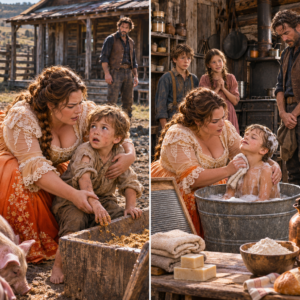
He was crouched beside the hog trough on the Toliver place, barefoot in the October cold, scooping something from the cloudy water with both hands and pushing it into his mouth as if he had forgotten there was any proper way to eat.
For one terrible second, Norah could not move.
Then she recognized him.
**Ned Toliver. Four years old. Eating from a trough meant for hogs.**
Her fingers tightened around the top rail of the fence until the old wood bit into her palm.
The morning was pale and sharp, with frost silvering the prairie grass between her small homestead and Ben Toliver’s larger spread next door.
She had come out carrying a basket of eggs.
She set it down without looking.
For four months she had watched the Toliver place decline.
At first, she told herself grief had a season.
Ben Toliver’s wife, Clara, had died in June after a fever that moved through Cutter’s Creek and took six people in less than two weeks.
Ben had buried her beneath the cottonwood at the edge of his south pasture.
Since then, the ranch had seemed to bury itself with her.
The laundry stopped appearing on the clothesline.
The windows stayed shut even on warm days.
The vegetable garden went to weeds.
Ben’s oldest boy, Sam, began wearing the same shirt for days at a time.
Nine-year-old Ruth stopped braiding her hair.
And little Ned grew quieter.
Too quiet.
Norah had seen all of it from the other side of the fence.
She had brought a pie once in July.
She left it on Ben’s porch without knocking because she feared embarrassing him.
She told herself he was proud.
She told herself he needed time.
She told herself widowers were allowed to fall apart.
But now a four-year-old child was eating from a hog trough.
Every excuse she had made for staying out of Ben Toliver’s business suddenly sounded exactly like what it had always been.
Cowardice dressed as courtesy.
Norah picked up the egg basket, turned, and marched back to her house.
Her own kitchen was clean, quiet, and painfully orderly.
Too orderly.
There were no children’s boots by her door.
No small shirts drying beside the stove.
No arguments over who had taken the last biscuit.
There never had been.
There never would be.
At forty-two, Norah had made peace with many things, but not all of them.
She had been married once.
Caleb Quinn had been kind, broad-handed, and patient.
They tried for children for eleven years.
None came.
Caleb died after a wagon accident six years before Clara Toliver’s fever.
Norah buried him on a windy March morning and returned home to a house that seemed larger than the prairie.
She had lived alone ever since.
She was a large woman, full through the hips and waist, with strong arms built from carrying grain sacks, kneading bread, hauling water, and managing her little property without help.
Her body was soft where life had softened it and solid where work had hardened it.
She had stopped apologizing for its size years ago.
The world still occasionally tried to remind her.
Women at church offered advice about darker fabrics.
Men assumed she needed help lifting things she could lift better than they could.
Once, a store clerk in Cutter’s Creek suggested that a certain chair might not be “comfortable enough” for her.
Norah had sat in it while discussing flour prices for twenty minutes out of spite.
She did not frighten easily.
But she had been frightened of Ben Toliver’s grief.
Not anymore.
She took the large wash kettle from the hook near her stove.
Then the washboard.
Then lye soap.
Then towels.
Then a clean shift she had made for Ruth months earlier and never found the nerve to give her.
She added two of Caleb’s old shirts, cut down years ago for cleaning rags but still usable for boys.
She packed bread, eggs, dried apples, salt pork, and coffee.
Then she stopped.
“Norah Quinn,” she said aloud to her empty kitchen, “if you are going to interfere, interfere properly.”
She added flour.
When she reached the Toliver house, she did not knock.
Knocking implied a question.
**Norah was not asking permission.**
She opened the door and stepped inside.
The smell nearly stopped her.
Cold ash.
Old grease.
Wet wool.
Unwashed dishes.
Something sour beneath it all.
The kitchen looked as though a storm had moved through and then become tired halfway.
Plates covered the table.
A blackened skillet sat on the stove.
Three days’ worth of ash filled the hearth.
A sack of potatoes had spilled under a chair and begun sprouting in the dimness.
Sam sat on the floor sharpening a stick with a kitchen knife.
Ruth was beside the wall attempting to sew a torn stocking.
Ned stood near the table, his bare feet gray with dirt.
And Ben Toliver sat in a chair with both hands resting on his knees.
He looked at Norah.
That was all.
He did not stand.
He did not ask why she had entered his house carrying half her kitchen.
He simply stared at her with the distant confusion of a man who had been underwater so long he no longer remembered the shape of air.
Ben was forty-five.
Before Clara’s death, he had been the kind of man people noticed.
Tall.
Broad through the shoulders.
Brown hair turning gray around the temples.
A face weathered by sun and ranch work rather than age.
He used to laugh easily.
Not loudly.
But often.
Norah had heard it across the fence.
She had not heard it once in four months.
Now his beard had grown uneven.
His shirt was stained.
His eyes looked hollow.
Norah placed the wash kettle on the stove.
Ben blinked.
She opened the stove and found nothing but dead coals.
“Sam.”
The boy looked up.
“Bring me kindling.”
He glanced at his father.
Ben did not react.
Sam stood and obeyed.
Norah filled the kettle from the water barrel.
Ruth stared at her.
Ned sucked two fingers.
When Sam returned, Norah built the fire.
Only then did Ben speak.
“What are you doing?”
His voice sounded rusted from disuse.
“Correcting an emergency.”
“There’s no emergency.”
Norah turned.
Ned still had dried trough water on his chin.
She pointed.
Ben looked.
Something flickered across his face.
Shame, perhaps.
Or recognition.
It disappeared too quickly.
“He gets into things.”
“He was eating from your hog trough.”
Ben flinched.
Norah continued.
“Your daughter’s stocking has more hole than stocking, your eldest is holding a kitchen knife sharp enough to open his hand, and I can smell your stove from my property.”
Sam lowered the knife.
Ruth tried to hide the stocking.
Ben stared at Norah.
“You came here to insult me?”
“No.”
She set the washboard beside the kettle.
“I came here to bathe your children.”
His expression changed.
“What?”
“And wash their clothes.”
He stood.
For the first time, the size of him filled the room.
Norah was not a small woman, but Ben Toliver towered over her.
Most people would have stepped back.
Norah did not.
“You don’t walk into my house and—”
“I just did.”
His jaw tightened.
“I don’t need your charity.”
“Good.”
Norah untied her bonnet.
“Because I didn’t bring any.”
Ben stared at her.
She pointed toward the kettle.
“I brought soap.”
Sam made a sound that might have been a laugh.
Ben looked at him.
The boy immediately became solemn.
Norah rolled up her sleeves.
“Sit down, Ben.”
“What?”
“You’re not ruining another meal under my watch.”
His eyes narrowed.
“I can feed my children.”
“Then today will be a useful demonstration.”
He opened his mouth.
Norah held up one finger.
“I watched your four-year-old eat pig mash this morning.”
The words landed hard.
Ben looked toward Ned.
Ned looked at the floor.
The anger drained from Ben’s face.
What replaced it was worse.
He sat.
Norah did not feel victorious.
She felt tired.
She had been angry enough to march over and furious enough to take control, but seeing him fold into the chair reminded her this was not laziness.
This was a collapse.
That did not excuse what was happening to the children.
But it changed how she handled the man.
Norah began with Sam.
He protested that he could wash himself.
She handed him soap and sent him behind a blanket she hung near the stove.
“Then prove it.”
He emerged fifteen minutes later cleaner, embarrassed, and noticeably less gray.
Ruth went next.
The girl tried to hide her hair.
Norah did not comment on the mats.
She worked slowly.
Warm water.
Soap.
A comb.
No questions.
Halfway through, Ruth began crying.
Quietly.
Tears slipped down her cheeks while Norah worked conditioner made from vinegar and herbs through the tangles.
Norah said nothing at first.
Then she began humming.
It was an old hymn her mother used to sing while mending clothes.
Ruth leaned against her.
The gesture was so small Norah nearly missed it.
Her chest tightened.
She had imagined children leaning against her more times than she could count.
She had stopped imagining years ago because hope had become painful.
Now a grieving nine-year-old rested her head against Norah’s full arm while being combed, and something old and hungry inside Norah woke up.
She did not trust it.
Not yet.
Ned went last.
He sat in the tub with enormous brown eyes.
Norah washed mud from behind his ears.
He watched her.
Finally he whispered, “Are you staying?”
Norah’s hands stopped.
Across the room, Ben’s head lifted.
Ruth looked over.
Sam stared toward the window.
Norah swallowed.
“For today.”
Ned considered that.
“Tomorrow?”
“I don’t know.”
He nodded with the seriousness only small children possess.
Then he said, “Mama went for one day.”
No one moved.
Ben stood abruptly and walked outside.
The door closed hard.
Ruth began crying again.
Sam looked angry.
Not at Norah.
At the world.
Norah wrapped Ned in a towel.
“He didn’t mean—” Sam began.
“I know.”
“No, you don’t.”
The boy’s voice sharpened.
“Papa thinks he killed her.”
Norah froze.
Ruth whispered, “Sam.”
But the words had already entered the room.
Norah stared at him.
“What do you mean?”
Sam looked frightened now.
He dropped his eyes.
“Nothing.”
“Sam.”
He shook his head.
“I shouldn’t have said.”
Norah looked toward the door Ben had gone through.
She remembered Clara’s fever.
The rumors.
Ben riding to Cutter’s Creek for medicine.
Returning too late.
She had always assumed his guilt was ordinary grief.
The kind that invents blame because helplessness is unbearable.
But Sam’s face told her there was more.
Norah finished dressing Ned.
Then she went outside.
Ben stood near the woodpile with both hands braced against a chopping block.
She stopped several feet away.
“I’m not asking what Sam meant.”
Ben’s shoulders tightened.
“Good.”
“Not yet.”
He looked back at her.
His face was pale beneath the beard.
“Norah.”
“Yes?”
“You should go home.”
“No.”
His eyes hardened.
“You cleaned them. You made your point.”
“I have not made breakfast.”
“It’s nearly noon.”
“Then lunch.”
He let out a bitter laugh.
“You think food fixes this?”
“No.”
She folded her arms.
“I think food fixes hunger.”
Silence.
“Soap fixes dirt.”
Silence.
“Sleep fixes exhaustion.”
His eyes dropped.
“And what fixes grief?” he asked.
Norah’s voice softened.
“Nothing.”
He looked at her.
“That’s the part no one tells you.”
Wind moved through the dry grass.
Norah continued.
“Grief does not get fixed. It gets carried differently.”
Ben’s jaw tightened.
“You sound like you know.”
“I buried a husband.”
His face changed.
“I know.”
“No.”
Norah’s eyes narrowed.
“You know Caleb died. That is not the same as knowing what came after.”
Ben looked away.
She continued.
“For six months, I set two cups on my table every morning.”
He said nothing.
“For nearly a year, I slept on the edge of the bed because the other side was his.”
Ben’s hands tightened.
“I understand more than you think.”
He swallowed.
“Then you should understand why I want to be left alone.”
“I do.”
She glanced toward the house.
“But you have three children.”
His face crumpled for half a second.
That was the first crack.
He turned away quickly.
Norah let him.
She went inside.
By sunset, the kitchen no longer smelled rotten.
The dishes were washed.
The floor had been scrubbed.
Three children were clean and fed.
Ben ate two bowls of stew without speaking.
Norah did not mention it.
She went home after dark.
The next morning, she woke before dawn.
She told herself she would stay on her side of the fence.
At seven, Ruth appeared at her door.
The girl wore the clean shift Norah had left behind.
Her hair was braided badly but proudly.
She held a folded piece of paper.
“Papa says you shouldn’t come.”
Norah stared at her.
“And?”
Ruth’s chin trembled.
“I think you should.”
Norah took the paper.
It was not from Ben.
The handwriting belonged to a woman.
Clara Toliver.
Norah knew it immediately because Clara had once written her a thank-you note after Norah delivered eggs during a flood.
The paper was unfinished.
Three lines.
Norah,
If anything happens to me, I need you to know that Ben is not—
The sentence stopped there.
No signature.
No explanation.
Norah looked at Ruth.
“Where did you find this?”
“In Mama’s Bible.”
“Does your father know?”
Ruth shook her head.
“No.”
“Why bring it to me?”
The girl’s answer came quietly.
“Because Mama wrote your name.”
And suddenly the question was no longer only whether Norah Quinn should keep interfering in Ben Toliver’s grief.
It was why a dying woman had been trying to send her a message.
**And what she had been about to say about Ben.**
## CHAPTER 2 — WHAT CLARA TRIED TO SAY
Norah spent most of that morning staring at the unfinished letter.
If anything happens to me, I need you to know that Ben is not—
Not what?
Not responsible?
Not alone?
Not the man people think?
Not the father of—
Norah stopped that thought immediately.
Grief could turn three unfinished lines into a hundred foolish stories if a person allowed it.
She needed facts.
That meant Ben.
She crossed the fence just before noon.
This time she knocked.
Ben opened the door wearing a clean shirt.
It was one of Caleb’s old shirts.
Norah recognized the stitching where she had narrowed the shoulders.
For some reason, seeing it on Ben unsettled her more than entering his filthy kitchen had.
He looked different clean.
Not healed.
Not even close.
But visible.
“Ruth went to you.”
It was not a question.
Norah held up the letter.
“Yes.”
His face drained.
“So you knew it existed.”
“No.”
The answer came too quickly to be false.
Norah studied him.
“May I come in?”
He stepped aside.
The kitchen remained cleaner than yesterday.
Not clean.
But better.
Sam was outside.
Ruth had taken Ned to gather eggs.
For the first time, Norah and Ben were alone.
She placed the letter on the table.
“Did Clara write to me often?”
Ben looked at it.
“No.”
“Did she ever talk about me?”
“Sometimes.”
“Why?”
His eyes lifted.
“Because you lived next door.”
“That is not an answer.”
A faint spark appeared in his expression.
“You always this pleasant?”
“Only when men avoid questions.”
That almost resembled the old Ben.
Almost.
He sat.
“She liked you.”
Norah remained standing.
“Clara and I were friendly. We were not close.”
“She wished you were.”
The answer surprised her.
Ben rubbed both hands over his face.
“She thought you were lonely.”
Norah stiffened.
“I was not.”
Ben looked at her.
She sighed.
“Fine. Sometimes.”
“She worried about you.”
“Clara had enough to worry about.”
“Yes.”
Something in his tone changed.
Norah sat across from him.
“Tell me what happened when she died.”
His entire body went still.
“I know the public version.”
“Then you know enough.”
“No.”
She pushed the letter toward him.
“Apparently your wife disagreed.”
Ben stared at the handwriting.
For a moment Norah thought he might tear it.
Instead he touched the edge with one finger.
“She wrote this the morning I went for medicine.”
“How sick was she?”
“Very.”
“Did you know?”
“Yes.”
“Then why leave?”
His face hardened.
“Because she told me to.”
Norah waited.
Ben’s eyes moved toward the window.
“Doctor Hale had been there the day before. Said there was nothing more he could do.”
“So you rode to town anyway.”
“I heard a traveling physician had come through with quinine and some new fever treatment.”
“You believed it might help.”
“I believed anything might help.”
His mouth twisted.
“Clara told me not to go.”
“But you did.”
“Yes.”
There it was.
The guilt.
“I was gone six hours.”
His voice had flattened.
“When I returned, she was barely conscious.”
Norah did not speak.
“Sam was sitting beside her. Ruth was crying in the pantry because she didn’t want Clara to hear. Ned was two.”
Ben swallowed.
“She died before sunset.”
“You think leaving killed her.”
He looked at Norah with anger.
“I wasn’t there.”
“That is not the same thing.”
“It is to me.”
“No.”
“You weren’t there.”
“I was with Caleb when he died.”
Ben flinched.
Norah forced herself onward.
“I held his hand. I heard every breath until there wasn’t another one.”
Her throat tightened.
“And for years I wondered whether I should have forced him to take the eastern road instead of the canyon. Whether we should have replaced that wagon wheel sooner. Whether I should have noticed the crack.”
Ben’s eyes changed.
“He died in an accident.”
“Yes.”
“So?”
“So I was there and still found a way to blame myself.”
Silence.
Norah pointed toward the letter.
“Guilt does not need facts.”
Ben looked down.
For a long while, neither moved.
Then he said, “There’s something else.”
Norah’s pulse shifted.
“What?”
“Clara and I argued before I left.”
“About what?”
He stood abruptly.
“That isn’t your concern.”
“Then why mention it?”
His jaw worked.
“Because if she wrote to you that morning, it may have been because of the argument.”
“What did you say?”
Ben looked at her.
“I told her I wouldn’t raise the children alone.”
Norah frowned.
“What did you mean?”
“She was dying.”
His voice cracked.
“I was angry.”
“At her?”
“At everything.”
He walked toward the stove.
“I told her she could not leave me with three children and a ranch and debts and no idea how to braid Ruth’s hair.”
Norah’s chest tightened.
“What did Clara say?”
Ben gave a broken laugh.
“She said, ‘Then learn.’”
Despite herself, Norah smiled.
“That sounds like her.”
“Yes.”
His face softened for the first time.
Then closed again.
“I told her I couldn’t.”
“And?”
“She said, ‘You will.’”
He stared at the cold stove.
“Then she said there were people who would help if I let them.”
Norah looked toward the letter.
“Did she name me?”
Ben did not answer.
“Ben.”
“Yes.”
The word dropped between them.
“What exactly did she say?”
His back remained toward her.
“She said if I got proud and stupid, I should go next door.”
Norah blinked.
Then laughed.
Actually laughed.
Ben turned.
She covered her mouth.
“I am sorry.”
“No, you aren’t.”
“No.”
Something moved in his face.
A tiny reluctant pull at one corner of his mouth.
Norah’s laughter stopped because seeing almost a smile on him felt more intimate than she expected.
She looked away.
“So Clara wanted me involved.”
“She thought highly of you.”
“Did she ever say why?”
Ben hesitated.
Then he shook his head.
“No.”
Norah knew he was lying.
Not completely.
But enough.
She did not press.
Not yet.
Instead she stood.
“I will come tomorrow.”
His eyes narrowed.
“That was not an invitation.”
“I know.”
“I may lock the door.”
“I have a shoulder.”
“Norah.”
She faced him.
“Your son ate from a hog trough yesterday.”
The fight left him.
She continued more gently.
“I am not trying to replace Clara.”
His head snapped up.
Norah felt heat rise in her face.
“That is what you think, isn’t it?”
“No.”
“Ben.”
He looked away.
“I don’t know what I think.”
“Good.”
She took her bonnet.
“Then do not decide before you do.”
For the next three weeks, Norah became part of the Toliver house by sheer persistence.
Not as a servant.
She refused that role immediately.
She made schedules.
Sam carried wood before breakfast.
Ruth washed dishes.
Ben handled laundry badly until he learned better.
Ned gathered eggs with supervision.
Norah cooked some meals.
Ben cooked others.
The first biscuits he attempted could have been used as ammunition.
Sam held one up.
“Can I throw it?”
Ben glared.
Norah said, “Only at coyotes.”
Ruth laughed so hard milk came out her nose.
Ben stared at his daughter.
Then he laughed too.
It was short.
Rough.
Almost painful.
But real.
The entire room went silent afterward.
Ben seemed ashamed.
Norah was not.
**That laugh became the first proof that the Toliver house was not dead.**
Norah also discovered Ben was not helpless.
He had simply stopped noticing what needed doing.
Once forced to see it, he worked.
He mended Sam’s boot.
He learned to braid Ruth’s hair, though his first effort leaned sideways like a damaged fence.
He built Ned a stool so the boy could reach the washbasin.
He opened the windows.
One afternoon, Norah saw Clara’s dress hanging on the line.
Freshly washed.
She stopped.
Ben came out carrying another basket.
“I thought you said changing things wasn’t betrayal.”
Norah looked at him.
“I did.”
“I’m trying.”
She nodded.
“Good.”
Their friendship grew in places neither expected.
Early mornings over coffee.
Arguments about whether children needed more discipline or more sleep.
Quiet walks between the barns.
Repairs.
Shared silence.
Norah noticed his hands first.
That irritated her.
She had no business noticing Ben Toliver’s hands.
They were large, scarred, capable.
When he fixed a broken hinge at her house, she watched his fingers work and became furious with herself.
Then she noticed his shoulders.
Worse.
Then his voice when he said her name softly.
Unacceptable.
She had been a widow for six years.
She had survived loneliness.
She did not need a grieving rancher with three children and enough emotional wreckage to fill a freight wagon.
Still, the body noticed things before wisdom could object.
One evening, Ben walked her home.
The sunset had turned the prairie copper.
Norah wore a dark green dress beneath her work apron.
Wind pressed the fabric against her full figure.
She caught Ben looking.
Not crudely.
Not accidentally.
Looking.
Norah stopped.
He stopped too.
“What?”
“Nothing.”
“You were staring.”
His ears reddened.
That almost delighted her.
“At what?”
Ben looked toward the horizon.
“Dangerous question.”
“Coward.”
His gaze returned.
This time he did not look away.
“At you.”
Norah’s pulse stumbled.
“Well.”
“That answer enough?”
“No.”
He gave her a disbelieving look.
She folded her arms.
“You interrupted my walk home with improper staring. Be thorough.”
Ben laughed under his breath.
“You are impossible.”
“I have been called worse.”
His expression softened.
“You’re beautiful.”
Norah forgot every clever answer she had ever possessed.
Men had complimented her before.
Usually carefully.
Pretty face.
Kind eyes.
Nice hair.
Words that avoided the body as though it were impolite terrain.
Ben’s eyes did not avoid anything.
Norah felt suddenly exposed.
“I am forty-two.”
“I can count.”
“I am not small.”
“I noticed.”
She narrowed her eyes.
“That could be interpreted badly.”
“It shouldn’t be.”
His voice changed.
“I like that you’re not small.”
Heat moved through her.
Ben continued, quieter.
“I like that when you walk into a room, it knows.”
Norah stared.
He looked embarrassed now.
Good.
She needed him embarrassed because she was dangerously close to being moved.
“Ben Toliver.”
“Yes?”
“That may be the strangest compliment I have ever received.”
“I haven’t practiced.”
“I can tell.”
They stood facing each other with the fence between their properties ten yards away.
For one moment, Norah thought he might kiss her.
She wanted him to.
That frightened her.
So she stepped back.
“Good night.”
His face closed slightly.
“Norah.”
She turned.
“I’m not Clara.”
The words came out harder than she intended.
Ben’s expression changed.
“I know.”
“Do you?”
“Yes.”
She searched his face.
“Good.”
Then she went home.
That night she barely slept.
Not because she regretted stopping him.
Because she had wanted him not to stop.
The next morning, Sam arrived before breakfast.
Norah opened the door.
He held another piece of paper.
Her stomach dropped.
“Where are you finding these?”
“Mama’s Bible.”
Norah frowned.
“You already searched it.”
“No.”
Sam looked guilty.
“Ruth did.”
Norah took the page.
Clara’s handwriting again.
This one was complete.
Ben must never know until he is ready, because he will mistake duty for love.
Norah stopped breathing.
Sam looked at her.
“What does that mean?”
She read the line again.
Below it was another.
If Norah ever comes to help, tell her to look inside the blue sewing box.
Norah’s heart began pounding.
Clara’s sewing box sat on a shelf in the Toliver bedroom.
She had seen it.
Never touched it.
Sam whispered, “Are we supposed to tell Papa?”
Norah folded the paper.
“No.”
The boy’s face tightened.
“That sounds like lying.”
“It might be.”
Norah looked toward the Toliver house.
Then back at Sam.
“But before we tell him anything, I need to know what Clara was trying to protect him from.”
That afternoon, while Ben was riding the west pasture, Norah stood in his bedroom beside Ruth and Sam.
The blue sewing box rested on the top shelf.
Norah took it down.
Inside were spools of thread.
Buttons.
Needles.
A child’s first tooth wrapped in cloth.
Then, beneath a false wooden panel, they found a bundle of letters.
Every envelope was addressed to the same person.
Norah Quinn.
None had ever been sent.
And the oldest one was dated **eleven years earlier—before Clara Toliver had ever married Ben.**
Don’t stop here—the ending will shock you. Continue reading Part 3 below.