CHAPTER 1 — THE BRIDE WHO DIDN’T RUN
**The first three women screamed when they saw Gideon Hayes’s face. Clara Simmons only looked at his trembling hands.**
That was the moment everything changed.
Bitter Creek, Wyoming Territory, 1881, was a hard little town built between a river that flooded in spring and mountains that tried to kill careless people in winter.
The stagecoach rolled into town beneath a sky the color of old iron, and every shopkeeper, ranch hand, widow, drunk, and child along Main Street seemed to stop what they were doing to stare.
Clara Simmons felt the coach groan when she stood.
She knew that sound.
Furniture had made it around her before.
Floorboards too.
People sometimes made a performance of pretending they had not noticed, which was worse than laughter because pity always carried the stink of superiority.
Clara lifted her carpetbag and stepped down by herself.
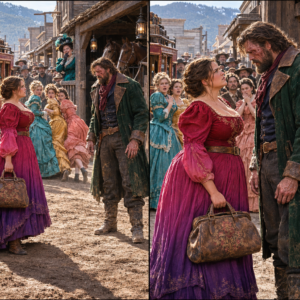
At twenty-eight, she weighed nearly two hundred sixty pounds and had spent most of her life being told that number was a confession.
Her shoulders were broad, her arms thick, her hips heavy, and her face soft and round beneath a plain brown traveling hat.
She had stopped wearing fashionable corsets three years earlier after one cracked against her ribs during a church dinner.
Her father called the decision vulgar.
Her mother called it unfortunate.
Clara called it breathing.
The first whisper reached her before both boots touched the ground.
“Good Lord.”
The second came from a woman standing outside the dry-goods store.
“She’s large enough to pull the plow herself.”
A few people laughed.
Clara knew the speaker immediately because Reverend Thomas O’Malley had mentioned her in one of his letters.
Beatrice Lawson.
Widow.
Church treasurer.
Owner of the sharpest tongue in three counties.
Clara lifted her chin.
She had survived twenty-eight years in Providence, Rhode Island, as Horace Simmons’s disappointing daughter.
She could survive ten minutes of Wyoming gossip.
The carriage driver climbed down beside her.
Rusty Flynn was a narrow man with white whiskers and a permanent squint.
“You want me to wait until you meet Hayes?” he murmured.
Clara looked at him.
“Do you think I should?”
Rusty scratched his jaw.
“I’ve learned not to tell women what they ought to do.”
“That sounds like knowledge purchased at great expense.”
“Two marriages.”
Clara almost smiled.
Then the crowd changed.
Not loudly.
No one announced anything.
People simply began moving aside.
A woman pulled her little boy closer.
Two men who had been lounging outside the saloon straightened.
Beatrice Lawson stopped smiling.
Clara followed their eyes.
A man stepped from the shadow beside the livery stable.
Her breath caught.
For two weeks, she had pictured Gideon Hayes.
The letters from Reverend O’Malley described him as thirty-six, hardworking, financially secure, sober, and “reserved following injuries sustained in a mining accident.”
Reserved had seemed harmless enough.
Injuries could mean anything.
A bad hand.
A limp.
Missing fingers.
Nothing in those careful words prepared her for the man walking toward her.
Gideon Hayes was tall, perhaps six feet three, with the heavy shoulders of someone accustomed to lifting timber.
His left leg dragged slightly behind the right.
That was not what stopped Clara’s breath.
The left side of his face had been destroyed.
A scar began near his temple, pulled the skin around his missing left eye, crossed a collapsed cheek, and twisted down toward his jaw.
The flesh was red in some places and pale in others, puckered and uneven from burns that had healed badly.
His left ear was partially gone.
The corner of his mouth pulled downward.
Three years after the dynamite blast that nearly killed him, the damage remained impossible to ignore.
People called him **the Beast of Iron Ridge**.
Clara understood why.
She also understood, almost immediately, why the name was cruel.
Gideon stopped ten feet away.
His right eye was gray-green and steady.
His hands were another matter.
They trembled.
Only slightly.
Most people probably would not have noticed.
Clara did.
He had walked toward her expecting something.
A scream.
A gasp.
Perhaps another woman covering her face and running.
He was braced for rejection so deeply that it lived in his fingers.
“I am Gideon Hayes.”
His voice was rough.
Not monstrous.
Just unused.
Clara nodded.
“Clara Simmons.”
“If you want to leave, Rusty departs in ten minutes.”
The people around them leaned closer without appearing to.
Gideon continued.
“I will pay your fare east.”
Clara blinked.
“That is how you greet your bride?”
His mouth tightened.
“You are not my bride yet.”
“I spent two weeks on trains and stages.”
“I know.”
“I slept beside a woman who snored like a sawmill.”
Rusty coughed.
Clara went on.
“I have eaten biscuits capable of killing a horse, crossed more mud than exists in Rhode Island, and been insulted by a woman in a blue bonnet before even finding breakfast.”
Beatrice’s face sharpened.
Clara pointed toward her trunk.
“If you have a wagon, Mr. Hayes, I suggest we load it.”
Gideon did not move.
“You saw me.”
“Yes.”
“All of me.”
“Yes.”
His good eye narrowed slightly.
Clara realized he needed her to say it plainly.
“You have scars.”
The crowd went silent.
“You limp.”
His jaw tightened.
“And?”
“And I am hungry.”
Rusty laughed first.
Someone else joined him.
Gideon stared at Clara as if she had spoken a language he had forgotten.
Beatrice whispered something behind her fan.
Clara turned.
“Mrs. Lawson?”
Beatrice lowered the fan.
“Nothing, dear.”
“Excellent.”
Clara faced Gideon again.
“I assume there is food on Iron Ridge.”
A strange sound escaped him.
Not quite a laugh.
“Yes.”
“Then I would like to meet it.”
For the first time in three years, Gideon Hayes did not know what to say.
He finally crossed the remaining distance, took Clara’s trunk, and lifted it into the wagon as if it weighed nothing.
Clara noticed something else then.
He did not look at her body with disgust.
He did not look at it with admiration either.
He simply looked at her as a person occupying space.
She had not realized how rare that felt until it happened.
Their wedding took place that afternoon in Reverend O’Malley’s small church.
No flowers.
No music.
No family.
Rusty Flynn served as witness.
Gideon stood stiffly beside Clara while the reverend spoke about duty, mercy, companionship, and courage.
When Gideon slid a plain gold band over Clara’s finger, his hand trembled again.
She covered it with hers.
He looked up sharply.
Clara did not explain.
Afterward, Reverend O’Malley drew Gideon aside.
Clara could not hear everything.
Only pieces.
“…land agent comes end of month…”
“…Larson pushing again…”
“…household proof…”
Gideon’s shoulders hardened.
When Clara approached, both men fell silent.
She hated secrets instantly.
Her father had built an entire family out of them.
“What is Larson?”
Gideon looked toward the church door.
“A problem.”
“Large or small?”
“Depends which side of a rifle you’re standing on.”
Reverend O’Malley frowned.
“Gideon.”
“What?”
“You might try not terrifying your wife in the first hour.”
Clara picked up her carpetbag.
“If I frighten easily, Reverend, I have made a disastrous mistake.”
Gideon looked at her again.
That strange almost-laugh returned.
The wagon ride toward Iron Ridge took nearly six hours.
The road began reasonably, then seemed to lose confidence in civilization.
Wagon ruts deepened.
Pines crowded closer.
Rock walls rose on one side while the ground fell sharply on the other.
Clara kept her hands folded because gripping the bench would have revealed how frightened she was.
Gideon noticed anyway.
“Don’t look down.”
“I wasn’t.”
“You were.”
“I was evaluating the possibility of death.”
“Low.”
“How low?”
“Today?”
She turned.
“That is not comforting.”
His mouth shifted.
Clara realized suddenly that Gideon Hayes possessed a sense of humor.
He had simply buried it with everything else.
They rode another mile.
Then he asked, “Why did you come?”
Clara stared ahead.
“I answered an .”
“That isn’t what I asked.”
She considered lying.
Then remembered what Reverend O’Malley had written about Gideon.
Sober.
Hardworking.
Reserved.
Nothing about cruel.
Nothing about dishonest.
“My father died last winter.”
“I’m sorry.”
“He was not.”
Gideon looked at her.
Clara continued.
“Horace Simmons owned textile warehouses in Providence.”
“I’ve heard the name.”
“That would have pleased him.”
She watched pine shadows cross the road.
“My family had money, servants, silver, imported furniture, and enough rooms that we could go days without seeing one another.”
“Sounds unpleasant.”
“It was.”
Her voice became quieter.
“My father believed appearance proved character.”
Gideon did not respond.
“He loved thin daughters, quiet daughters, daughters who looked beautiful beside expensive curtains.”
“You weren’t quiet.”
“No.”
“Or thin.”
She glanced at him.
“No.”
He nodded once, as though she had given him practical information.
Clara nearly smiled.
“My sisters married well.”
“And you?”
“I became useful.”
“That sounds useful.”
“Not the way he meant it.”
She swallowed.
“I managed kitchen inventories, supervised linens, carried trays, handled household accounts, and disappeared when guests came.”
Gideon’s hand tightened on the reins.
“Why?”
Clara laughed without humor.
“My father said no man wanted to look at a heifer while eating.”
The horses kept walking.
Gideon said nothing for several seconds.
Then, very softly, “Your father sounds like a bastard.”
Clara turned so quickly her hat shifted.
No one had ever said that to her.
Not servants.
Not cousins.
Not even her mother.
Respectability protected cruel men better than walls.
She laughed.
This time for real.
“Yes.”
Gideon’s good eye flicked toward her.
“Yes, he was.”
They reached the cabin near sunset.
Clara had imagined something poor.
She had not imagined loneliness made visible.
The cabin itself was strong, built from thick pine logs with a stone chimney and a roof meant for heavy snow.
Everything around it had been neglected.
Weeds reached the porch.
One shutter hung crooked.
The goat pen sagged.
Tools leaned beneath the eaves instead of being stored.
Inside smelled of smoke, leather, old coffee, and a man who had stopped expecting company.
Gideon set down her trunk.
“It isn’t much.”
Clara looked around.
A heavy table.
Two chairs.
A stove.
A rifle rack.
Shelves.
A bed near the fire.
A smaller room behind a rough plank door.
“Whose bed?”
“Yours.”
“And yours?”
“Back room.”
Clara looked at him.
“We are married.”
His face went rigid.
“I know.”
“I am not asking for anything.”
“Neither am I.”
There was hurt beneath the words.
Clara understood.
Three women had fled from his face.
He had learned to reject himself before anyone else could.
“You think I’m afraid of you.”
“You should be afraid of strangers.”
“That is sensible.”
“I am still a stranger.”
“Yes.”
He looked almost relieved.
Clara continued.
“But I am not afraid because of your face.”
The relief disappeared.
He glanced toward the window.
“Fresh water?” Clara asked.
He frowned.
“What?”
“You have a pump?”
“Creek. Forty yards east.”
“Buckets?”
“By the door.”
“Good.”
She removed her hat.
Gideon stared.
“What are you doing?”
“Finding out whether your kitchen can be saved.”
“You just arrived.”
“I noticed.”
“You should rest.”
“I rested for two weeks.”
“That stagecoach was not rest.”
“Neither is standing here discussing it.”
She rolled up her sleeves.
Gideon watched a woman twice rejected by her own family walk into his dead, neglected cabin and begin opening cupboards as though she had already decided it belonged to the living.
Something in his chest hurt.
He did not yet know whether that feeling was hope.
He only knew it frightened him.
The first week was warfare disguised as housekeeping.
Clara moved the flour.
Gideon moved it back.
Clara threw away moldy beans.
Gideon argued they could be washed.
Clara informed him that thrift and poisoning oneself were different skills.
He lost that argument.
She scrubbed soot from the windows until actual sunlight entered.
She washed blankets.
She dragged an old chair outside and beat enough dust from it to create weather.
She built shelves from scrap boards.
She found three spoons in places spoons had no business being.
“Why was this in the rifle cabinet?”
Gideon looked at the spoon.
“I knew where it was.”
“That is not an answer.”
“It worked for me.”
“You were living like a raccoon with land rights.”
Gideon stared.
Then laughed.
The sound startled both of them.
It was deep, rusty, and brief.
Clara pretended not to notice the way his face changed when he laughed.
A scarred face could still become gentle.
She found that discovery more unsettling than she expected.
By the second week, snow began dusting the higher slopes.
Gideon spent long days cutting wood, reinforcing fences, and checking his cattle below the ridge.
Clara learned the goats.
She learned the stove.
She learned that mountain water tasted like stone and cold.
She learned that Gideon’s limp worsened after he worked too long.
He tried to hide it.
She let him.
Until the storm.
It arrived with almost no warning.
One moment the sky was gray.
The next, wind slammed against the cabin hard enough to shake the shutters.
Gideon cursed and grabbed his coat.
“What?”
“Goat pen roof.”
Clara looked through the window.
The small structure leaned under the wind.
“Can’t it wait?”
“No.”
He was gone before she finished.
Clara watched from the doorway.
Snow swept sideways.
Gideon fought toward the pen.
He reached the roof.
Then his left leg buckled.
He fell.
Clara did not think.
She pulled on his spare coat and stepped into the storm.
The cold struck like a slap.
Snow climbed above her boots.
Her lungs burned.
Gideon tried to rise and failed.
“Go back!” he shouted.
Clara kept coming.
“Clara!”
She reached him.
His face was twisted with anger.
Not at her.
At himself.
“Leave me.”
“No.”
“My leg—”
“I can see your leg.”
“I’m too heavy.”
She stared.
Then almost laughed.
“You have met me, haven’t you?”
Before he could answer, Clara hooked both arms beneath his shoulders.
“Push with the good leg.”
“You can’t—”
“Gideon.”
He stopped.
Her voice changed.
“I have spent my entire life carrying things people said were too heavy.”
She tightened her grip.
“Push.”
He did.
Clara hauled.
He rose.
The two of them staggered through snow together.
Halfway to the cabin, Gideon collapsed again.
Clara cursed.
He looked shocked.
“What?”
“My father taught me Scripture.”
“Apparently not all Scripture.”
“He also owned warehouses.”
She dragged him another yard.
“And sailors taught me the rest.”
By the time they reached the porch, Clara’s lungs felt torn.
She got Gideon inside.
He sat near the stove, breathing hard.
His bad knee had swollen beneath his trousers.
Clara heated water.
“Take those off.”
His head snapped up.
“What?”
“Your trousers.”
He stared.
“Mrs. Hayes—”
“I am attempting to save your leg, not seduce you.”
His scarred cheek darkened.
Clara almost smiled.
He removed them.
She wrapped the knee in hot cloths.
The scars continued below his hip.
Long, pale lines crossed the thigh.
Crushed muscle had healed unevenly.
Clara touched nothing she did not need to.
Gideon watched her.
Finally, he asked, “Why did you stay?”
Clara looked up.
“What?”
“In town.”
His voice had lost its gravel.
“The others ran.”
Clara returned to the bandage.
“I am not the others.”
“You saw my face.”
“Yes.”
“You don’t have to pretend.”
“I am not.”
“Look at me.”
Clara did.
He flinched despite asking.
“My face frightens children.”
“Children are frightened by thunder.”
“Women cover their eyes.”
“Women covered their mouths when I walked into church in Providence.”
His jaw tightened.
“That’s different.”
“Why?”
“You aren’t ruined.”
Clara stopped.
The fire cracked behind her.
“Do you think I have never been called ruined?”
Gideon looked at her.
“My father told people I was sick so they would stop asking why I was not introduced at parties.”
Her voice remained steady.
“He hid me upstairs during my sister’s engagement dinner.”
Gideon’s good eye darkened.
“He said my body embarrassed him.”
Clara placed the cloth around his knee.
“You wear your scars outside, Gideon.”
He looked away.
“That makes it easier.”
“Easier?”
“To know where they are.”
He breathed slowly.
Clara continued.
“The world is full of monsters.”
Her fingers rested against his injured leg.
“But they do not always look like you.”
Gideon closed his eye.
A single tear crossed the ruined side of his face.
Clara pretended not to see it.
That night, neither slept much.
But something invisible between them had broken open.
Not love.
Not yet.
Something simpler.
Recognition.
Two people whom the world had reduced to bodies had finally been seen as human by each other.
Neither understood how dangerous that could become.
Because down in Bitter Creek, Beau Larson had just received news that the fourth bride had stayed.
And before the month ended, **he intended to take Iron Ridge from Gideon Hayes whether Clara was alive on it or not.**
CHAPTER 2 — THE HOUSE ON IRON RIDGE
Three days after the storm, Gideon woke to the smell of cinnamon.
He lay still.
For years, mornings had smelled like coffee, smoke, leather, damp wool, or nothing at all.
Cinnamon belonged to another kind of life.
He dressed and limped into the main room.
Clara stood beside the stove making something in an iron pan.
“What is that?”
“Breakfast.”
“It smells suspicious.”
“You may starve if frightened.”
She turned.
Her hair was braided loosely over one shoulder.
She was not beautiful according to any standard Gideon had grown up hearing men praise.
She was too large, too broad, too soft in some places and too powerful in others.
He realized with a jolt that he no longer understood why those categories mattered.
She looked alive in his cabin.
That was enough to unsettle him.
“What?”
Clara asked.
“You’re staring.”
“No.”
“You are.”
He looked toward the stove.
“What’s in the pan?”
“Apples.”
“We don’t have apples.”
“We did.”
“Where?”
“Behind six jars of nails.”
Gideon frowned.
“That’s where I kept winter nails.”
“You kept fruit with hardware.”
“They were dry.”
Clara shook her head.
He smiled before he could stop himself.
It became easier after that.
Not easy.
Easier.
Gideon still disappeared for hours without telling her exactly where he was going.
Clara still became angry when he treated pain like a private insult.
He disliked how she climbed onto chairs instead of asking for help.
She disliked how he moved things to higher shelves because he thought bending might hurt her back.
They quarreled about lamps.
About bacon.
About whether the goat named Mercy was intelligent.
“She understands gates,” Clara said.
“She eats rope.”
“Curiosity.”
“Stupidity.”
“Perhaps she dislikes imprisonment.”
Gideon looked at the goat chewing his glove.
“Perhaps she dislikes me.”
Clara smiled.
“Now you understand her.”
The cabin changed.
Clara made curtains from an old flour sack dyed with walnut.
She scrubbed the table until the grain showed.
She built wooden boxes beneath the windows and planted dried wildflower seeds Reverend O’Malley had given her.
“Nothing will grow before spring.”
“I know.”
“Then why plant now?”
“So the dirt remembers.”
Gideon stood very still.
Clara looked at him.
“What?”
“Nothing.”
“You say that often.”
“Safer.”
He walked away.
She watched him limp toward the shed and understood that something about her answer had hurt him.
Or healed him.
Perhaps both.
A week later, Gideon rode down to Bitter Creek for supplies.
Clara went with him.
The ride took nearly two hours.
When they entered town, people looked.
Clara had expected that.
What surprised her was how quickly she stopped caring.
Gideon looked too.
Not at them.
At her.
Every time a whisper rose, his shoulders stiffened.
Finally, outside the mercantile, Clara caught his sleeve.
“Stop.”
“What?”
“You are preparing to kill half the town with your expression.”
“They’re staring.”
“They stared last time.”
“They should know better.”
Clara smiled faintly.
“People rarely improve because someone glares at them.”
“I have had some success.”
“I imagine.”
Inside the store, Beatrice Lawson stood near the fabric counter.
She wore lavender wool and a smile that had no warmth.
“Mrs. Hayes.”
Clara nodded.
“Mrs. Lawson.”
“How are you finding the mountain?”
“Still there.”
Beatrice’s eyes moved over Clara’s dress.
“I imagine the climb is strenuous.”
“Yes.”
“I suppose extra… reserves are useful in winter.”
The words were wrapped politely.
The cruelty was not.
Gideon stepped forward.
Clara placed one hand against his chest.
He stopped.
She looked at Beatrice.
“I have found that extra reserves are useful in many circumstances.”
Beatrice blinked.
“For instance, patience.”
A ranch hand near the counter coughed.
Clara continued.
“I had plenty when I arrived.”
Her smile sharpened.
“It is diminishing quickly.”
Beatrice’s cheeks reddened.
Clara walked away.
Gideon followed.
Outside, he looked at her.
“You did not need help.”
“No.”
“Good.”
She studied him.
“Were you disappointed?”
“A little.”
Clara laughed.
Then a shadow crossed Gideon’s face.
Beau Larson stood across the street.
Clara knew him without introduction.
Some men carried power like a coat.
Beau wore it like a weapon.
He was perhaps forty-five, broad through the chest, clean-shaven, dressed in a black coat too expensive for a man who claimed to spend his days around cattle.
Two hired hands stood behind him.
He crossed the street.
“Hayes.”
Gideon’s body changed.
The humor vanished.
“Larson.”
Beau looked at Clara.
His eyes lingered long enough to be rude.
“So the bride stayed.”
Clara answered.
“I was unaware my residency concerned you.”
Beau smiled.
“Everything on Iron Ridge concerns me eventually.”
Gideon stepped between them.
“Walk away.”
Beau’s smile remained.
“You always were touchy about property.”
Clara felt something beneath the sentence.
History.
Not merely land.
Beau continued.
“Month ends soon.”
“I know.”
“Briggs files his report.”
“I know.”
“Hard to prove a thriving homestead with two people hiding on a mountain.”
Clara frowned.
“We are not hiding.”
Beau looked at her.
“Mrs. Hayes, you are new here.”
“That is usually what arrival means.”
His smile cooled.
“The ridge is difficult country.”
“So I have noticed.”
“Men have died trying to keep it.”
Gideon’s voice lowered.
“Enough.”
Beau looked at Gideon’s scar.
For one heartbeat, something ugly passed between them.
“Some men survive things they shouldn’t.”
Clara saw Gideon’s hand close.
“Gideon.”
Her voice stopped him.
Beau tipped his hat.
“Enjoy the mountain while it lasts.”
He walked away.
Clara watched him go.
“What was that?”
“Beau Larson.”
“I gathered.”
“Cattle baron.”
“You sound impressed.”
“I’m not.”
“What does he want?”
Gideon lifted their flour sack.
“Water.”
Clara followed him toward the wagon.
“Explain.”
He loaded the sack.
“My creek runs year-round.”
“And?”
“His lower range dries by August.”
“So he wants rights to your creek.”
“Yes.”
“Buy them.”
“He offered.”
“You refused.”
“Yes.”
“How much?”
“Enough.”
“That is your favorite number.”
He glanced at her.
“It wasn’t enough.”
They drove out of town.
Only when Bitter Creek disappeared behind them did Clara ask, “What does the month ending have to do with our marriage?”
Gideon kept his eyes on the trail.
“The land office says my final proof is weak.”
“How?”
“I filed under the Homestead Act after the mine accident.”
“You have lived there three years.”
“Before that I lived in company housing near the Silver Queen.”
“So?”
“Agent says Larson has challenged my improvements and residency.”
Clara’s jaw tightened.
“Can someone do that?”
“They can challenge.”
“Can they win?”
Gideon hesitated.
“Yes.”
“Why?”
“Briggs says I need proof the land is maintained as a permanent household.”
Clara looked at him.
“And that is why you needed a wife.”
He said nothing.
The silence answered.
Something inside her dropped.
Not because she had believed the marriage romantic.
She had not.
But she had begun believing it meant something beyond paperwork.
“So I am evidence.”
“No.”
“Gideon.”
“That is why I sent the .”
She looked away.
The mountains seemed colder.
He continued.
“It is not why I married you.”
“You did not know me before marrying me.”
“No.”
“Then please don’t insult us both.”
His hand tightened on the reins.
Clara stared straight ahead.
They rode in silence for nearly a mile.
Finally Gideon said, “I wanted the land.”
“I understand.”
“I also wanted a wife.”
Clara did not look at him.
“I wanted one before the accident.”
That made her turn.
He stared ahead.
“I bought the ridge because I planned a ranch.”
His voice had changed.
Younger somehow.
“I wanted cattle on the lower slope, horses, a bigger house, children.”
Clara said nothing.
“After the blast, I stopped thinking about it.”
“Because women ran?”
“Because I stopped believing any woman would stay long enough to hate me honestly.”
That hurt.
He continued.
“Then Briggs said Larson’s challenge could cost me the claim.”
“So you tried again.”
“Yes.”
“Three times.”
“Yes.”
“And all three left.”
“Yes.”
Clara looked at his scarred profile.
“Then I came.”
“Yes.”
“And I stayed.”
His good eye turned toward her.
“Yes.”
Something passed between them.
Not forgiveness.
Not yet.
But truth.
Clara understood the strange bargain more clearly.
Gideon had needed a wife for land.
She had needed a husband for escape.
Neither had arrived innocent.
That made the marriage feel less false.
Not more.
“What happened at the Silver Queen?”
Gideon’s face hardened.
“Mine accident.”
“I know.”
“Then you know.”
“No.”
Clara shifted toward him.
“I know dynamite exploded.”
His jaw moved.
“Three men died.”
She waited.
“I lived.”
“You say that like an accusation.”
He looked at her.
“Some days it is.”
He told her pieces.
Not everything.
The Silver Queen Mine sat two miles south of Iron Ridge.
Gideon had been foreman.
He knew every tunnel.
Every powder schedule.
Every crew.
The blast happened during a controlled expansion of the eastern drift.
A dynamite charge detonated early.
The concussion threw Gideon against a timber brace.
Rock and metal tore through his face.
A support beam crushed his leg.
When he woke two days later, half his world was dark.
“Who set the charge?”
“Powder man named Daniel Pike.”
“Did he survive?”
“No.”
“So no one knew why it went early.”
“Bad fuse.”
“Was that proven?”
Gideon shrugged.
“Company said so.”
Clara looked ahead.
“Did you believe them?”
“At the time.”
“And now?”
His silence lasted too long.
Before she could press him, the wagon jolted.
Gideon grimaced.
His left hand grabbed the seat.
Clara saw pain flash across his face.
“Stop.”
“I’m fine.”
“Stop the wagon.”
He did.
Clara climbed down.
“What are you doing?”
“Moving.”
“Where?”
“Your side.”
“I can drive.”
“I know.”
She climbed up beside the reins.
“Then why—”
“Because your leg hurts.”
His face closed.
Clara did not argue.
She simply took the reins.
Gideon watched her.
“You know horses?”
“I know enough.”
“That means no.”
“It means I watched our stableman for fifteen years.”
“That is not the same.”
“Then this will be educational.”
He almost protested.
Then his leg spasmed again.
He let her drive.
That surrender mattered more than either said.
At the cabin, Clara helped him inside.
That evening she found him sitting shirtless beside the stove, examining the scar along his thigh.
He heard her and reached for his shirt.
“Don’t.”
He froze.
Clara crossed the room.
Not close.
Not yet.
“You keep hiding from me.”
“I am sitting in front of you.”
“Your body is.”
His eye hardened.
“You want honesty?”
“Yes.”
“I don’t know what to do when you look at me.”
Clara stopped.
Gideon continued.
“Everyone else decides before they look long.”
“Decides what?”
“That I am something to endure.”
The words were quiet.
Clara felt them in her chest.
“You think I haven’t?”
“I don’t know.”
“Then ask.”
He stared at her.
“Do you find me ugly?”
There it was.
Not Beast.
Not monster.
Ugly.
A human question.
Clara sat across from him.
“Yes.”
His face went blank.
She continued before he could turn away.
“Sometimes.”
He looked back.
“The scar is ugly.”
She spoke gently.
“It was violence done to you.”
His breathing slowed.
“Your eye is gone.”
“Yes.”
“You limp.”
“Yes.”
“The injury is not beautiful.”
Something in him curled inward.
Clara leaned forward.
“But you are not your injury.”
His expression broke.
She touched her own stomach.
“My father thought this made all of me ugly.”
Gideon stared at her hand.
“He was wrong.”
“Yes.”
“Then why do you think I would make the same mistake about you?”
He closed his eye.
Clara reached for his hand.
He let her.
That night, their first kiss almost happened.
Almost.
Gideon lifted his face.
Clara’s breath caught.
Then hoofbeats sounded outside.
He was on his feet before she could move.
Pain shot through his leg.
He grabbed the rifle.
Clara stood.
“Who?”
Gideon looked through the shutter.
A rider waited in the snow.
Reverend O’Malley.
He came inside carrying an envelope.
“Land office.”
Gideon took it.
Clara watched his face harden as he read.
“What?”
He handed her the page.
The language was formal.
Clara read it twice.
Then a third time.
A final inspection of improvements and household would occur in twelve days.
If Gideon failed to satisfy the agent, the claim could be declared insufficient and reopened.
At the bottom was the signature.
**Elias Briggs, District Land Agent.**
Reverend O’Malley removed his hat.
“Beau Larson filed another complaint.”
Gideon looked toward the dark mountain.
Clara folded the paper.
“Twelve days.”
“Yes.”
She looked around the cabin.
The cleaned windows.
The stocked shelves.
The repaired goat pen.
The wood.
The curtains.
The two people living there.
Then she looked at Gideon.
“He wants proof of a household?”
“Yes.”
Clara’s mouth tightened.
“Then we will give him one.”
Gideon stared.
Reverend O’Malley smiled.
Neither man yet understood Clara Simmons Hayes.
Her father had spent twenty-eight years teaching her what wealthy men did when they wanted something.
They smiled.
They hired other people to make cruelty look respectable.
And they put lies on paper because they assumed women would never read closely enough to catch them.
Clara looked again at Briggs’s notice.
The paper felt strange beneath her fingers.
Cheap.
Local.
She knew paper.
Simmons Textiles had shipped invoices, contracts, warehouse receipts, and correspondence across the country for decades.
She turned the sheet toward the lamp.
A faint watermark appeared.
Not federal.
Not territorial.
A local manufacturer’s mark.
**Bitter Creek Mercantile Supply.**
Clara’s eyes narrowed.
“Gideon.”
“What?”
She lifted the notice.
“Who exactly is Elias Briggs?”
Neither man answered quickly enough.
And for the first time, Clara wondered whether the threat hanging over Iron Ridge had anything to do with federal law at all.
Don’t stop here—the ending will shock you. Continue reading Part 3 below.