### THE RING ON THE TABLE
### PART 1
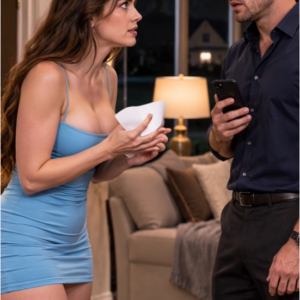
At on Saturday night, my wife stepped out of a hotel elevator carrying another man’s jacket. Twenty-three minutes earlier, she’d texted me that a budget crisis would keep her at the office until midnight.
Before she could retreat, the process server sitting beside me stood up.
“Paula Hale, these are for you.”
My wife stared at the divorce papers, then at me. She didn’t cry. She didn’t even drop the jacket. Instead, she studied my expression, trying to calculate how much I knew.
Behind her, Anthony Russo stepped out of the elevator. His expensive silver watch caught the chandelier light. The moment he saw me, he stopped.
I’d spent eight days imagining this confrontation. But standing there, I realized I had nothing to say to him. He wasn’t the person who had promised to remain faithful to me.
“Is this why you fought so hard to keep me at home?” I asked Paula.
“Aaron, not here.”
“Why not?”
“There are people watching.”
“You weren’t worried about that when you walked through the lobby with him.”
Anthony glanced toward the exit.
Paula looked at his overnight bag.
“It isn’t what you think.”
“I know about the dinners, the club, and the hotel reservations under his name. I know this started before our tenth anniversary.”
Anthony took a step backward. Paula’s expression immediately hardened.
“How did you get into my accounts?”
“They were synchronized to the family tablet.”
“You searched through my private correspondence!”
“You used the same tablet to tell me our son’s pediatric appointment was at two.”
She looked down at the divorce papers. For years, I’d admired her ability to remain composed under pressure. Now, I was watching her struggle to regain control of a situation she hadn’t anticipated.
“You don’t get to decide this alone,” she said.
I slowly removed my wedding ring and placed it on the marble table between us.
“You’ve been deciding alone for a long time.”
PART 2
Paula stared at the ring as though it were something she had never seen before.
Anthony cleared his throat.
“I think I should give you two some privacy.”
For the first time that evening, Paula looked genuinely frightened.
“Anthony, wait.”
He didn’t.
She watched him walk toward the hotel entrance, carrying his overnight bag. Within seconds, the man for whom she had risked her marriage disappeared through the glass doors.
His jacket was still in her hands.
I almost laughed at the absurdity of it.
Instead, I stood up.
“I’m going home.”
Paula grabbed my wrist.
“Aaron, please. We need to discuss this.”
“We will. Through our attorneys, and privately whenever it’s about our son.”
“You can’t seriously mean that.”
I looked at her hand until she released me.
“I wouldn’t have brought a process server if I didn’t.”
She followed me into the parking lot, struggling to balance the envelope, her purse, and Anthony’s jacket.
“Nothing happened tonight.”
I unlocked my car.
“Then I suppose you were planning to discuss the budget in his hotel room.”
She closed her eyes.
“I made some mistakes.”
“Mistakes?”
“I know how this looks.”
“Paula, I know what happened. There is a difference.”
Eight days earlier, I had been sitting at our kitchen table, checking the family tablet for our son’s upcoming appointments. A notification appeared from an account Paula had forgotten was connected to the device.
Anthony had sent her a message thanking her for the previous evening.
The previous evening, Paula had told me she was attending a professional networking event.
I opened the conversation.
For nearly an hour, I sat at that kitchen table, reading messages from a marriage I no longer recognized.
There were dinner arrangements, hotel confirmations, affectionate conversations, and discussions about how she could explain her absences.
But the messages that hurt most weren’t the romantic ones.
They were the ordinary ones.
She told Anthony about our disagreements. She complained that I was predictable. She mocked the little routines that had been the foundation of our family.
One evening, after I had cooked dinner and helped our son finish his homework, she had messaged Anthony about how exhausting domestic life had become.
I remembered that evening clearly.
When she returned home, I had warmed her dinner because I thought she’d had a difficult day.
That memory had been harder to accept than any hotel reservation.
In the parking lot, Paula began crying.
“Can we at least drive home together?”
“No. You have your car.”
“Aaron, stop treating me like a stranger.”
I opened the driver’s door.
“You’ve spent months living like one.”
I drove away before she could answer.
Our son, Oliver, was nine years old. He was spending Saturday evening at my mother’s house, where he had planned to stay overnight.
I’d arranged it because whatever happened between Paula and me, I didn’t want him witnessing the aftermath.
When I arrived home, the house felt unusually quiet.
There were family photographs along the hallway. Our wedding picture stood on the bookshelf. Oliver’s school drawings covered the refrigerator.
Nothing looked different.
Yet everything was.
I made myself a cup of coffee and sat at the kitchen table.
My phone began vibrating.
Paula called seven times before I answered.
“Where are you?”
“Home.”
“I’m coming.”
“That’s your decision.”
She arrived approximately twenty minutes later.
Anthony’s jacket was gone.
She placed her handbag on the counter and sat opposite me.
“Please let me explain.”
I nodded.
For the first time in eight days, I was willing to hear what she had to say.
“It wasn’t supposed to become anything serious,” she began.
“How long?”
She looked away.
“Paula. How long?”
“Almost seven months.”
I swallowed.
I’d suspected six.
Hearing seven made it worse.
“Was our anniversary part of it?”
She knew exactly what I meant.
For our tenth anniversary, I’d arranged a weekend away. Paula had canceled at the last minute, claiming she couldn’t leave because of work.
She had spent part of that weekend with Anthony.
“Yes,” she whispered.
I looked down at my coffee.
There had been a time when I believed that hearing the truth would bring relief.
It didn’t.
“Why?”
“I felt like we’d stopped being a couple. Everything was about work, bills, Oliver, responsibilities. Anthony made me feel interesting again.”
“Did you ever tell me you felt that way?”
“I tried.”
“When?”
She hesitated.
“I don’t know. There were times.”
“Did you tell me you were considering leaving our marriage?”
“No.”
“Did you ask me to go to counseling?”
“No.”
“Did you tell Anthony you were married?”
“Of course.”
I nodded slowly.
“So he knew. You knew. I was the only one who didn’t.”
She covered her face.
“I never wanted to hurt you.”
“You didn’t want me to find out. That’s different.”
For several minutes, neither of us spoke.
Then Paula asked the question I had been expecting.
“What happens to the house?”
There it was.
Not what happened to our marriage.
Not whether I could ever trust her again.
The house.
“We’ll work everything out properly,” I said.
“Are you trying to take everything from me?”
“No.”
“What about Oliver?”
“We’re both his parents. I’m not going to interfere with your relationship with him.”
Her shoulders relaxed slightly.
“Then why are you doing this?”
“Because being his father doesn’t require me to remain your husband.”
She stood up and walked toward the window.
“You’re throwing away ten years.”
I couldn’t believe she had said it.
“Ten years mattered to me, Paula. That’s why this hurts.”
She turned around.
“People survive affairs all the time.”
“Some do.”
“Then why can’t we?”
“Because surviving an affair requires more than getting caught.”
She opened her mouth, but nothing came out.
That night, I slept in the guest room.
At least, I tried.
I heard Paula moving around upstairs. At one point, she stood outside the guest room door for several minutes.
She knocked softly.
“Aaron?”
I didn’t answer.
Eventually, she went away.
The following morning, I picked Oliver up from my mother’s house.
He spent the entire drive telling me about a movie they had watched and pancakes Grandma had made for breakfast.
I listened carefully, grateful for something normal.
When we arrived home, Paula hugged him longer than usual.
Oliver laughed.
“Mom, you’re squishing me.”
She immediately released him.
“Sorry, sweetheart.”
He ran upstairs to play.
Paula waited until we were alone.
“We shouldn’t tell him anything yet.”
“I agree that we shouldn’t tell him details.”
“No, I mean anything. We can pretend things are normal until we’ve worked this out.”
“We haven’t worked it out because I’ve decided to leave the marriage.”
Her face tightened.
“You’re not even giving me a chance.”
I took a breath.
“You had seven months of chances.”
She walked away.
Later that afternoon, I received a message from an unfamiliar number.
It was Anthony.
Aaron, I understand you’re upset. I’d appreciate the opportunity to explain my side of things.
I stared at the message for a moment before replying.
There is nothing you need to explain to me. Please don’t contact me again.
I blocked the number.
Unfortunately, Paula was still waiting for Anthony to explain something to her.
And by Monday evening, she was beginning to understand that the man who had promised her excitement had never promised her a future.
PART 3
When I returned from work on Monday, Paula was sitting on the living room couch with her phone in her hand.
Oliver was upstairs doing homework.
I knew something had happened.
Paula had been crying.
“Did Anthony contact you?” she asked.
“Yesterday.”
“What did he say?”
“He wanted to explain himself.”
“And?”
“I told him not to contact me again.”
She nodded, staring at the carpet.
“He says we need to stop seeing each other.”
I placed my keys on the table.
“That sounds like something you need to discuss with him.”
“He won’t discuss anything.”
I said nothing.
“He told me he doesn’t want to get involved in a divorce.”
I almost asked what he had expected to become involved in when he started sleeping with a married woman.
But I stopped myself.
I had no interest in comforting her over the collapse of her affair.
“He says things have become too complicated,” she continued.
“Paula, I can’t be the person you talk to about losing Anthony.”
Her face crumpled.
“I’m not asking you to comfort me.”
“Then what are you asking?”
“I don’t know.”
For once, I believed her.
She had spent months maintaining two versions of her life. One involved a husband, a child, a home, and responsibilities. The other involved expensive dinners, hotel rooms, and a man who made her feel desirable.
Now the two worlds had collided.
Anthony had chosen to leave.
I had chosen to end our marriage.
And Paula was left confronting decisions she’d never expected to make.
Over the next two weeks, we began organizing our separation.
I met with my attorney. Paula eventually hired one of her own. We gathered financial records, discussed household expenses, and started working toward a parenting arrangement.
I didn’t hide money.
I didn’t empty accounts.
I didn’t threaten to take Oliver away from her.
I wanted a fair settlement and a stable life for our son.
Paula seemed surprised by that.
One evening, while we were reviewing household bills, she looked at me and asked, “Why aren’t you angrier?”
“I am angry.”
“You don’t act like it.”
“Would shouting make this easier for Oliver?”
She shook her head.
“Then there’s your answer.”
The truth was that I had plenty of anger.
There were mornings when I woke up remembering nothing, only to have the entire situation return within seconds.
Sometimes, I caught myself reaching for my wedding ring.
Sometimes, I started telling Paula something about my day before remembering that she was no longer the person I wanted to share it with.
Ending a marriage wasn’t like switching off a light.
It was discovering how many ordinary parts of your life had been connected to another person.
And then learning how to live without those connections.
The most difficult conversation came on a Sunday afternoon.
Paula and I agreed that Oliver deserved an age-appropriate explanation before our living arrangements changed.
We sat together at the dining table.
Oliver immediately sensed something was wrong.
“Am I in trouble?”
“No, buddy,” I said.
Paula reached for his hand.
“Your dad and I have been having some grown-up problems.”
He looked between us.
“What kind?”
“Problems with our marriage,” I explained. “We’ve decided we’re going to live in different homes.”
His expression changed.
“Like a divorce?”
“Yes.”
He pulled his hand away from Paula.
“Why?”
I glanced at her.
She was crying already.
“Sometimes adults have problems they can’t fix by staying together,” I said. “But we’re both still your parents. That will never change.”
“Did I do something?”
“No.”
I answered so quickly that he jumped.
“Oliver, listen to me. None of this happened because of you. You didn’t cause it, and you don’t have to fix it.”
He began crying.
Paula moved closer and hugged him.
I joined them.
For several minutes, the three of us sat together.
It was a terrible feeling.
I had never wanted my son to grow up dividing holidays and birthdays between two households.
But I also knew that pretending our marriage was healthy would teach him something equally damaging.
That love required accepting dishonesty.
That keeping a family together mattered more than respecting the people in it.
I couldn’t teach him that.
Not through words.
And certainly not through my example.
Later, after Oliver had gone upstairs, Paula sat beside me.
“We did this to him.”
I looked at her.
“He’s going to need both of us.”
She wiped her face.
“I wish I could go back.”
“So do I.”
It was the first time since the hotel that I had admitted it.
She looked at me hopefully.
“Then maybe we still can.”
“No, Paula. Wishing something hadn’t happened doesn’t mean it didn’t.”
She lowered her head.
Three weeks later, Paula asked me to attend a marriage counseling session with her.
I initially refused.
Then she explained that she wasn’t asking me to cancel the divorce. She wanted an opportunity for us to speak with someone who could help us understand how to move forward, particularly as parents.
I agreed.
During the session, the counselor asked Paula what she hoped to accomplish.
“I want my husband back.”
The counselor looked at me.
“And you?”
“I want to be able to trust my own judgment again.”
Paula turned toward me.
“What does that mean?”
“It means I spent months believing the person closest to me was telling me the truth. I need to understand how to move forward without questioning every relationship I have.”
She looked devastated.
“I didn’t realize I’d done that to you.”
“I know.”
The counselor asked whether Paula believed the affair was a consequence of problems in our marriage.
“Yes,” she said quietly.
I waited.
Then Paula corrected herself.
“No. I mean, we had problems. But Anthony wasn’t a solution to them.”
It was the first time I had heard her separate the two things.
She continued.
“I could have talked to Aaron. I could have asked for counseling. I could have left if I was that unhappy.”
Her voice trembled.
“Instead, I wanted everything. I wanted my family, my husband, and Anthony. I thought I could keep them separate.”
I looked at her.
“And when you couldn’t?”
“I blamed you.”
For months, Paula had been increasingly critical of me.
She complained that I didn’t understand her ambitions. That I didn’t make enough effort. That our weekends were boring.
I’d taken those complaints seriously.
I’d tried harder.
I’d planned dinners, offered to take on additional household responsibilities, and suggested spending more time together.
Meanwhile, she had already been investing her emotional energy elsewhere.
Hearing her acknowledge it didn’t erase what she’d done.
But it helped me stop wondering whether I’d somehow caused it.
After the session, we stood beside our cars.
Paula looked at me.
“Do you think you could ever forgive me?”
“Maybe someday.”
“And then?”
“Forgiveness isn’t necessarily reconciliation.”
She nodded reluctantly.
“I understand.”
For the first time, I thought she actually did.
A month later, we agreed to sell the family home rather than create a financial arrangement neither of us could comfortably maintain.
We would divide the proceeds according to our settlement and establish separate households.
I found a modest place near Oliver’s school.
Paula found another within a short drive.
Together, we developed a parenting schedule that allowed Oliver to maintain his friendships, school activities, and time with both families.
There were disagreements.
Paula wanted more flexibility. I wanted consistency.
We discussed it until we found something workable.
By then, Anthony had become a subject she rarely mentioned.
One afternoon, while we were packing boxes, she unexpectedly brought him up.
“He was never going to leave his life for me.”
I kept folding a stack of towels.
“He told me what I wanted to hear. I thought that meant something.”
“Did he actually promise you a future?”
She hesitated.
“No.”
I placed the towels into the box.
“Then perhaps you were both enjoying something that didn’t require responsibility.”
She looked at me for several seconds.
“I think that’s exactly what it was.”
There was no satisfaction in hearing it.
Anthony hadn’t taken my wife away from me.
Paula had chosen to step away from our marriage.
That distinction mattered.
Because if I blamed Anthony for everything, I would be ignoring the person who had actually made promises to me.
Before leaving that evening, Paula handed me a small envelope.
Inside was my wedding ring.
“I picked it up after you left the hotel,” she explained.
“I thought you might want it back.”
I held it between my fingers.
For ten years, that ring had meant commitment, security, and a future I thought I understood.
Now it was simply a piece of metal.
“You can keep it,” I said.
She shook her head.
“I don’t think that’s right.”
I closed my hand around it.
“All right.”
She waited, perhaps hoping I would put it on.
I placed it in my pocket instead.
ENDING
Our divorce was finalized several months later.
There was no dramatic courtroom confrontation.
No shouting.
No last-minute revelation.
Just paperwork, signatures, and the formal conclusion of a relationship that had once been the most important part of my life.
Paula and I stood outside afterward.
She looked tired.
“So that’s it?”
I nodded.
“That’s it.”
She stared at the pavement.
“I never imagined this was how we’d end.”
“Neither did I.”
For a moment, she reached toward my hand.
Then she stopped.
“I’m sorry, Aaron.”
She had apologized many times since the hotel.
But this apology felt different.
There was no request attached.
No explanation about feeling lonely.
No accusation that I had failed her.
Just an acknowledgment.
“I know,” I said.
We walked toward our separate cars.
That evening, Oliver helped me make dinner.
He insisted that we make homemade pizza, even though his version involved approximately three times the necessary amount of cheese.
As we sat together eating, he looked around our new living room.
“Dad?”
“Yeah?”
“Are you happy here?”
I thought about the question.
The apartment was smaller than our old house. The furniture wasn’t particularly impressive. Some of the walls were still bare.
But there was peace.
I no longer wondered whether someone’s late-night meeting was real.
I no longer studied the expression on my wife’s face, searching for an explanation she wouldn’t give me.
And I no longer felt like I had to earn the loyalty of someone who had already promised it.
“Yeah, buddy,” I said. “I think I am.”
He smiled.
“Me too.”
That was enough.
Over the following year, our new routines became familiar.
Oliver kept a toothbrush at both homes. He had favorite books at my apartment and a collection of games at Paula’s.
We attended school events together when appropriate.
We shared information about appointments and homework.
On his birthday, Paula and I organized a small celebration together.
It wasn’t awkward in the way I had feared.
We were simply two parents celebrating their child.
At one point, Oliver ran toward us holding a piece of cake.
“This is the best birthday ever!”
Paula laughed.
I smiled.
For the first time, I could look at our family without dwelling on everything that had been lost.
Something important remained.
It just looked different.
Paula continued attending counseling.
She told me occasionally that she was learning more about why she had depended so heavily on outside validation.
I hoped those lessons would help her.
Not because I wanted her back.
Because Oliver deserved a mother who was emotionally healthy, and Paula deserved the opportunity to become a better version of herself.
Her mistakes didn’t mean she was incapable of growth.
They simply meant I was no longer obligated to remain beside her while she grew.
One Saturday afternoon, almost a year after the confrontation at the hotel, Paula and I were watching Oliver play soccer.
She sat beside me on the metal bleachers.
For a while, we talked about school and his upcoming summer activities.
Then she asked, “Do you ever think about that night?”
I knew which night she meant.
“Sometimes.”
“I still remember seeing you sitting there.”
I nodded.
“I thought you’d yell at me,” she continued. “I thought you’d confront Anthony. I thought you’d demand that I choose between you.”
“Would you have chosen me?”
She considered the question.
“Yes.”
“Why?”
Her eyes filled with tears.
“Because I knew what I was about to lose.”
I watched Oliver run across the field.
“That’s the problem, Paula.”
She didn’t respond.
“I wanted a wife who chose me before she was afraid of losing me.”
A long silence followed.
Finally, she nodded.
“I understand that now.”
Oliver’s team scored, and we both stood up to applaud.
The conversation ended naturally.
There was no need to say anything else.
A few weeks later, I was organizing a drawer when I found the wedding ring.
It had been sitting inside the same envelope Paula had given me.
I turned it over in my hand.
I remembered our wedding.
I remembered holding Oliver for the first time.
I remembered vacations, holiday mornings, quiet conversations, and years of believing I had found the person with whom I would grow old.
Those memories were real.
Paula’s betrayal didn’t make every happy moment a lie.
But those happy moments didn’t obligate me to overlook her betrayal either.
Both things could be true.
I had loved her.
She had hurt me.
And I had chosen to leave.
I put the ring back into the envelope and returned it to the drawer.
I didn’t need to throw it away.
I didn’t need to destroy it.
It no longer had power over me.
That evening, Oliver and I went for a walk.
He rode his bicycle while I followed along the sidewalk.
The air was cool, and the neighborhood was peaceful.
At one point, he stopped and waited for me.
“Come on, Dad! You’re too slow!”
I laughed.
“I’m coming.”
He pedaled ahead again.
As I watched him, I realized that for the first time in a very long time, I wasn’t thinking about what Paula had done, where Anthony was, or how differently my life might have turned out.
I was thinking about dinner.
About Oliver’s upcoming school project.
About the weekend ahead.
Ordinary things.
Beautifully ordinary things.
Paula had once complained that our life together was too predictable.
Perhaps it had been.
But I had never considered loyalty boring. I’d never considered coming home to someone you loved a burden. I’d never believed that peace was something to escape.
At on a Saturday night, my marriage had ended in a hotel lobby.
I had walked away without my wedding ring, without the future I’d imagined, and without knowing how difficult the following months would be.
For a while, I thought that evening would define the rest of my life.
It didn’t.
What defined my life was everything I chose to do afterward.
I chose to remain a devoted father.
I chose fairness instead of revenge.
I chose to stop asking someone else to give me the respect I could give myself.
And eventually, I chose to let go.
Not because the betrayal stopped mattering.
But because my future mattered more.
### THE END.