

Unveiling the Lost Trident of Atlantis: A Deep-Sea Archaeological Discovery Near Bimini Road
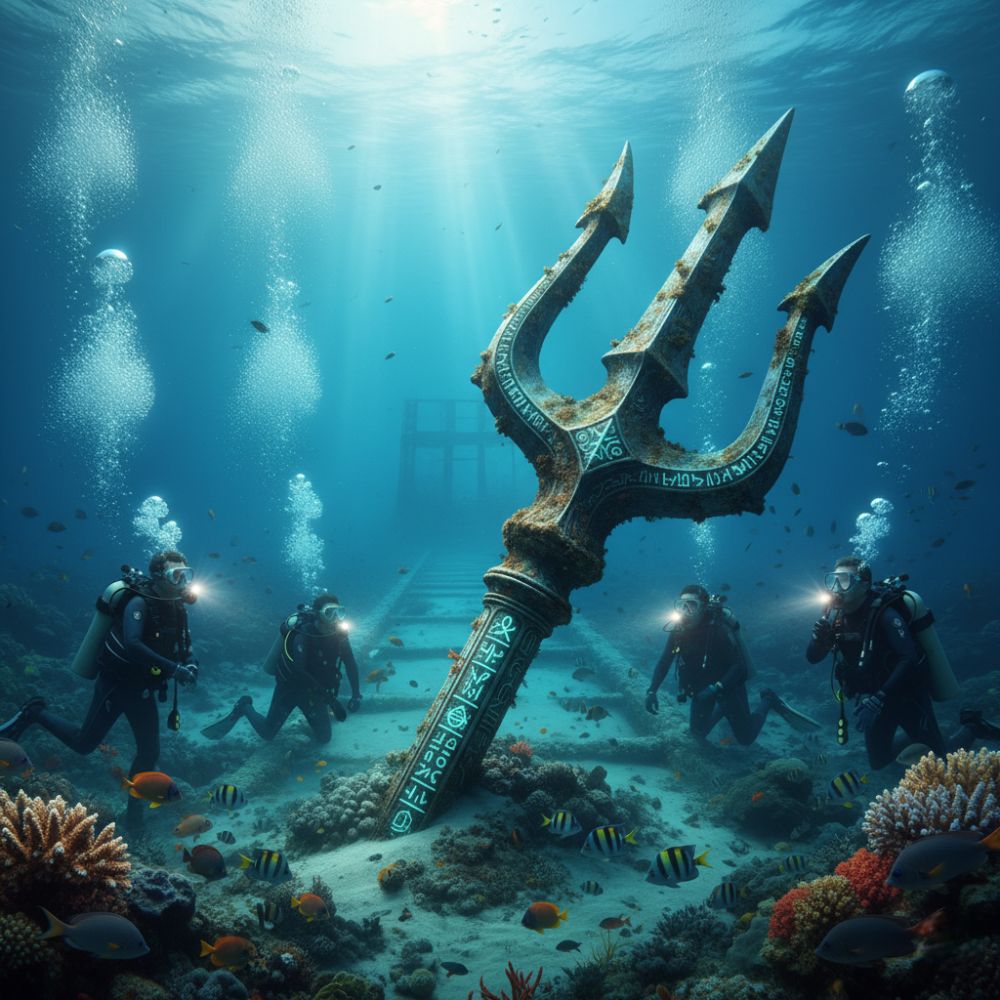
The year was 1978. Dr. Aris Thorne, a maverick marine archaeologist with a penchant for the unconventional, stared out at the shimmering expanse of the Atlantic. His eyes, though weary from countless hours poring over ancient texts and cryptic charts, held a spark of wild determination. For decades, the enigma of Atlantis had consumed him, not as a fanciful myth, but as a tangible possibility, a lost civilization waiting to be rediscovered.
Conventional archaeology scoffed at his obsession, but Dr. Thorne found an unlikely ally in a whispered legend among Bahamian fishermen – tales of strange, rectilinear rock formations on the seabed near North Bimini Island. These were dismissed by most as natural phenomena, but Thorne saw something more. He saw design, purpose, and a chilling echo of Plato’s descriptions. He saw the Bimini Road.
With a shoestring budget and a motley crew of equally eccentric divers and historians, Thorne embarked on what many called a fool’s errand. Days bled into weeks as they explored the shallow, crystal-clear waters, painstakingly mapping the peculiar stone pathway. Then, one fateful afternoon, a new lead emerged. A rogue current, stronger than any they had charted, had exposed a deeper trench, previously hidden beneath layers of sand and sediment.
“Dr. Thorne, you need to see this!” came the urgent crackle over the comms from his lead diver, Maria Rodriguez.
Thorne descended, his heart pounding a rhythm as ancient as the ocean itself. The beam of his underwater light cut through the gloom, revealing a sight that made his breath catch in his throat. There, half-buried in the sand, massive and undeniably artificial, lay what appeared to be the hilt of something monumental.
Over the next several months, a more extensive excavation began. The world watched, initially with skepticism, then with breathless anticipation, as the incredible object slowly emerged from its watery tomb. It was colossal, crafted from an unknown, barnacle-encrusted metal that glowed with an ethereal luminescence when disturbed. And as the final layers of sediment were carefully cleared, its true form was revealed.
It was a trident. Not merely a weapon, but a symbol of immense power and antiquity. Its prongs, each as thick as an ancient oak, pointed skyward, adorned with intricate, never-before-seen glyphs that seemed to hum with latent energy. Around it, the seabed teemed with life – vibrant corals and schools of fish, seemingly drawn to its silent majesty. Divers circled the relic, their lights illuminating its scale, their air bubbles testament to the awe they felt.
The discovery sent shockwaves through the scientific community. Carbon dating proved impossible, but the geological strata suggested an age far predating any known human civilization. The trident’s material defied contemporary metallurgy. Was this truly a relic of the legendary Atlantis, lying just off the shores of the Bahamas, connected to the mysterious Bimini Road?
Dr. Aris Thorne, no longer a maverick but a pioneer, stood on the deck of his research vessel, the sea breeze carrying the scent of salt and ancient mysteries. He looked at the sonar images of the colossal trident, now meticulously documented and being carefully prepared for a deeper study. The journey had been long, fraught with disbelief and challenges, but the unveiling of this magnificent artifact was undeniable proof. The ocean still held its secrets, and sometimes, with enough persistence and belief, humanity could finally begin Unveiling the Lost Trident of Atlantis: A Deep-Sea Archaeological Discovery Near Bimini Road. The search for Atlantis had just begun anew.