

Unearthing Giants: The Giza Desert’s Prehistoric Secrets
The year was 1922, and the relentless Egyptian sun beat down on the Giza Desert. Howard Carter was making headlines, but miles away, a lesser-known, equally determined team led by Dr. Aris Thorne was toiling under a different kind of pressure. They weren’t after pharaohs; their quest was far more ancient, driven by fragmented Bedouin tales of enormous “desert dragons” buried beneath the sands.
For months, their efforts yielded little beyond pottery shards and minor faunal remains. Morale was flagging, and funding was tighter than ever. Then, late one sweltering afternoon in September, a young local guide, Mahmoud, struck something unusually hard and vast beneath a shifting dune. The sound resonated differently, a dull thud that sent a shiver of anticipation through Dr. Thorne.
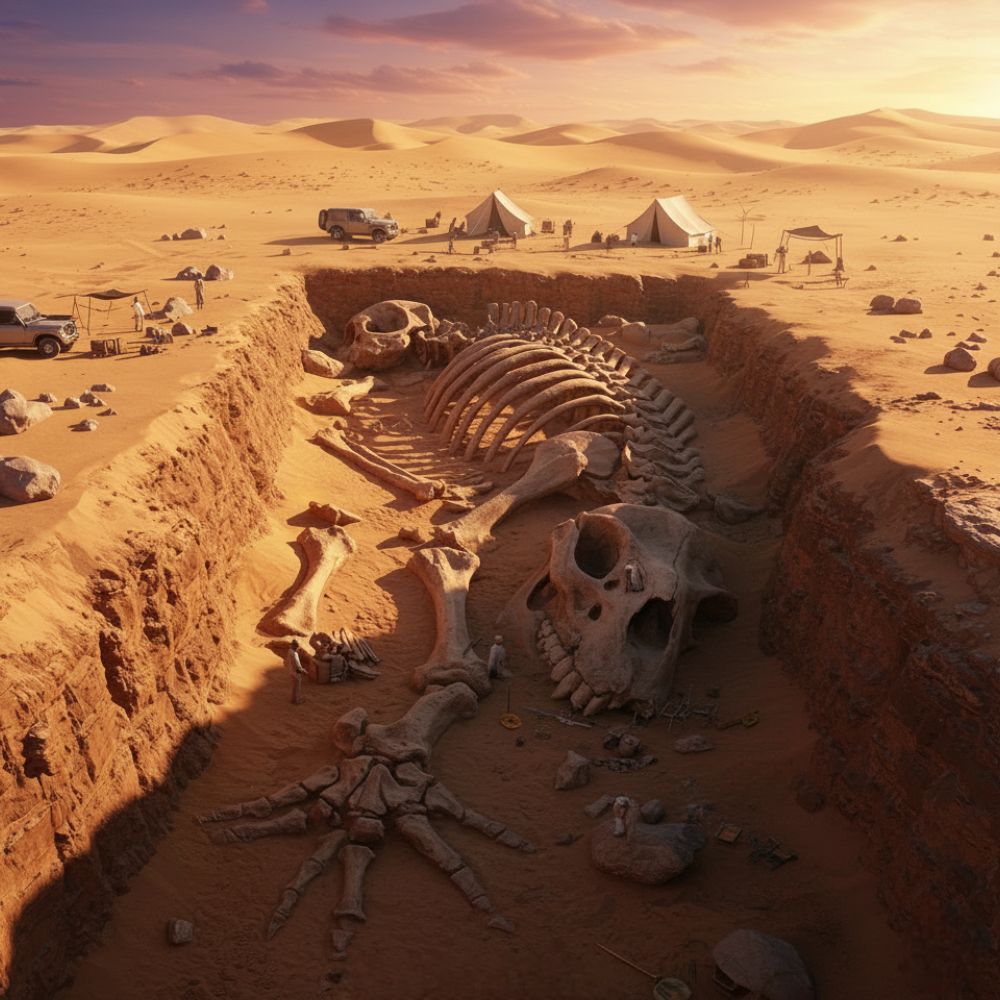
What began as a careful excavation soon spiraled into a monumental undertaking. The team dug a trench of unprecedented scale, revealing not fragments, but the sheer, colossal architecture of an ancient being. As days blurred into weeks, the outline of a gargantuan skeleton began to emerge, each bone larger than any known terrestrial creature. The skull alone was the size of a small car, its eye sockets like deep, ancient wells. Ribs curved outward like the beams of a sunken ship, protecting a space where a heart the size of a drum must once have pulsed.
The discovery sent shockwaves through the scientific community. This was no ordinary dinosaur, no mastodon. Its anatomical structure, while vaguely reptilian, possessed unique characteristics that defied easy classification. Paleontologists, geologists, and even bewildered zoologists flocked to the site, debating its origins, its diet, and its place in the primordial tapestry of Earth. Theories ranged from an unknown super-apex predator from the late Cretaceous, perhaps a species driven to extinction by the very desert that now cradled its bones, to an entirely new branch of life.
Dr. Thorne, a man of quiet intensity, presided over the site with a mix of awe and scientific rigor. He oversaw the painstaking process of cataloging and preserving each immense bone, his mind constantly racing to piece together the narrative of this forgotten giant. As the sun dipped below the horizon each evening, painting the desert in hues of fiery orange and deep violet, the skeletal remains seemed to glow with an ethereal light, a silent testament to a world lost to time.
The Giza Desert, long synonymous with the pharaohs, had now revealed an even deeper secret, rewriting not just a chapter, but an entire epoch of Earth’s ancient history. The “desert dragon” was real, and its unearthing in 1922 stood as a testament to the boundless mysteries that the sands of time still held, waiting for the patient hand of discovery.