

Unearthing Giants: The Hell Creek Formation’s Latest Discovery
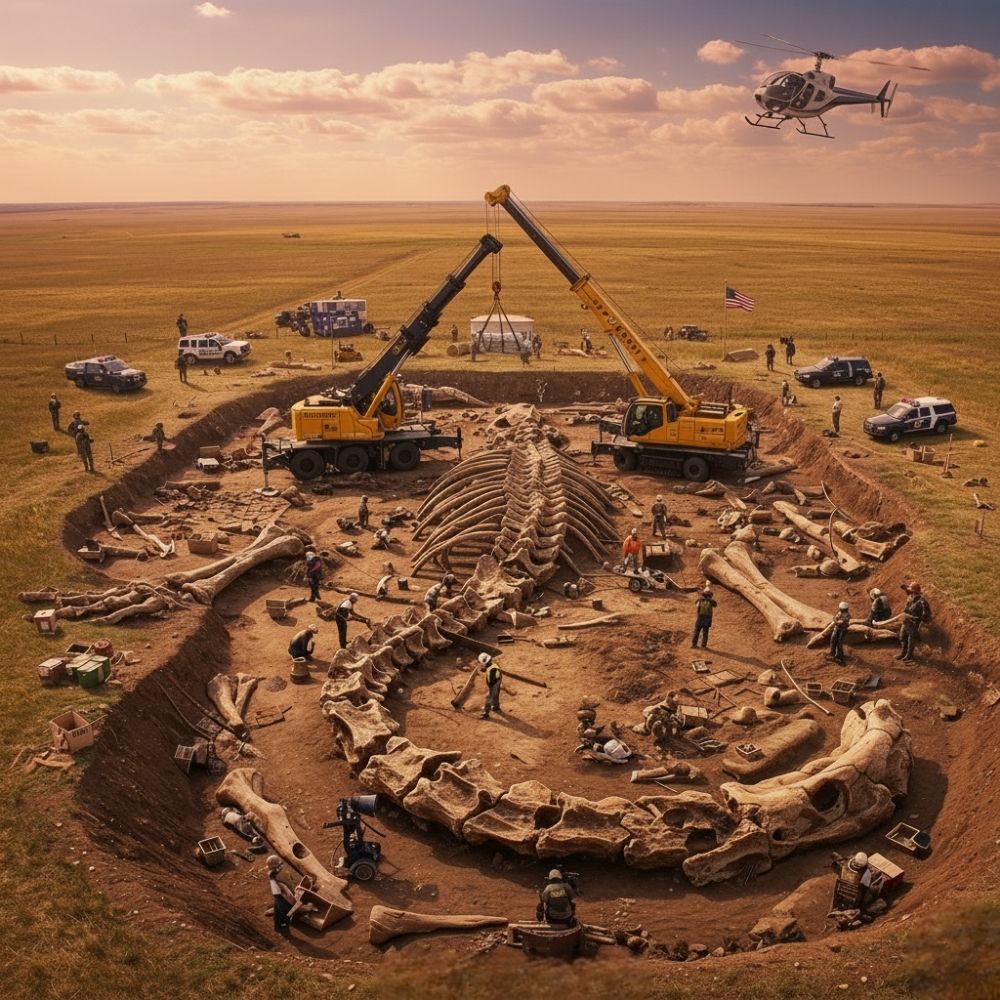
The Montana sky, painted in hues of apricot and rose by the setting sun, cast long, dramatic shadows across the vast expanse of the Hell Creek Formation. Below, a scene of meticulously organized chaos unfolded within a colossal excavation pit. For months, this unassuming patch of badlands, previously known only to cattle and coyotes, had become the epicenter of the paleontological world.
Dr. Eleanor Vance, her face smudged with dust and a glint of triumph in her eyes, directed the placement of another custom-built crate near the ribcage of the colossal specimen. “Steady, team,” she called out, her voice carrying a calm authority that belied the monumental task at hand. “This section is particularly fragile. We don’t want to lose a single fragment of this incredible beast.”
The “beast” was nothing short of miraculous. Initially discovered by a local rancher after an unusually heavy spring rain exposed a massive vertebrae, the find quickly escalated into the most significant paleontological excavation in decades. What they had unearthed was a nearly complete skeleton of a previously undescribed species of long-necked sauropod, a behemoth that once roamed these very lands during the Late Cretaceous period. Nicknamed “Titanus Aeturnus” – the Eternal Giant – by the team, its sheer scale was breathtaking.
Two massive mobile cranes, nicknamed “Bronto” and “Rex” by the crew, stood like sentinels, their powerful arms poised to gently lift the heaviest bones. Below, a veritable army of paleontologists, students, and technicians swarmed over the exposed fossil bed. Each person played a crucial role: some painstakingly removed the surrounding matrix with delicate brushes and dental picks, others meticulously documented every inch of the bone structure with 3D scanners and cameras, while still others applied plaster jackets to stabilize the more fragile elements.
The distant hum of helicopter blades was a constant companion, a reminder of the remote nature of their dig and the invaluable logistical support provided by the Montana Bureau of Land Management. Supplies, specialized equipment, and even emergency medical personnel were ferried in and out of the site, making this a true collaboration between science and resourcefulness.
As the last rays of sunlight faded, casting the landscape in a deep indigo, Eleanor leaned against the exposed hip bone of Titanus. She remembered the initial skepticism, the endless grant applications, the countless hours spent poring over geological maps. Now, standing amidst the skeletal grandeur of a creature that had died 68 million years ago, all the challenges seemed insignificant.
This wasn’t just about digging up old bones; it was about piecing together a story. The story of a vibrant ecosystem teetering on the brink of a catastrophic extinction event. The story of life’s incredible resilience and its ultimate fragility. Tomorrow, the sun would rise again, and the meticulous work would continue. But for tonight, under the vast, star-dusted canopy of the Montana sky, Dr. Vance allowed herself a moment of quiet awe, surrounded by the silent majesty of the Hell Creek Formation’s latest, and perhaps greatest, discovery. The giants, after millions of years of slumber, were finally beginning to tell their tale.