

The Sunken Secrets of Alexandria: An Underwater Discovery
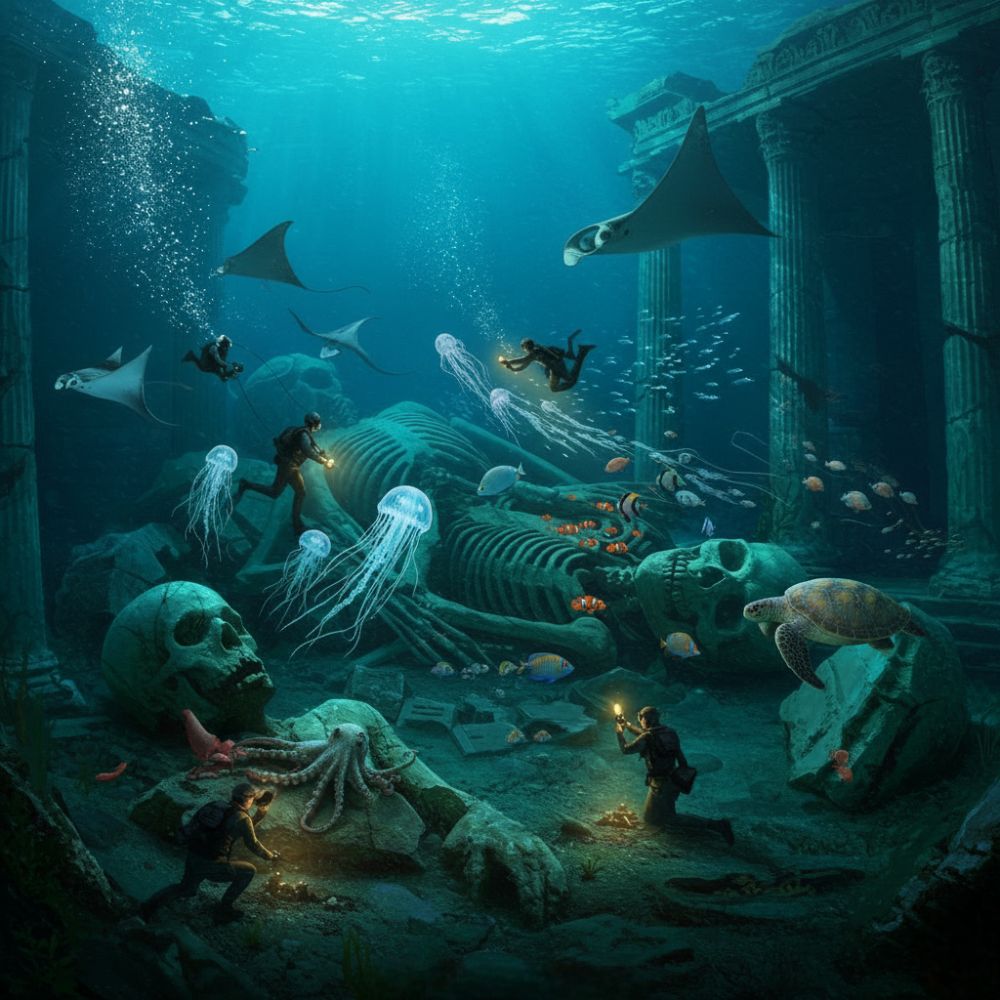
The year was 1998, a pivotal moment in the annals of underwater archaeology. Dr. Aris Thorne, a man whose life had been dedicated to deciphering the whispers of the past, was aboard the Tethys, a research vessel bobbing gently over the submerged ancient ruins of Alexandria, Egypt. For years, sonar maps had hinted at anomalies deeper than previously explored, beyond the well-documented palace of Cleopatra and the Pharos lighthouse fragments. Today, Aris and his team were finally descending into that unexplored abyss.
The current was gentle as Aris, clad in his specialized rebreather suit, dropped through the cerulean layers. His powerful dive light cut through the gloom, revealing the ghostly outlines of monumental columns and collapsed structures – far grander and more archaic than anything attributed to the Ptolemaic era. “This isn’t just a part of the city,” he murmured into his comms, his voice echoing with awe. “This is something else entirely.”
Then, his light beam hit it. Not a statue, not a sarcophagus, but something far more impossible. Lying amidst the rubble of what appeared to be a grand temple courtyard was a titanic skeleton, easily fifty feet long. Its skull, larger than a small car, gazed blankly into the perpetual twilight. Nearby lay another, equally massive, its arm bones sprawled across a shattered plinth.
“Report!” came the urgent voice of his lead assistant, Dr. Lena Petrova, from above. “Aris, what are you seeing?”
“Giants, Lena,” Aris breathed, his mind racing. “Not mythical, but real. Or at least, their remains are. And this isn’t Greek or Roman. The architecture, the scale… this predates everything we know about Alexandria’s origins.”
The subsequent dives over the next few weeks unveiled more. Cuneiform-like carvings, unlike any known script, adorned the surviving walls. Artifacts crafted from an unknown, iridescent metal lay scattered, hinting at a technology beyond ancient Egypt. The site wasn’t merely a ruin; it was a carefully planned necropolis for these colossal beings, a city built around their sacred resting place, eventually swallowed by the very sea that now guarded its secrets.
One evening, while meticulously cataloging a strange, spherical object that glowed faintly, Aris had a revelation. He recalled ancient Egyptian texts, often dismissed as myth, speaking of “Those Who Came Before,” giant guardians who helped lay the foundations of civilization before retreating beneath the waves. Could these be them?
The discovery sent shockwaves through the archaeological community. Debates raged, theories clashed, but the undeniable physical evidence remained. The Sunken Secrets of Alexandria weren’t just about a lost city; they were about a lost chapter of humanity, a re-writing of history hidden for millennia beneath the Mediterranean’s watchful eye. Aris Thorne, with his team, had not merely found ruins; he had unearthed a legend, transforming Alexandria into the gateway to a forgotten epoch, forever changing our understanding of antiquity. And as the manta rays glided silently over the colossal bones, and schools of fish darted through the columns, the ancient giants continued their timeless slumber, now under the curious gaze of a new generation of