

Unearthing Giants: Prehistoric Discoveries in the Mariana Trench
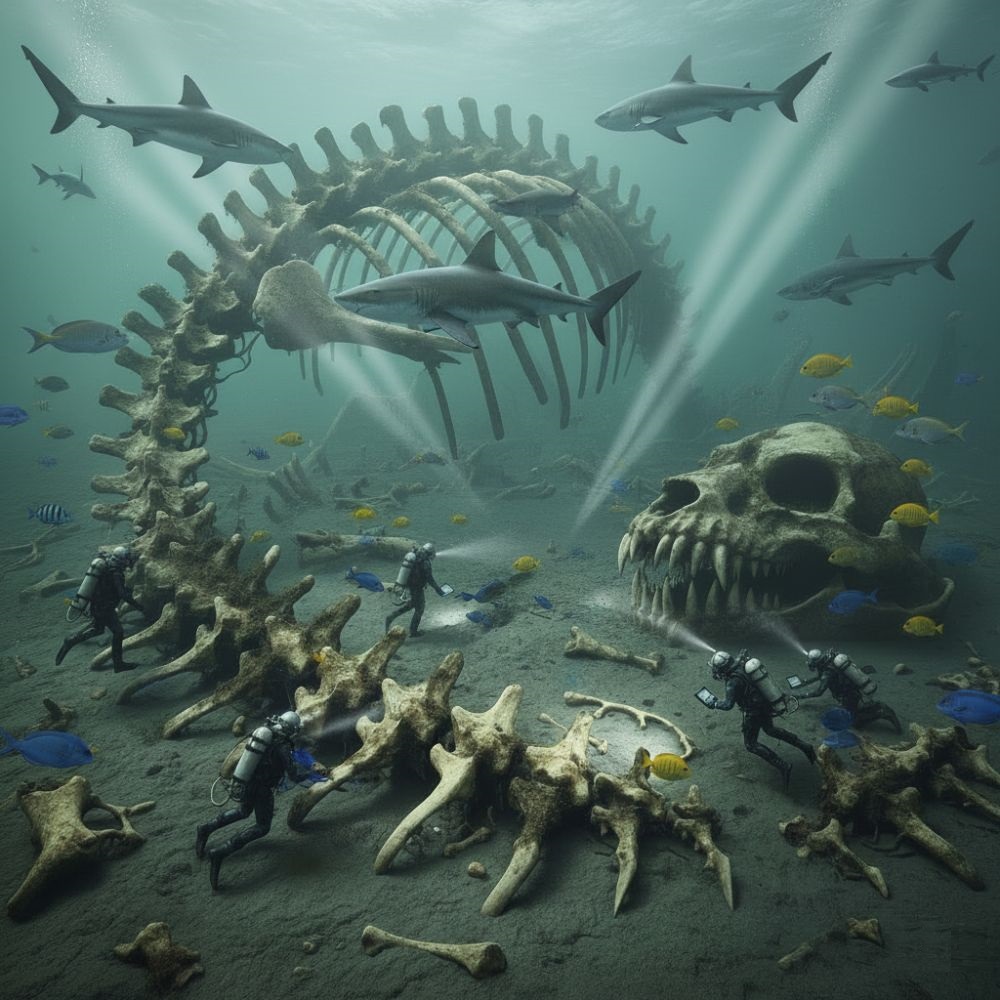
The year was 2023. Humanity, having long since mastered terrestrial exploration, turned its gaze to the last great frontier: the abyssal depths of Earth’s oceans. Dr. Aris Thorne, a marine archaeozoologist whose name was synonymous with daring underwater expeditions, was at the helm of the Challenger III, a state-of-the-art deep-sea submersible. Their mission: to investigate anomalous sonar readings from the HMRG Deep, a particularly remote and unexplored section of the Mariana Trench.
For weeks, the Challenger III had meticulously mapped the crushing pressures and perpetual twilight of the trench. Then, the sonar pinged, not with the familiar echoes of basalt formations or hydrothermal vents, but with something impossibly vast, organic, and fragmented.
“Magnify visual feed, Sector Gamma-7,” Aris commanded, his voice a low thrum of excitement through the comms.
The screens flickered, resolving into an awe-inspiring sight. Stretched across the abyssal plain, half-buried in sediment, lay a spine of monumental proportions. Each vertebra was the size of a small car, arcing in a magnificent, eerie curve into the murky distance. And beside it, a skull – a grotesque, magnificent edifice of bone with eye sockets large enough to house a diver, and teeth like ancient, blunted daggers.
“It’s… it’s beyond anything we’ve ever cataloged,” whispered his lead paleontologist, Dr. Lena Hansen, her voice a mix of reverence and disbelief. “This isn’t just a whale, Aris. This is a leviathan.”
Donning their reinforced exosuits, Aris and his team descended. The light from their suits cut through the gloom, revealing the true scale of the discovery. The skeleton, easily hundreds of meters long, sprawled across the seabed like a fallen monument. As they meticulously documented each bone, the currents stirred, revealing more fragments—massive ribs, colossal limb bones, all bearing the hallmarks of an ancient, unknown predator.
Suddenly, a shadow passed over them. Aris looked up, his heart pounding not from fear, but from exhilaration. A great white shark, followed by two more, glided silently above the ancient bones, their sleek forms a stark contrast to the massive, stationary remains. Schools of vibrant deep-sea fish, oblivious to the grandeur of the fossilized giant, darted between the divers.
“It’s a sanctuary,” Lena breathed, her flashlight beam sweeping across the scene. “Even in death, this creature continues to sustain life.”
The expedition lasted months. Each day brought new revelations, new questions. What kind of creature was this? How had it come to rest in the deepest part of the ocean? Was it a distant ancestor of known marine life, or a relic of a completely unknown lineage?
The findings from the Mariana Trench rewrote textbooks. They challenged preconceived notions of deep-sea ecosystems and the sheer scale of ancient life. Dr. Aris Thorne and his team had not just found a skeleton; they had unearthed a forgotten chapter in Earth’s natural history, a testament to the enduring mysteries hidden beneath the waves, and the insatiable human drive to explore and understand them. The Mariana Trench, once a symbol of impenetrable depth, became a beacon of prehistoric wonder.