

Unearthing Giants: Paleontologists Discover Massive Skeleton in the Australian Outback
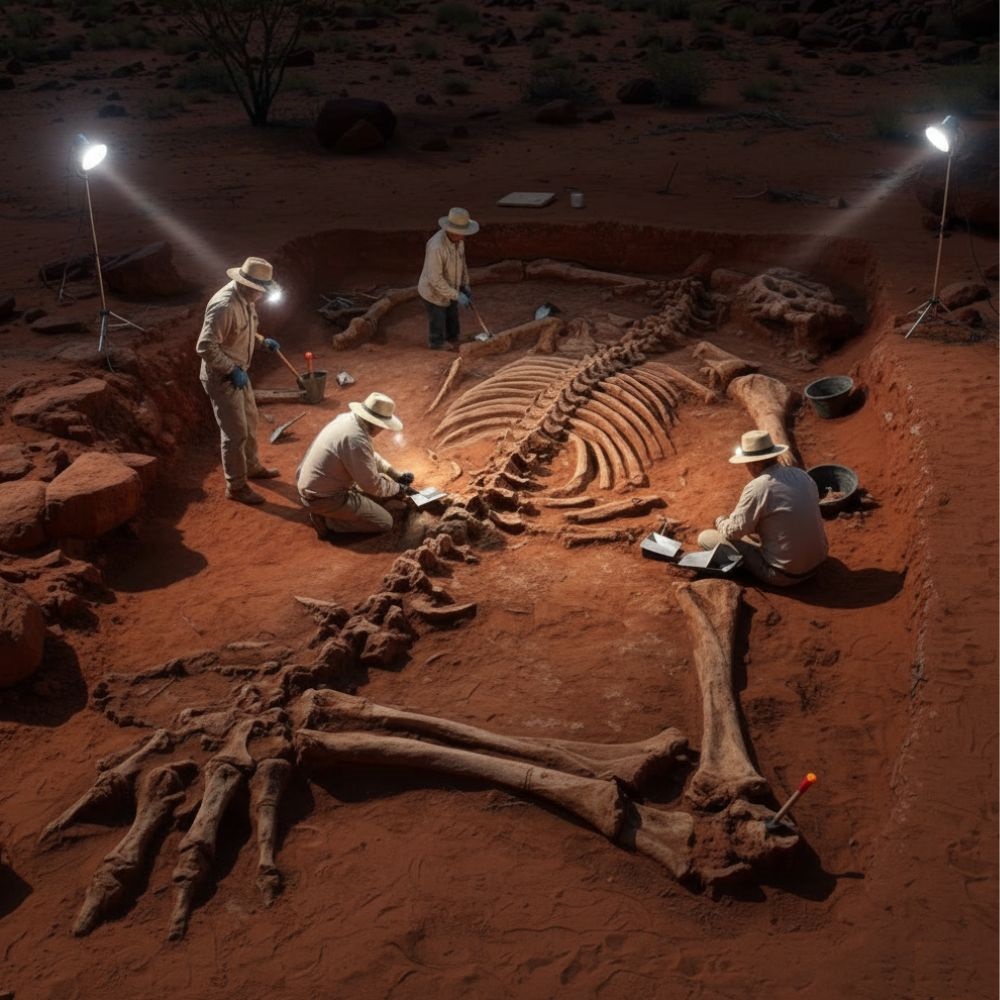
The searing sun beat down on the red earth of the Australian Outback, casting long, stark shadows across the vast, ancient landscape. For weeks, Dr. Evelyn Reed and her team from the University of Sydney had been toiling in the remote reaches of Queensland, driven by faint seismic readings and local aboriginal legends of “earth-shakers.” Most dismissed the tales as folklore, but Evelyn, a seasoned paleontologist with a nose for the impossible, felt a prickle of anticipation.
“Another day, another scoop of dust,” muttered a junior researcher, wiping sweat from his brow.
“Patience, Marcus,” Evelyn replied, her gaze fixed on a faint anomaly beneath the soil. “The greatest discoveries often hide in plain sight.”
Then, a glint of bone. Not a fragment, but something massive, curving out of the earth like a petrified wave. The team sprang into action, replacing shovels with delicate brushes and dental picks. Days turned into nights, illuminated by powerful floodlights, as the desert gave up its secret.
Piece by agonizing piece, a colossal skeleton began to emerge. It was unlike anything they had ever seen – a quadruped, with limbs thicker than tree trunks and a skull the size of a small car. The vertebrae alone were as large as dinner plates. This was no ordinary dinosaur; this was a megafauna of truly unprecedented scale, a creature that would have dwarfed even the most formidable sauropods.
The sheer size of the bones suggested an animal that had roamed this very ground millions of years ago, perhaps during the Miocene epoch, when Australia was a verdant continent, a stark contrast to the arid desert they now stood upon. The implication was staggering: a new species, a new branch on the tree of life, a creature that rewrote the history of ancient Australian ecosystems.
As the final fragments were carefully exposed, the full majesty of the beast was revealed. The team, exhausted but exhilarated, stood in awe. They had not just unearthed a skeleton; they had unearthed a piece of lost history, a giant from a forgotten world that once thundered across the continent now known as the Australian Outback. The air crackled with the promise of countless scientific papers, museum exhibits, and a renewed understanding of Earth’s ancient past, all thanks to a persistent team and a landscape that finally yielded its incredible secret.