

The Colossus of Rhodes: Unearthing the Gigantic Remains of an Ancient God at the Crossroads of the Aegean
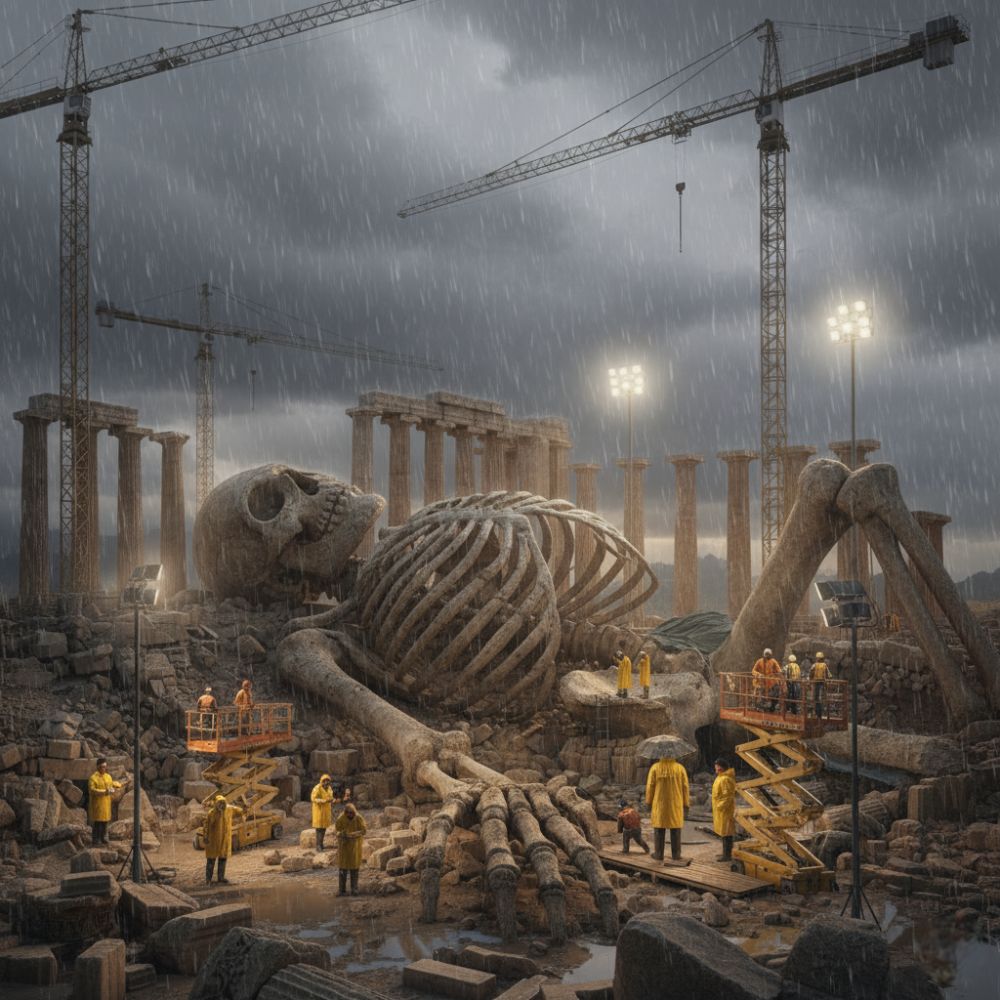
The year is 2024. Climate change has reshaped the Mediterranean coastline, but with new challenges come new opportunities for discovery. Dr. Aris Thorne, a leading geo-archaeologist from the University of Athens, had been following anomalous seismic readings from beneath the modern city of Rhodes for years. His theories, once dismissed as fantastical, centered on a submerged landmass, a legendary section of the island lost to a cataclysmic earthquake in antiquity—and perhaps, something far grander.
Initial deep-sea sonar scans, utilizing cutting-edge holographic imaging, revealed vast, geometric anomalies beneath what was once the harbor of Mandraki. It wasn’t just sunken ruins; it was a structure of impossible scale. Funding was secured, and soon, a monumental engineering project began: the creation of a temporary, transparent dome over the primary excavation zone, allowing the Aegean waters to be carefully displaced and the ancient seabed revealed.
When the last drops of seawater receded, the team was met with a sight that defied belief. Amidst the waterlogged remnants of a grand Hellenistic city, half-buried in silt and marine life, lay a skeleton of truly epic proportions. The first exposed bone, a femur, was larger than a modern human’s entire torso. As more of the remains were meticulously uncovered by robotic excavators and human specialists in specialized exosuits, the sheer magnitude became terrifyingly clear.
“It’s… it’s not just a statue,” whispered Dr. Thorne, his voice hoarse with awe as a giant rib cage, adorned with ancient barnacles, emerged into the artificial daylight. “It’s organic. It’s… real.”
The skeleton lay sprawling, its head turned slightly, one massive arm extending towards where the Colossus of Rhodes was fabled to have stood. The sheer artistry of its ancient construction was breathtaking; every vertebra, every phalange, was crafted from an unknown, incredibly durable, white-gold alloy, seamlessly interlocked with organic bone that had petrified into a marble-like substance over millennia. Runes, faintly glowing with an internal energy that pulsed almost imperceptibly, were etched along its colossal skull and across its breastplate-like sternum.
Early linguistic analysis of the runes, led by Dr. Lena Petrova, a brilliant epigrapher, suggested a narrative far more complex than simple myth. These weren’t just the remains of the sun god Helios, as local legends recounted the Colossus; they were the actual, physical embodiment of a divine being, a protector, perhaps even a progenitor, of the ancient Rhodians. The texts spoke of a “Living Colossus,” a guardian brought forth from the very essence of the sun, tasked with shielding the island from primordial threats.
The excavation site quickly became a global sensation. News feeds were dominated by holographic projections of the “Rhodes Giant,” sparking debates among theologians, scientists, and conspiracy theorists. Was this proof of ancient alien intervention? Or a testament to a forgotten age of gods walking the Earth?
As the years passed, the team meticulously unearthed the entirety of the Colossus, each discovery deepening the mystery. Intricate gears and conduits were found within its joint structures, suggesting it was once animated. Energy signatures, unlike anything known to modern physics, emanated faintly from its core. The rainstorms, once a nuisance, sometimes intensified over the site, almost as if the giant structure itself was calling to the elements, echoing its past connection to a stormy divine will.
The Colossus of Rhodes had not been merely a statue; it was a monumental feat of ancient engineering and divine creation, a testament to a time when gods and mortals intertwined in ways modern humanity could barely comprehend. It stood as a silent, colossal question mark, challenging humanity’s understanding of history, myth, and the very fabric of existence, forever changing the narrative of the ancient world at the vibrant crossroads of the Aegean.