

Unveiling the Leviathan: Ancient Relics Discovered Off the Coast of Alexandria
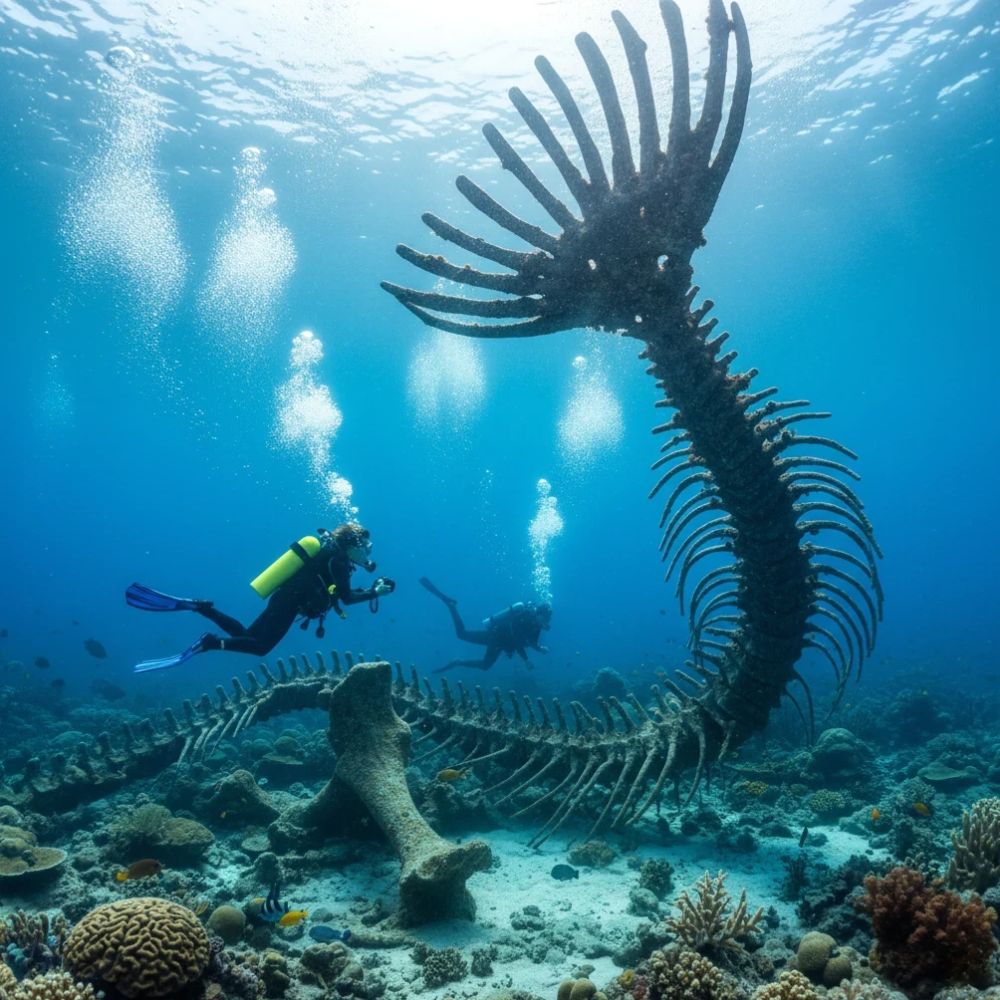
The Mediterranean’s cerulean embrace often held secrets, but none as profound as the one Dr. Aris Thorne and his team uncovered. For years, the legend of a sunken city, swallowed by the waves off Alexandria’s ancient shores, had fueled Aris’s expeditions. Yet, what they found was not a city, but something far more primal, far more colossal.
It began with an anomalous sonar reading, a ripple in the sea’s digital canvas, far deeper than expected. Descending into the sun-dappled abyss, the team’s initial awe turned to disbelief. Before them lay a skeletal structure of unimaginable scale, its massive stone vertebrae snaking across the ocean floor like a petrified serpent. It was not bone, but a form of ancient, calcified limestone, meticulously carved or naturally formed over millennia into the unmistakable likeness of a gargantuan marine creature.
“It’s… it’s a leviathan,” whispered Aris into his comms, his voice thick with wonder. “A creature of myth, brought to stone.”
The tail fin, a majestic sweep of ridged rock, pierced the water column, catching the light like a forgotten monument. Divers moved cautiously around its immense form, their lights dancing over hieroglyphs and pictograms etched into the stone, surprisingly preserved by the cool, dark depths. These were not the common symbols of dynastic Egypt, but something older, predating known civilizations. The carvings depicted figures in strange, flowing robes, offering reverence to the colossal creature, and scenes of celestial bodies aligning with a hidden underwater temple.
Back on the research vessel, Dr. Lena Petrova, a renowned archaeo-linguist, painstakingly cataloged the glyphs. “This isn’t just a statue,” she announced one evening, poring over digital renderings. “It’s a testament. These inscriptions speak of an advanced coastal civilization, lost to a cataclysm, who believed this ‘Leviathan’ was their protector, a guardian of the deep. They constructed this effigy, not just as art, but as a ritualistic anchor to their deity, hoping to appease the very forces that ultimately submerged them.”
The implications were staggering. If true, this “Leviathan” off Alexandria wasn’t just a relic; it was the Rosetta Stone to a forgotten civilization, a bridge to a time before pharaohs and pyramids, a world where myth and reality blurred beneath the waves. The discovery promised to rewrite entire chapters of human history, placing Alexandria at the heart of an even older, more enigmatic past. The Mediterranean, it seemed, still had endless stories to tell.